Brembo Espen Andreas, Kapstad Heidi, Eide Tom, Månsson Lukas, Van Dulmen Sandra, Eide Hilde
Faculty of Health Sciences, University College of Southeast Norway, Papirbredden - Drammen kunnskapspark. Grønland 58, 3045, Drammen, Norway.
Department of Behavioural Sciences in Medicine, Faculty of Medicine, University of Oslo, Oslo, Norway.
BMC Health Serv Res. 2016 Mar 12;16:88. doi: 10.1186/s12913-016-1342-5.
Osteoarthritis (OA) is the most common form of arthritis worldwide, affecting a growing number of people in the ageing populations. Currently, it affects about 50 % of all people over 65 years of age. There are no disease-modifying treatments for OA; hence preference-sensitive treatment options include symptom reduction, self-management and surgical joint replacement for suitable individuals. People have both ethical and legal rights to be informed about treatment choices and to actively participate in decision-making. Individuals have different needs; they differ in their ability to understand and make use of the provided information and to sustain behaviour change-dependent treatments over time.
As a part of a larger research project that aims to develop and test a web-based support tool for patients with hip OA, this paper is a qualitative in-depth study to investigate patients' need for information and their personal emotional needs. We invited 13 patients to participate in individual interviews, which were audiotaped. The audio-tapes were transcribed verbatim and analysed using an inductive thematic analysis approach.
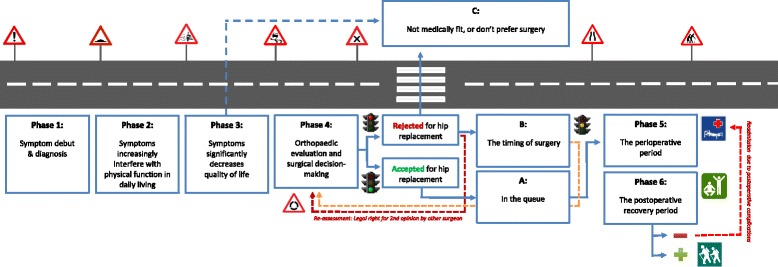
The thematic analysis revealed a pattern of patients' information and emotional needs, captured in several key questions relevant to the different stages of the disease experience. Based on these results and research literature, we developed a model illustrating the patients' disease experience and treatment continuum. Six phases with accompanying key questions were identified, displaying how patients information and emotional needs arise and change in line with the progression of the disease experience, the clinical encounters and the decision-making process. We also identified and included in the model an alternative route that bypasses the surgical treatment option.
Patients with hip OA are in great need of information both at the time of diagnosis and further throughout the disease development and care continuum. Lack of information may result in unnecessary and dysfunctional misconceptions, underuse of potentially helpful treatment options and uninformed decisions. Patients need continuous support from health professionals and their families in order to find and consider effective treatment strategies.
骨关节炎(OA)是全球最常见的关节炎形式,在老龄化人群中影响着越来越多的人。目前,65岁以上的人群中约有50%受其影响。对于OA尚无改变病情的治疗方法;因此,对偏好敏感的治疗选择包括减轻症状、自我管理以及为合适的个体进行手术关节置换。人们有道德和法律权利了解治疗选择并积极参与决策。个体有不同的需求;他们在理解和利用所提供信息的能力以及随着时间维持依赖行为改变的治疗方面存在差异。
作为一个旨在为髋骨关节炎患者开发和测试基于网络的支持工具的更大研究项目的一部分,本文是一项定性深入研究,旨在调查患者的信息需求和个人情感需求。我们邀请了13名患者参加个人访谈,并进行了录音。录音逐字转录,并采用归纳主题分析方法进行分析。
主题分析揭示了患者信息和情感需求的模式,体现在与疾病经历不同阶段相关的几个关键问题中。基于这些结果和研究文献,我们开发了一个模型来说明患者的疾病经历和治疗连续过程。确定了六个阶段及相应的关键问题,展示了患者的信息和情感需求如何随着疾病经历、临床接触和决策过程的进展而产生和变化。我们还在模型中确定并纳入了一条绕过手术治疗选择的替代途径。
髋骨关节炎患者在诊断时以及疾病发展和护理连续过程中都非常需要信息。信息不足可能导致不必要的和功能失调的误解、对潜在有益治疗选择的使用不足以及不明智的决策。患者需要卫生专业人员及其家人的持续支持,以便找到并考虑有效的治疗策略。