Chun Sung Kook, Go Kristina, Yang Ming-Jim, Zendejas Ivan, Behrns Kevin E, Kim Jae-Sung
Department of Surgery, University of Florida, Gainesville, FL 32610, USA.
Toxicol Res. 2016 Jan;32(1):35-46. doi: 10.5487/TR.2016.32.1.035. Epub 2016 Jan 31.
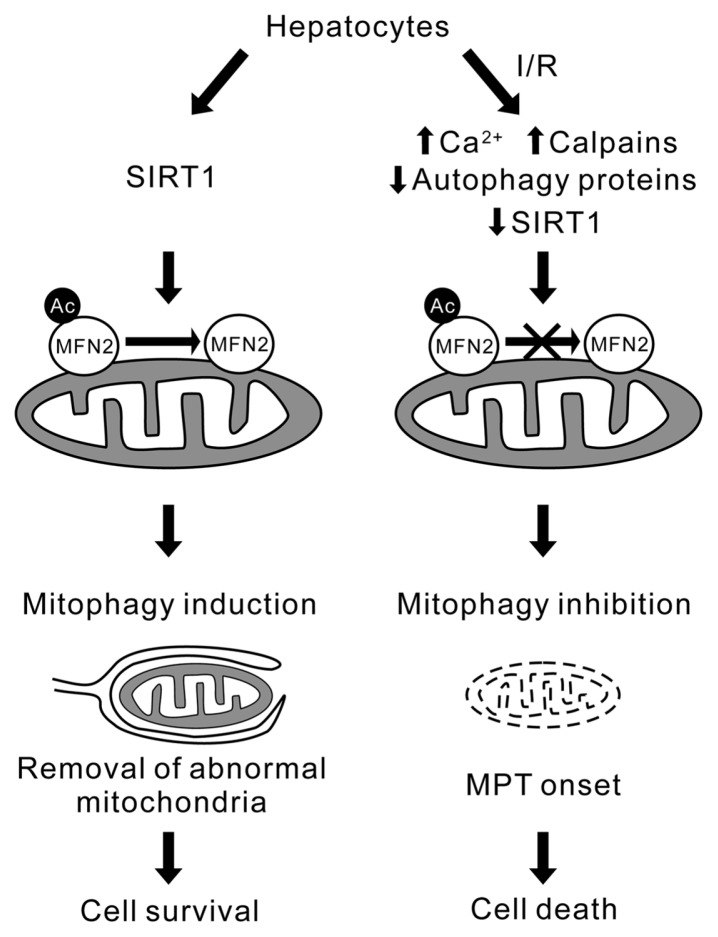
No-flow ischemia occurs during cardiac arrest, hemorrhagic shock, liver resection and transplantation. Recovery of blood flow and normal physiological pH, however, irreversibly injures the liver and other tissues. Although the liver has the powerful machinery for mitochondrial quality control, a process called mitophagy, mitochondrial dysfunction and subsequent cell death occur after reperfusion. Growing evidence indicates that reperfusion impairs mitophagy, leading to mitochondrial dysfunction, defective oxidative phosphorylation, accumulation of toxic metabolites, energy loss and ultimately cell death. The importance of acetylation/deacetylation cycle in the mitochondria and mitophagy has recently gained attention. Emerging data suggest that sirtuins, enzymes deacetylating a variety of target proteins in cellular metabolism, survival and longevity, may also act as an autophagy modulator. This review highlights recent advances of our understanding of a mechanistic correlation between sirtuin 1, mitophagy and ischemic liver injury.
无血流缺血发生在心脏骤停、失血性休克、肝切除及肝移植过程中。然而,恢复血流及正常生理pH值会对肝脏和其他组织造成不可逆损伤。尽管肝脏拥有强大的线粒体质量控制机制,即一种称为线粒体自噬的过程,但再灌注后仍会出现线粒体功能障碍及随后的细胞死亡。越来越多的证据表明,再灌注会损害线粒体自噬,导致线粒体功能障碍、氧化磷酸化缺陷、有毒代谢产物积累、能量损失并最终导致细胞死亡。线粒体中乙酰化/去乙酰化循环在自噬中的重要性最近受到了关注。新出现的数据表明,沉默调节蛋白(在细胞代谢、存活和寿命中使多种靶蛋白去乙酰化的酶)可能也作为自噬调节剂发挥作用。本综述重点介绍了我们对沉默调节蛋白1、线粒体自噬与缺血性肝损伤之间机制相关性的最新认识进展。