Department of Biosciences, Biotechnologies and Biopharmaceutics University of Bari Bari Italy.
Pharmacovigilance unit Regione Puglia ASL BA Bari Italy.
Pharmacol Res Perspect. 2016 Jan 15;4(1):e00197. doi: 10.1002/prp2.197. eCollection 2016 Feb.
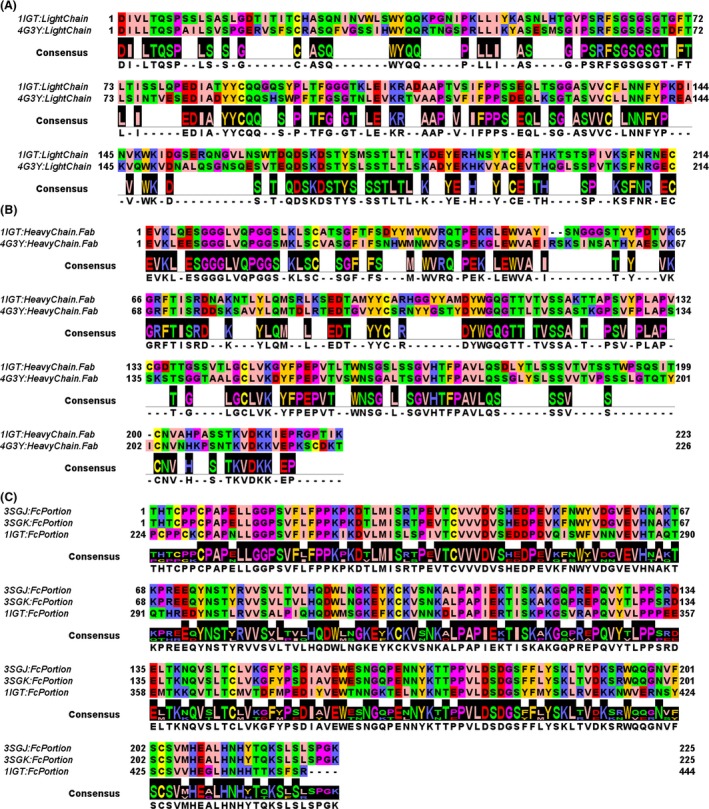
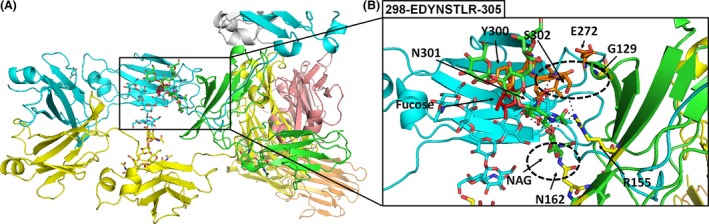
Therapeutic monoclonal antibodies (mAbs) have high efficacy in treating TNF α-related immunological diseases. Other than neutralizing TNF α, these IgG1 antibodies exert Fc receptor-mediated effector functions such as the complement-dependent cytotoxicity (CDC) and antibody-dependent cell cytotoxicity (ADCC). The crystallizable fragment (Fc) of these IgG1 contains a single glycosylation site at Asn 297/300 that is essential for the CDC and ADCC. Glycosylated antibodies lacking core fucosylation showed an improved ADCC. However, no structural data are available concerning the ligand-binding interaction of these mAbs used in TNF α-related diseases and the role of the fucosylation. We therefore used comparative modeling for generating complete 3D mAb models that include the antigen-binding fragment (Fab) portions of infliximab, complexed with TNF α (4G3Y.pdb), the Fc region of the human IGHG1 fucosylated (3SGJ) and afucosylated (3SGK) complexed with the Fc receptor subtype Fcγ RIIIA, and the Fc region of a murine immunoglobulin (1IGT). After few thousand steps of energy minimization on the resulting 3D mAb models, minimized final models were used to quantify interactions occurring between Fcγ RIIIA and the fucosylated/afucosylated Fc fragments. While fucosylation does not affect Fab-TNF α interactions, we found that in the absence of fucosylation the Fc-mAb domain and Fcγ RIIIA are closer and new strong interactions are established between G129 of the receptor and S301 of the Chimera 2 Fc mAb; new polar interactions are also established between the Chimera 2 Fc residues Y299, N300, and S301 and the Fcγ RIIIA residues K128, G129, R130, and R155. These data help to explain the reduced ADCC observed in the fucosylated mAbs suggesting the specific AA residues involved in binding interactions.
治疗性单克隆抗体(mAbs)在治疗 TNF-α 相关免疫性疾病方面具有很高的疗效。除了中和 TNF-α 外,这些 IgG1 抗体还发挥 Fc 受体介导的效应功能,如补体依赖性细胞毒性(CDC)和抗体依赖性细胞毒性(ADCC)。这些 IgG1 的可结晶片段(Fc)在 Asn 297/300 处含有一个单一的糖基化位点,对 CDC 和 ADCC 至关重要。缺乏核心岩藻糖基化的糖基化抗体显示出改善的 ADCC。然而,目前尚无关于 TNF-α 相关疾病中使用的这些 mAbs 的配体结合相互作用以及岩藻糖基化作用的结构数据。因此,我们使用比较建模生成完整的 3D mAb 模型,包括与 TNF-α(4G3Y.pdb)结合的 infliximab 的抗原结合片段(Fab)部分、人 IGHG1 糖基化(3SGJ)和去糖基化(3SGK)与 Fc 受体亚型 Fcγ RIIIA 结合的 Fc 区,以及鼠免疫球蛋白(1IGT)的 Fc 区。在对生成的 3D mAb 模型进行几千步能量最小化后,使用最小化的最终模型来量化 Fcγ RIIIA 与糖基化/去糖基化 Fc 片段之间发生的相互作用。虽然岩藻糖基化不影响 Fab-TNF-α 相互作用,但我们发现,在没有岩藻糖基化的情况下,Fc-mAb 结构域和 Fcγ RIIIA 更接近,并且在受体 G129 和 Chimera 2 Fc mAb 的 S301 之间建立了新的强相互作用;Chimera 2 Fc 残基 Y299、N300 和 S301 与 Fcγ RIIIA 残基 K128、G129、R130 和 R155 之间也建立了新的极性相互作用。这些数据有助于解释在糖基化 mAbs 中观察到的降低的 ADCC,表明参与结合相互作用的特定 AA 残基。