Lee S H, Paz-Filho G, Mastronardi C, Licinio J, Wong M-L
Department of Genome Sciences, John Curtin School of Medical Research, Australian National University, Canberra, ACT, Australia.
Pharmacogenomics Research Program, Mind and Brain Theme, South Australian Health and Medical Research Institute and Department of Psychiatry, School of Medicine, Flinders University, Adelaide, SA, Australia.
Transl Psychiatry. 2016 Mar 15;6(3):e759. doi: 10.1038/tp.2016.25.
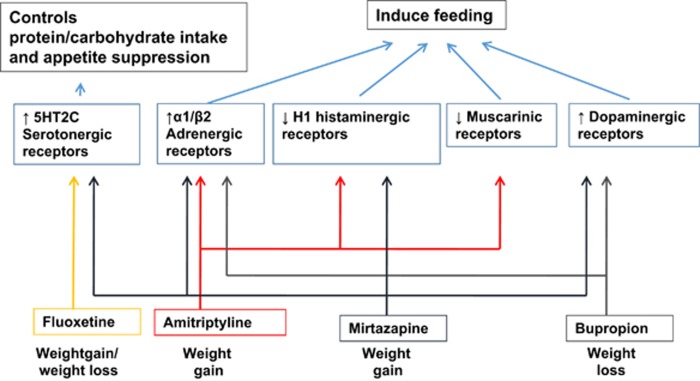
Major depressive disorder (MDD) and obesity are both common heterogeneous disorders with complex aetiology, with a major impact on public health. Antidepressant prescribing has risen nearly 400% since 1988, according to data from the Centers for Disease Control and Prevention (CDC). In parallel, adult obesity rates have doubled since 1980, from 15 to 30 percent, while childhood obesity rates have more than tripled. Rising obesity rates have significant health consequences, contributing to increased rates of more than thirty serious diseases. Despite the concomitant rise of antidepressant use and of the obesity rates in Western societies, the association between the two, as well as the mechanisms underlying antidepressant-induced weight gain, remain under explored. In this review, we highlight the complex relationship between antidepressant use, MDD and weight gain. Clinical findings have suggested that obesity may increase the risk of developing MDD, and vice versa. Hypothalamic-pituitary-adrenal (HPA) axis activation occurs in the state of stress; concurrently, the HPA axis is also dysregulated in obesity and metabolic syndrome, making it the most well-understood shared common pathophysiological pathway with MDD. Numerous studies have investigated the effects of different classes of antidepressants on body weight. Previous clinical studies suggest that the tricyclics amitriptyline, nortriptyline and imipramine, and the serotonin norepinephrine reuptake inhibitor mirtazapine are associated with weight gain. Despite the fact that selective serotonin reuptake inhibitor (SSRI) use has been associated with weight loss during acute treatment, a number of studies have shown that SSRIs may be associated with long-term risk of weight gain; however, because of high variability and multiple confounds in clinical studies, the long-term effect of SSRI treatment and SSRI exposure on body weight remains unclear. A recently developed animal paradigm shows that the combination of stress and antidepressants followed by long-term high-fat diet results, long after discontinuation of antidepressant treatment, in markedly increased weight, in excess of what is caused by high-fat diet alone. On the basis of existing epidemiological, clinical and preclinical data, we have generated the testable hypothesis that escalating use of antidepressants, resulting in high rates of antidepressant exposure, might be a contributory factor to the obesity epidemic.
重度抑郁症(MDD)和肥胖症都是常见的异质性疾病,病因复杂,对公众健康有重大影响。根据美国疾病控制与预防中心(CDC)的数据,自1988年以来,抗抑郁药物的处方量增长了近400%。与此同时,自1980年以来,成人肥胖率翻了一番,从15%升至30%,而儿童肥胖率更是增长了两倍多。肥胖率上升带来了严重的健康后果,导致三十多种严重疾病的发病率增加。尽管西方社会抗抑郁药物的使用和肥胖率同时上升,但两者之间的关联以及抗抑郁药物导致体重增加的潜在机制仍有待探索。在这篇综述中,我们强调了抗抑郁药物使用、MDD和体重增加之间的复杂关系。临床研究结果表明,肥胖可能会增加患MDD的风险,反之亦然。下丘脑-垂体-肾上腺(HPA)轴激活发生在应激状态下;同时,HPA轴在肥胖和代谢综合征中也失调,这使其成为与MDD最容易理解的共同病理生理途径。许多研究调查了不同类别的抗抑郁药物对体重的影响。先前的临床研究表明,三环类药物阿米替林、去甲替林和丙咪嗪,以及5-羟色胺去甲肾上腺素再摄取抑制剂米氮平与体重增加有关。尽管选择性5-羟色胺再摄取抑制剂(SSRI)在急性治疗期间与体重减轻有关,但多项研究表明,SSRI可能与体重增加的长期风险有关;然而,由于临床研究中的高变异性和多种混杂因素,SSRI治疗和SSRI暴露对体重的长期影响仍不清楚。最近开发的一种动物模型表明,应激和抗抑郁药物联合使用,随后长期高脂饮食,在抗抑郁药物治疗停止很久之后,会导致体重显著增加,超过单纯高脂饮食所导致的体重增加。基于现有的流行病学、临床和临床前数据,我们提出了一个可检验的假设,即抗抑郁药物使用的增加,导致高比例的抗抑郁药物暴露,可能是肥胖流行的一个促成因素。