Yoo Ha Yeong, Son Jae Sung, Park Hye Won, Kwak Byung Ok, Kim Hyeong Su, Bae Sun Hwan
Department of Pediatrics, Konkuk University Medical Center, Konkuk University School of Medicine, Seoul, Korea.
Department of Preventive Medicine, Konkuk University Medical Center, Konkuk University School of Medicine, Seoul, Korea.
J Neurogastroenterol Motil. 2016 Jul 30;22(3):483-9. doi: 10.5056/jnm15128.
BACKGROUND/AIMS: A colon transit time test using radio-opaque markers (CTTRM) is considered the gold standard for evaluating colon transit function. A 24-hour delayed film of barium enema (BE) has been used as a supplementary method in structural evaluations. The aim of this study was to evaluate the utility of a 24-hour delayed BE film for assessing colon transit function in young children with constipation.
In total, 93 children with constipation who performed both single-contrast BE and CTTRM were enrolled in this study. Of these, the data from 70 children were analyzed (males 33, females 37; mean age [range], 5.63 ± 2.94 [2-14] years). The basic principle of the study is "velocity = distance/time". Time values were identified in both studies, and the colon length and distance of barium movement were measured on the 24-hour delayed BE film. Thus, colon transit velocity values could be calculated using both methods. The correlation between colon transit velocity using a 24-hour delayed BE film versus CTTRM was analyzed statistically.
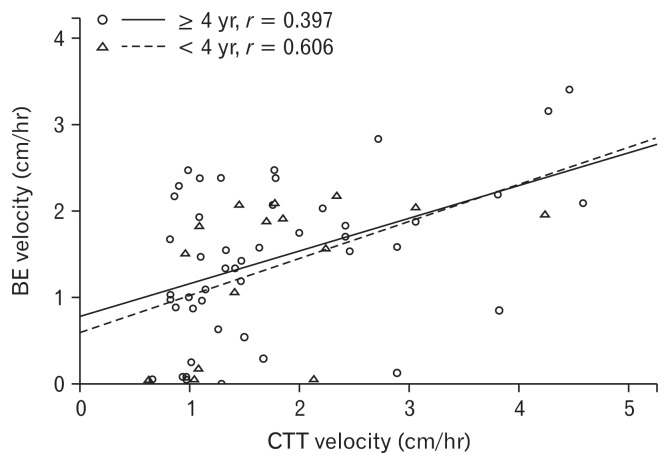
Median value (interquartile range) of colon transit velocity using CTTRM was 1.57 (1.07-2.89) cm/hr, and that using BE of that was 1.58 (0.94-2.07) cm/hr. The Spearman correlation coefficient was 0.438 (P < 0.001) for the overall group. The correlation was strongest in children younger than 4 years (r= 0.537, P = 0.032).
Although the correlation between BE and CTTRM was not very strong, the 24‑hour delayed BE film could provide broad information about colon transit function in young children, especially those under 4 years who usually cannot undergo CTTRM.
背景/目的:使用不透X线标志物的结肠运输时间试验(CTTRM)被认为是评估结肠运输功能的金标准。24小时延迟钡剂灌肠(BE)片已被用作结构评估的补充方法。本研究的目的是评估24小时延迟BE片在评估便秘幼儿结肠运输功能中的效用。
本研究共纳入93例同时进行单对比BE和CTTRM的便秘儿童。其中,对70例儿童的数据进行了分析(男性33例,女性37例;平均年龄[范围],5.63±2.94[2-14]岁)。研究的基本原理是“速度=距离/时间”。在两项研究中均确定了时间值,并在24小时延迟BE片上测量结肠长度和钡剂移动距离。因此,可使用两种方法计算结肠运输速度值。对使用24小时延迟BE片与CTTRM的结肠运输速度之间的相关性进行了统计学分析。
使用CTTRM的结肠运输速度的中位数(四分位间距)为1.57(1.07-2.89)cm/小时,使用BE的为1.58(0.94-2.07)cm/小时。整个组的Spearman相关系数为0.438(P<0.001)。4岁以下儿童的相关性最强(r=0.537,P=0.032)。
虽然BE与CTTRM之间的相关性不是很强,但24小时延迟BE片可为幼儿的结肠运输功能提供广泛信息,尤其是那些通常无法进行CTTRM的4岁以下儿童。