Kabaghe Alinune N, Visser Benjamin J, Spijker Rene, Phiri Kamija S, Grobusch Martin P, van Vugt Michèle
Public Health Department, College of Medicine, Private Bag 360, Blantyre, Malawi.
Division of Internal Medicine, Department of Infectious Diseases, Center of Tropical Medicine and Travel Medicine, Academic Medical Center, University of Amsterdam, Meibergdreef 9, PO Box 22700, 1100 DE, Amsterdam, The Netherlands.
Malar J. 2016 Mar 15;15:163. doi: 10.1186/s12936-016-1218-5.
The World Health Organization recommends malaria to be confirmed by either microscopy or a rapid diagnostic test (RDT) before treatment. The correct use of RDTs in resource-limited settings facilitates basing treatment onto a confirmed diagnosis; contributes to speeding up considering a correct alternative diagnosis, and prevents overprescription of anti-malarial drugs, reduces costs and avoids unnecessary exposure to adverse drug effects. This review aims to evaluate health workers' compliance to RDT results and factors contributing to compliance.
A PROSPERO-registered systematic review was conducted to evaluate health workers' compliance to RDTs in sub-Saharan Africa, following Preferred Reporting Items for Systematic Reviews and Meta-Analyses (PRISMA) guidelines. Studies published up to November 2015 were searched without language restrictions in Medline/Ovid, Embase, Cochrane Central Register of Controlled Trials, Web of Science, LILACS, Biosis Previews and the African Index Medicus. The primary outcome was health workers treating patients according to the RDT results obtained.
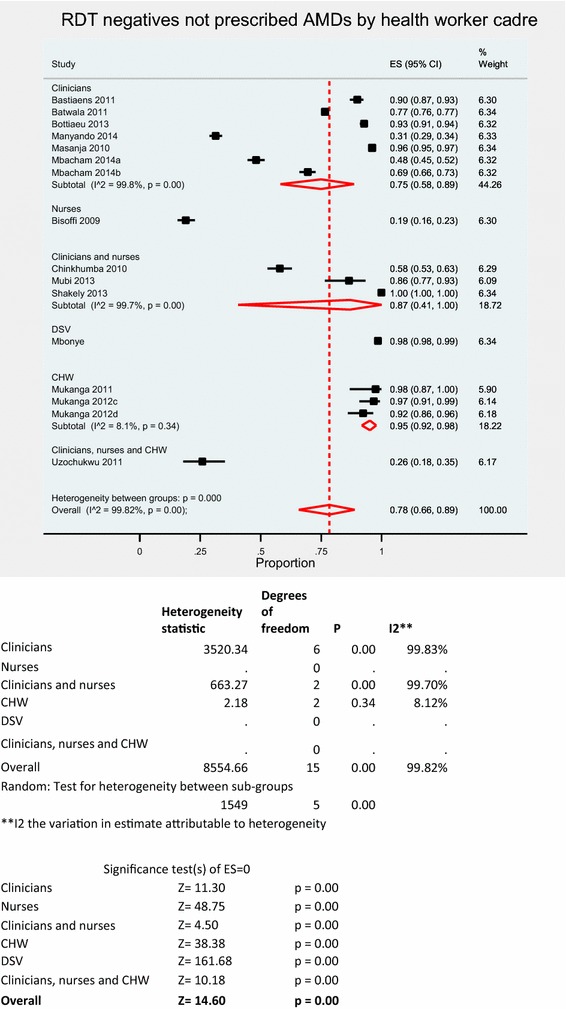
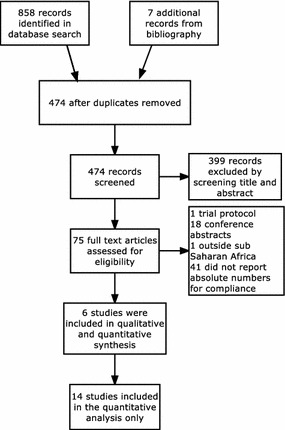
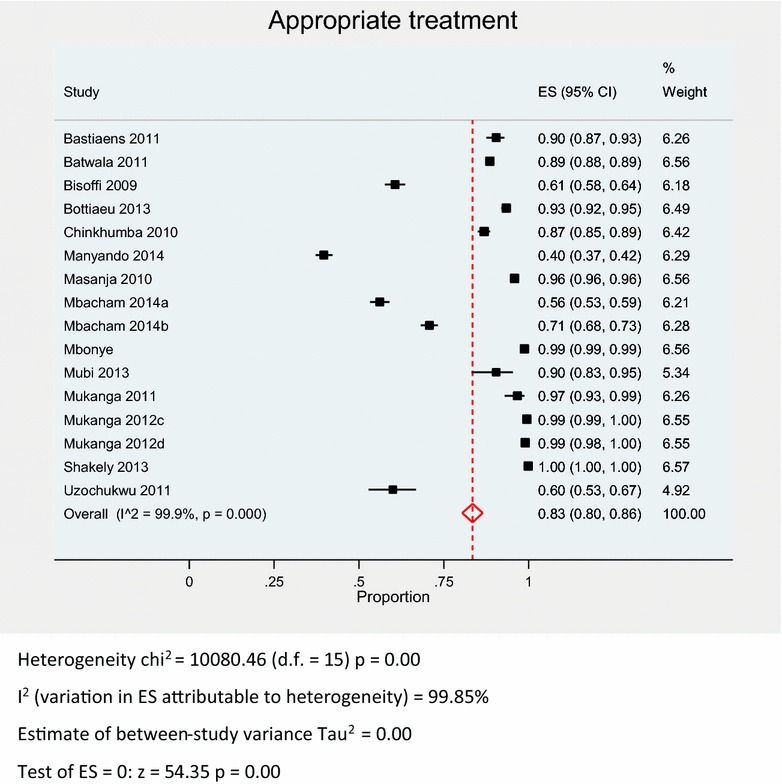
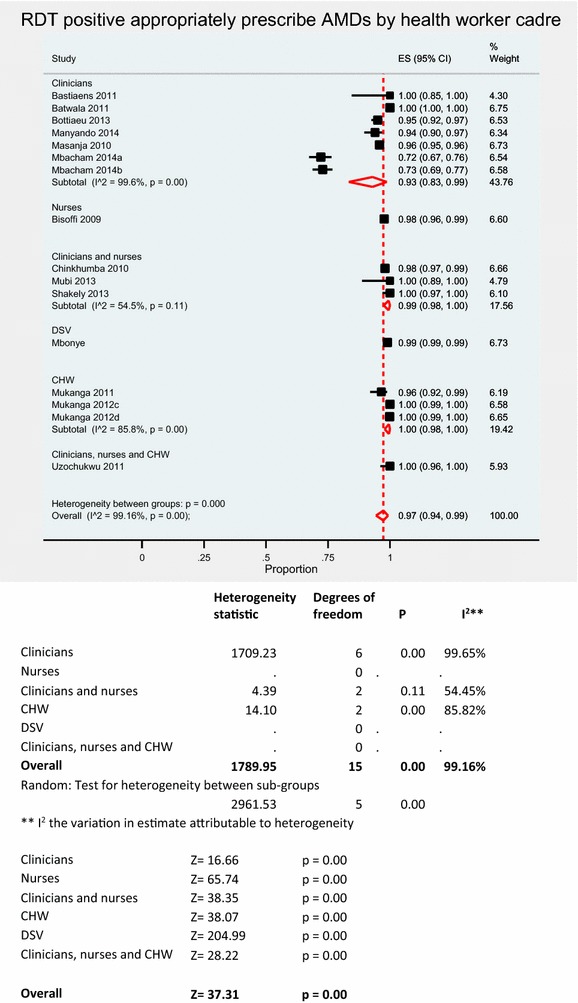
The literature search identified 474 reports; 14 studies were eligible and included in the quantitative analysis. From the meta-analysis, health workers' overall compliance in terms of initiating treatment or not in accordance with the respective RDT results was 83% (95% CI 80-86%). Compliance to positive and negative results was 97% (95% CI 94-99%) and 78% (95% CI 66-89%), respectively. Community health workers had higher compliance rates to negative test results than clinicians. Patient expectations, work experience, scepticism of results, health workers' cadres and perceived effectiveness of the test, influenced compliance.
With regard to published data, compliance to RDT appears to be generally fair in sub-Saharan Africa; compliance to negative results will need to improve to prevent mismanagement of patients and overprescribing of anti-malarial drugs. Improving diagnostic capacity for other febrile illnesses and developing local evidence-based guidelines may help improve compliance and management of negative RDT results.
CRD42015016151 (PROSPERO).
世界卫生组织建议在治疗前通过显微镜检查或快速诊断检测(RDT)来确诊疟疾。在资源有限的环境中正确使用RDT有助于根据确诊结果进行治疗;有助于加快考虑正确的替代诊断,并防止抗疟药物的过度处方,降低成本并避免不必要的药物不良反应暴露。本综述旨在评估卫生工作者对RDT结果的依从性以及影响依从性的因素。
按照系统评价和Meta分析的首选报告项目(PRISMA)指南,进行了一项在PROSPERO注册的系统评价,以评估撒哈拉以南非洲地区卫生工作者对RDT的依从性。检索了截至2015年11月发表的研究,在Medline/Ovid、Embase、Cochrane对照试验中央注册库、科学网、拉丁美洲和加勒比卫生科学数据库、生物学文摘数据库以及非洲医学索引中进行检索,无语言限制。主要结局是卫生工作者根据获得的RDT结果治疗患者。
文献检索共识别出474篇报告;14项研究符合纳入标准并纳入定量分析。荟萃分析显示,卫生工作者根据各自RDT结果决定是否开始治疗的总体依从率为83%(95%CI 80 - 86%)。对阳性和阴性结果的依从率分别为97%(95%CI 94 - 99%)和78%(95%CI 66 - 89%)。社区卫生工作者对阴性检测结果的依从率高于临床医生。患者期望、工作经验、对结果的怀疑、卫生工作者的类别以及对检测有效性的认知,都会影响依从性。
就已发表的数据而言,在撒哈拉以南非洲地区,对RDT的依从性总体上似乎尚可;对阴性结果的依从性需要提高,以防止患者管理不善和抗疟药物的过度处方。提高对其他发热性疾病的诊断能力并制定基于当地证据的指南,可能有助于提高依从性并改善对RDT阴性结果的管理。
CRD42015016151(PROSPERO)