Nakato Ryuichiro, Shirahige Katsuhiko
Research Center for Epigenetic Disease, Institute of Molecular and Cellular Biosciences, The University of Tokyo, Tokyo, Japan.
Core Research for Evolutional Science and Technology (CREST), Japan Science and Technology Agency, Kawaguchi, Japan.
Brief Bioinform. 2017 Mar 1;18(2):279-290. doi: 10.1093/bib/bbw023.
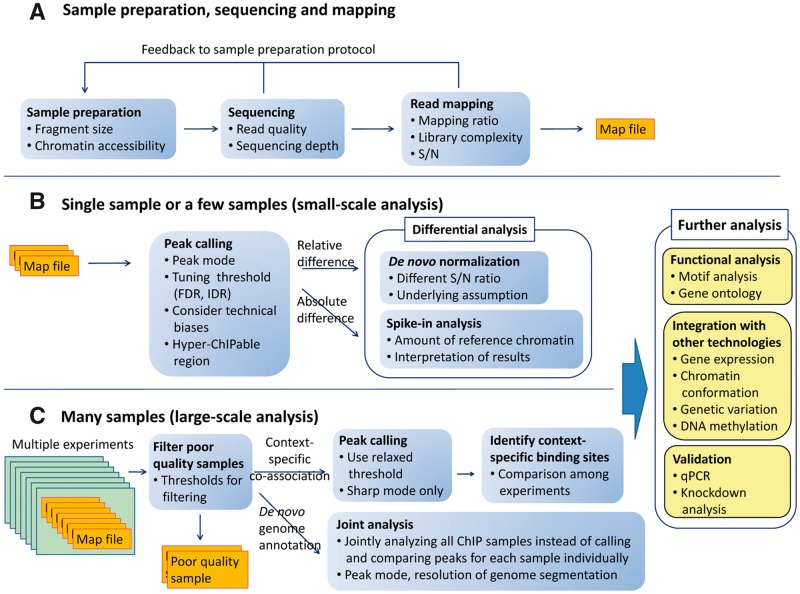
Chromatin immunoprecipitation followed by sequencing (ChIP-seq) analysis can detect protein/DNA-binding and histone-modification sites across an entire genome. Recent advances in sequencing technologies and analyses enable us to compare hundreds of samples simultaneously; such large-scale analysis has potential to reveal the high-dimensional interrelationship level for regulatory elements and annotate novel functional genomic regions de novo. Because many experimental considerations are relevant to the choice of a method in a ChIP-seq analysis, the overall design and quality management of the experiment are of critical importance. This review offers guiding principles of computation and sample preparation for ChIP-seq analyses, highlighting the validity and limitations of the state-of-the-art procedures at each step. We also discuss the latest challenges of single-cell analysis that will encourage a new era in this field.
染色质免疫沉淀测序(ChIP-seq)分析能够检测全基因组范围内的蛋白质/DNA结合位点和组蛋白修饰位点。测序技术和分析方法的最新进展使我们能够同时比较数百个样本;这种大规模分析有潜力揭示调控元件的高维相互关系水平,并从头注释新的功能基因组区域。由于在ChIP-seq分析中,许多实验因素与方法的选择相关,因此实验的整体设计和质量管理至关重要。本综述提供了ChIP-seq分析的计算和样本制备指导原则,强调了每个步骤中现有最先进方法的有效性和局限性。我们还讨论了单细胞分析的最新挑战,这些挑战将推动该领域进入一个新时代。