Johns Hopkins Bloomberg School of Public Health, Department of Epidemiology, Baltimore, MD, USA.
JMIR Mhealth Uhealth. 2016 Mar 15;4(1):e27. doi: 10.2196/mhealth.4470.
The use of mHealth methods for capturing illicit drug use and associated behaviors have become more widely used in research settings, yet there is little research as to how valid these methods are compared to known measures of capturing and quantifying drug use.
We examined the concordance of ecological momentary assessment (EMA) of drug use to previously validated biological and audio-computer assisted self-interview (ACASI) methods.
The Exposure Assessment in Current Time (EXACT) study utilized EMA methods to assess drug use in real-time in participants' natural environments. Utilizing mobile devices, participants self-reported each time they used heroin or cocaine over a 4-week period. Each week, PharmChek sweat patch samples were collected for measurement of heroin and cocaine and participants answered an ACASI-based questionnaire to report behaviors and drug using events during the prior week. Reports of cocaine and heroin use captured through EMA were compared to weekly biological or self-report measures through percent agreement and concordance correlation coefficients to account for repeated measures. Correlates of discordance were obtained from logistic regression models.
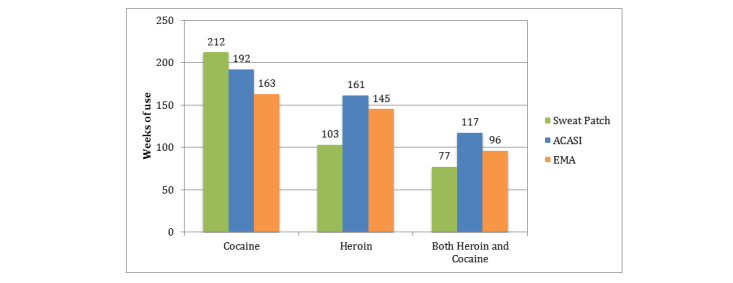
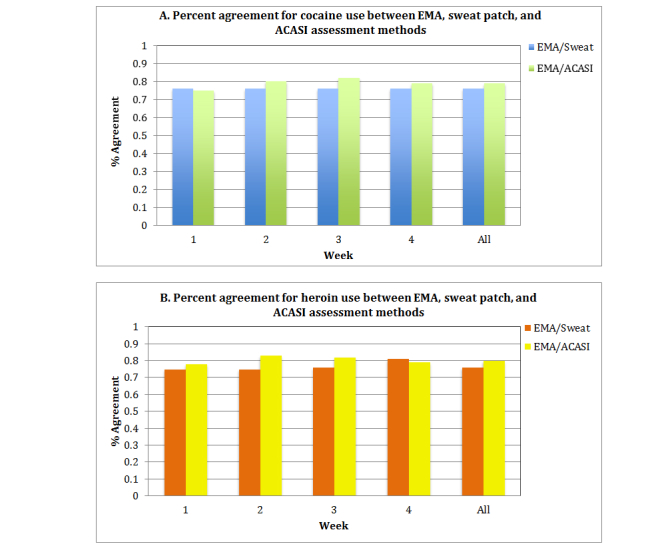
A total of 109 participants were a median of 48.5 years old, 90% African American, and 52% male. During 436 person-weeks of observation, we recorded 212 (49%) cocaine and 103 (24%) heroin sweat patches, 192 (44%) cocaine and 161 (37%) heroin ACASI surveys, and 163 (37%) cocaine and 145 (33%) heroin EMA reports. The percent agreement between EMA and sweat patch methods was 70% for cocaine use and 72% for heroin use, while the percent agreement between EMA and ACASI methods was 77% for cocaine use and 79% for heroin use. Misreporting of drug use by EMA compared to sweat patch and ACASI methods were different by illicit drug type.
Our work demonstrates moderate to good agreement of EMA to biological and standard self-report methods in capturing illicit drug use. Limitations occur with each method and accuracy may differ by type of illicit drugs used.
移动医疗方法(mHealth methods)在研究环境中用于捕捉非法药物使用和相关行为的应用越来越广泛,但与用于捕捉和量化药物使用的已知方法相比,这些方法的有效性如何,相关研究还很少。
我们检查了药物使用的生态瞬时评估(Ecological Momentary Assessment,EMA)与先前经过验证的生物和音频计算机辅助自我访谈(Audio-Computer-Assisted Self-Interview,ACASI)方法的一致性。
暴露评估当前时间(EXACT)研究利用 EMA 方法实时评估参与者自然环境中的药物使用情况。参与者使用移动设备,在 4 周的时间内每次使用海洛因或可卡因时进行自我报告。每周,收集 PharmChek 汗液贴片样本,以测量海洛因和可卡因的含量,参与者回答基于 ACASI 的问卷,报告前一周的行为和药物使用事件。通过 EMA 报告的可卡因和海洛因使用情况与每周的生物或自我报告测量结果进行比较,通过百分比一致性和一致性相关系数来考虑重复测量。通过逻辑回归模型获得不一致的相关性。
共有 109 名参与者的中位年龄为 48.5 岁,90%为非洲裔美国人,52%为男性。在 436 个人观察周中,我们记录了 212 次(49%)可卡因和 103 次(24%)海洛因汗液贴片,192 次(44%)可卡因和 161 次(37%)海洛因 ACASI 调查,以及 163 次(37%)可卡因和 145 次(33%)海洛因 EMA 报告。EMA 与汗液贴片方法在可卡因使用方面的百分比一致性为 70%,在海洛因使用方面为 72%,而 EMA 与 ACASI 方法在可卡因使用方面的百分比一致性为 77%,在海洛因使用方面为 79%。与汗液贴片和 ACASI 方法相比,EMA 对药物使用的错误报告在非法药物类型上有所不同。
我们的工作表明,EMA 在捕捉非法药物使用方面与生物和标准自我报告方法具有中等至良好的一致性。每种方法都存在局限性,准确性可能因使用的非法药物类型而异。