Choi Seon Young, Rashed Shah M, Hasan Nur A, Alam Munirul, Islam Tarequl, Sadique Abdus, Johura Fatema-Tuz, Eppinger Mark, Ravel Jacques, Huq Anwar, Cravioto Alejandro, Colwell Rita R
Maryland Pathogen Research Institute, University of Maryland, College Park, Maryland, USA CosmosID, Inc., Rockville, Maryland, USA.
Maryland Pathogen Research Institute, University of Maryland, College Park, Maryland, USA.
mBio. 2016 Mar 15;7(2):e02160. doi: 10.1128/mBio.02160-15.
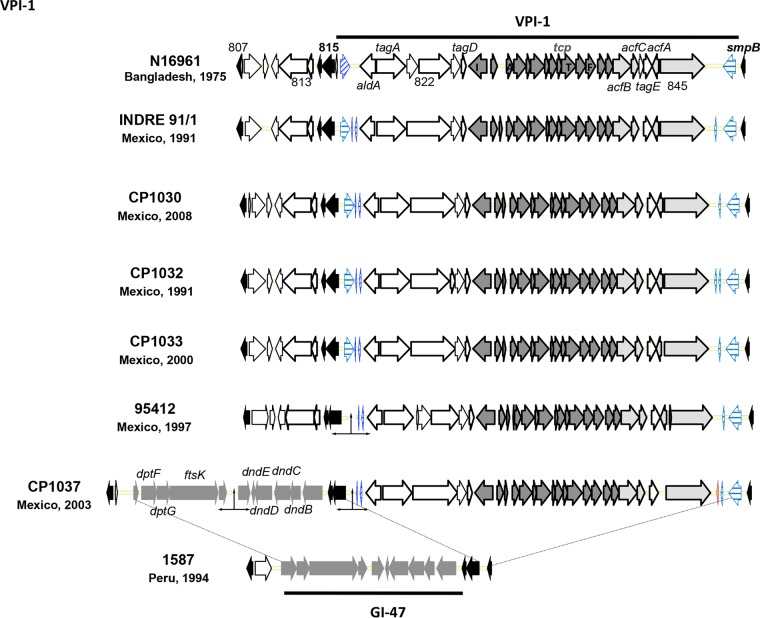
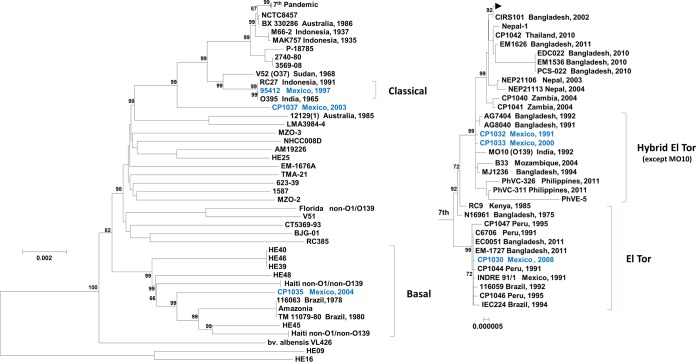
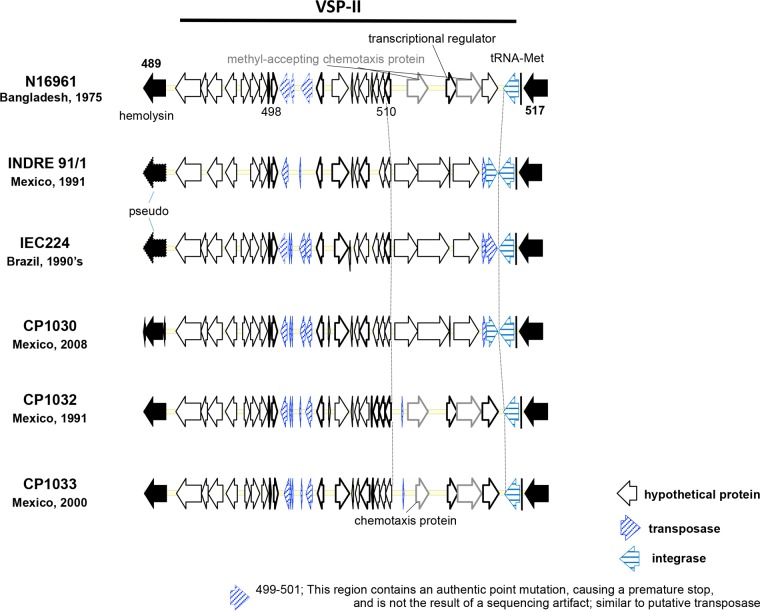
An outbreak of cholera occurred in 1991 in Mexico, where it had not been reported for more than a century and is now endemic. Vibrio cholerae O1 prototype El Tor and classical strains coexist with altered El Tor strains (1991 to 1997). Nontoxigenic (CTX(-)) V. cholerae El Tor dominated toxigenic (CTX(+)) strains (2001 to 2003), but V. cholerae CTX(+) variant El Tor was isolated during 2004 to 2008, outcompeting CTX(-) V. cholerae. Genomes of six Mexican V. cholerae O1 strains isolated during 1991 to 2008 were sequenced and compared with both contemporary and archived strains of V. cholerae. Three were CTX(+) El Tor, two were CTX(-) El Tor, and the remaining strain was a CTX(+) classical isolate. Whole-genome sequence analysis showed the six isolates belonged to five distinct phylogenetic clades. One CTX(-) isolate is ancestral to the 6th and 7th pandemic CTX(+) V. cholerae isolates. The other CTX(-) isolate joined with CTX(-) non-O1/O139 isolates from Haiti and seroconverted O1 isolates from Brazil and Amazonia. One CTX(+) isolate was phylogenetically placed with the sixth pandemic classical clade and the V. cholerae O395 classical reference strain. Two CTX(+) El Tor isolates possessing intact Vibrio seventh pandemic island II (VSP-II) are related to hybrid El Tor isolates from Mozambique and Bangladesh. The third CTX(+) El Tor isolate contained West African-South American (WASA) recombination in VSP-II and showed relatedness to isolates from Peru and Brazil. Except for one isolate, all Mexican isolates lack SXT/R391 integrative conjugative elements (ICEs) and sensitivity to selected antibiotics, with one isolate resistant to streptomycin. No isolates were related to contemporary isolates from Asia, Africa, or Haiti, indicating phylogenetic diversity.
Sequencing of genomes of V. cholerae is critical if genetic changes occurring over time in the circulating population of an area of endemicity are to be understood. Although cholera outbreaks occurred rarely in Mexico prior to the 1990s, genetically diverse V. cholerae O1 strains were isolated between 1991 and 2008. Despite the lack of strong evidence, the notion that cholera was transmitted from Africa to Latin America has been proposed in the literature. In this study, we have applied whole-genome sequence analysis to a set of 124 V. cholerae strains, including six Mexican isolates, to determine their phylogenetic relationships. Phylogenetic analysis indicated the six V. cholerae O1 isolates belong to five phylogenetic clades: i.e., basal, nontoxigenic, classical, El Tor, and hybrid El Tor. Thus, the results of phylogenetic analysis, coupled with CTXϕ array and antibiotic susceptibility, do not support single-source transmission of cholera to Mexico from African countries. The association of indigenous populations of V. cholerae that has been observed in this study suggests it plays a significant role in the dynamics of cholera in Mexico.
1991年墨西哥爆发了霍乱,在该国霍乱已一个多世纪未被报告,而现在霍乱在墨西哥呈地方性流行。霍乱弧菌O1型原型埃尔托生物型和古典生物型菌株与变异的埃尔托生物型菌株共存(1991年至1997年)。非产毒(CTX(-))的霍乱弧菌埃尔托生物型在产毒(CTX(+))菌株中占主导地位(2001年至2003年),但在2004年至2008年期间分离出了霍乱弧菌CTX(+)变异埃尔托生物型,其数量超过了CTX(-)霍乱弧菌。对1991年至2008年期间分离出的6株墨西哥霍乱弧菌O1菌株的基因组进行了测序,并与当代和存档的霍乱弧菌菌株进行了比较。其中3株是CTX(+)埃尔托生物型,2株是CTX(-)埃尔托生物型,其余1株是CTX(+)古典生物型分离株。全基因组序列分析表明,这6株分离株属于5个不同的系统发育分支。1株CTX(-)分离株是第6次和第7次霍乱大流行CTX(+)霍乱弧菌分离株的祖先。另一株CTX(-)分离株与来自海地的CTX(-)非O1/O139分离株以及来自巴西和亚马逊地区的血清转化O1分离株归为一类。1株CTX(+)分离株在系统发育上与第6次霍乱大流行古典分支以及霍乱弧菌O395古典参考菌株归为一类。2株拥有完整的霍乱弧菌第七次大流行岛II(VSP-II)的CTX(+)埃尔托生物型分离株与来自莫桑比克和孟加拉国的杂交埃尔托生物型分离株相关。第三株CTX(+)埃尔托生物型分离株在VSP-II中含有西非-南美(WASA)重组,与来自秘鲁和巴西的分离株相关。除1株分离株外,所有墨西哥分离株均缺乏SXT/R391整合接合元件(ICEs)且对选定抗生素敏感,其中1株对链霉素耐药。没有分离株与来自亚洲、非洲或海地的当代分离株相关,表明存在系统发育多样性。
如果要了解地方性流行地区循环种群中随时间发生的基因变化,对霍乱弧菌基因组进行测序至关重要。尽管在20世纪90年代之前墨西哥很少发生霍乱疫情,但在1991年至2008年期间分离出了基因多样的霍乱弧菌O1菌株。尽管缺乏有力证据,但文献中已提出霍乱从非洲传播到拉丁美洲的观点。在本研究中,我们对一组124株霍乱弧菌菌株(包括6株墨西哥分离株)进行了全基因组序列分析,以确定它们的系统发育关系。系统发育分析表明,这6株霍乱弧菌O1分离株属于5个系统发育分支:即基部、非产毒、古典、埃尔托生物型和杂交埃尔托生物型。因此,系统发育分析结果以及CTXϕ阵列和抗生素敏感性分析结果均不支持霍乱从非洲国家单源传播至墨西哥的观点。本研究中观察到的霍乱弧菌本土种群关联表明,它在墨西哥霍乱动态中发挥着重要作用。