Departamento de Fisioterapia, Universidade Federal de Pernambuco (UFPE), Recife, PE, Brazil, Universidade Federal de Pernambuco, Universidade Federal de Pernambuco, Departamento de Fisioterapia, Recife PE , Brazil.
Departamento de Educação Física, Universidade Federal de Minas Gerais (UFMG), Belo Horizonte, MG, Brazil, Universidade Federal de Minas Gerais, Universidade Federal de Minas Gerais, Departamento de Educação Física, Belo Horizonte MG , Brazil.
Braz J Phys Ther. 2016 Mar 15;20(2):114-25. doi: 10.1590/bjpt-rbf.2014.0144.
While there are several instruments in Brazil that measure motor function in patients after stroke, it is unknown whether the measurement properties of these instruments are appropriate.
To identify the motor function instruments available in Brazil for patients after stroke. To assess the methodological quality of the studies and the results related to the measurement properties of these instruments.
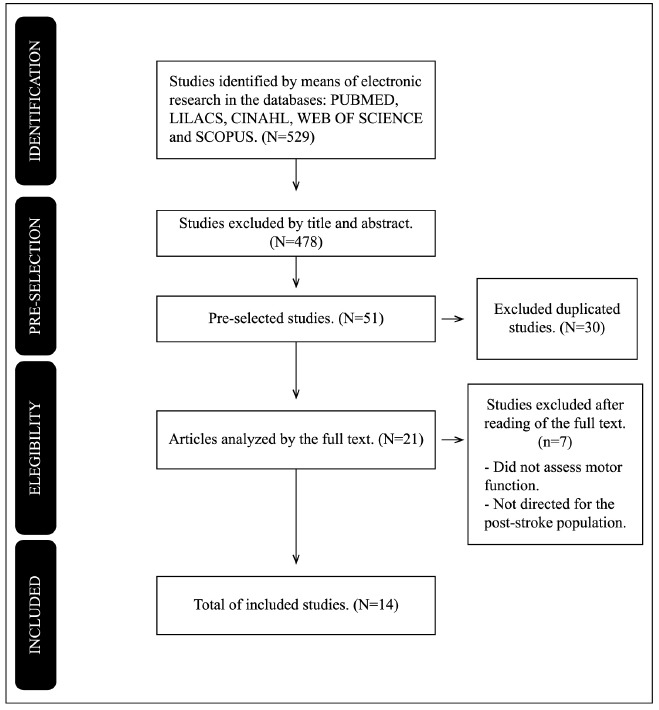
Two independent reviewers conducted searches on PubMed, LILACS, CINAHL, Web of Science, and Scopus. Studies that aimed to cross-culturally adapt an existing instrument or create a Brazilian instrument and test at least one measurement property related to motor function in patients after stroke were included. The methodological quality of these studies was checked by the COSMIN checklist with 4-point rating scale and the results of the measurement properties were analyzed by the criteria developed by Terwee et al.
A total of 11 instruments were considered eligible, none of which were created in Brazil. The process of cross-cultural adaptation was inadequate in 10 out of 11 instruments due to the lack of back-translation or due to inappropriate target population. All of the instruments presented flaws in the measurement properties, especially reliability, internal consistency, and construct validity.
The flaws observed in both cross-cultural adaptation process and testing measurement properties make the results inconclusive on the validity of the available instruments. Adequate procedures of cross-cultural adaptation and measurement properties of these instruments are strongly needed.
尽管巴西有几种仪器可用于测量中风后患者的运动功能,但这些仪器的测量特性是否合适尚不清楚。
确定巴西现有的用于中风后患者的运动功能评估工具。评估这些工具的研究方法质量和与测量特性相关的结果。
两名独立的审查员在 PubMed、LILACS、CINAHL、Web of Science 和 Scopus 上进行了检索。纳入了旨在跨文化适应现有仪器或创建巴西仪器并至少测试与中风后患者运动功能相关的一种测量特性的研究。使用 COSMIN 检查表(4 分制)对这些研究的方法学质量进行了检查,并根据 Terwee 等人制定的标准分析了测量特性的结果。
共有 11 种仪器被认为符合条件,但没有一种是在巴西创建的。由于缺乏反向翻译或由于目标人群不合适,11 种仪器中的 10 种在跨文化适应性方面存在缺陷。所有的仪器在测量特性方面都存在缺陷,特别是可靠性、内部一致性和结构有效性。
在跨文化适应性过程和测试测量特性方面观察到的缺陷使得现有仪器的有效性的结果不确定。这些仪器需要进行适当的跨文化适应性程序和测量特性评估。