Ito Masaya, Okumura Yasuyuki, Horikoshi Masaru, Kato Noriko, Oe Yuki, Miyamae Mitsuhiro, Hirabayashi Naotsugu, Kanie Ayako, Nakagawa Atsuo, Ono Yutaka
National Center for Cognitive Behavior Therapy and Research, National Center of Neurology and Psychiatry, Ogawa Higashi 4-1-1, Kodaira, Tokyo, 187-8511, Japan.
Institute for Health Economics and Policy, Association for Health Economics Research and Social Insurance and Welfare, Tokyo, Japan.
BMC Psychiatry. 2016 Mar 18;16:71. doi: 10.1186/s12888-016-0779-8.
The unified protocol for the transdiagnostic treatment of emotional disorders is a promising treatment approach that could be applicable to a broad range of mental disorders, including depressive, anxiety, trauma-related, and obsessive-compulsive disorders. However, no randomized controlled trial has been conducted to verify the efficacy of the unified protocol on the heterogeneous clinical population with depressive and anxiety disorders.
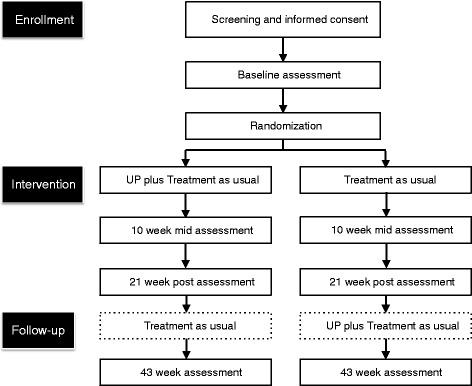
METHODS/DESIGN: The trial was designed as a single-center, assessor-blinded, randomized, 20-week, parallel-group superiority study in order to compare the efficacy of the combination of unified protocol and treatment-as-usual versus waiting-list with treatment-as-usual for patients with depressive and/or anxiety disorders. The primary outcome was depression at 21 weeks, assessed by the 17-item version of the GRID-Hamilton Rating Scale for Depression. Estimated minimum sample size was 27 participants in each group. We will also examine the treatment mechanisms, treatment processes, and neuropsychological correlates.
The results of this study will clarify the efficacy of the unified protocol for depressive and anxiety disorders, and the treatment mechanism, process, and neurological correlates for the effectiveness of the unified protocol. If its efficacy can be confirmed, the unified protocol may be of high clinical value for Japan, a country in which cognitive behavioral treatment has not yet been widely adopted.
ClinicalTrials.gov NCT02003261 (registered on December 2, 2013).
情绪障碍的跨诊断统一治疗方案是一种很有前景的治疗方法,可应用于广泛的精神障碍,包括抑郁症、焦虑症、创伤相关障碍和强迫症。然而,尚未进行随机对照试验来验证统一治疗方案对患有抑郁症和焦虑症的异质性临床人群的疗效。
方法/设计:该试验设计为一项单中心、评估者盲法、随机、为期20周的平行组优效性研究,目的是比较统一治疗方案与常规治疗联合使用与等待名单加常规治疗对患有抑郁症和/或焦虑症患者的疗效。主要结局是21周时的抑郁情况,通过17项版的抑郁症状自评量表(GRID-汉密尔顿抑郁量表)进行评估。每组估计的最小样本量为27名参与者。我们还将研究治疗机制、治疗过程和神经心理学相关性。
本研究结果将阐明统一治疗方案对抑郁症和焦虑症的疗效,以及统一治疗方案有效性的治疗机制、过程和神经学相关性。如果其疗效能够得到证实,统一治疗方案对于认知行为治疗尚未广泛采用的日本可能具有很高的临床价值。
ClinicalTrials.gov NCT02003261(于2013年12月2日注册)。