Mbae C, Mulinge E, Guleid F, Wainaina J, Waruru A, Njiru Z K, Kariuki S
Centre for Microbiological Research, KEMRI, P.O Box 19464-00202, Nairobi, Kenya.
International Livestock Research Institute, Naivasha Rd, P.O Box 30709, Nairobi, Kenya.
BMC Infect Dis. 2016 Mar 22;16:135. doi: 10.1186/s12879-016-1436-z.
Giardia duodenalis is an important intestinal protozoan in humans worldwide with high infection rates occurring in densely populated and low resource settings. The parasite has been recorded to cause diarrhea in children. This study was carried out to identify G. duodenalis assemblages and sub-assemblages in children presenting with diarrhea in Kenya.
A total of 2112 faecal samples were collected from children aged ≤ 5 years and screened for the presence of Giardia cysts using microscopy. A total of 96 (4.5%) samples were identified as Giardia positive samples and were genotyped using glutamate dehydrogenase (gdh), triose phosphate isomerase (tpi) and β-giardin loci.
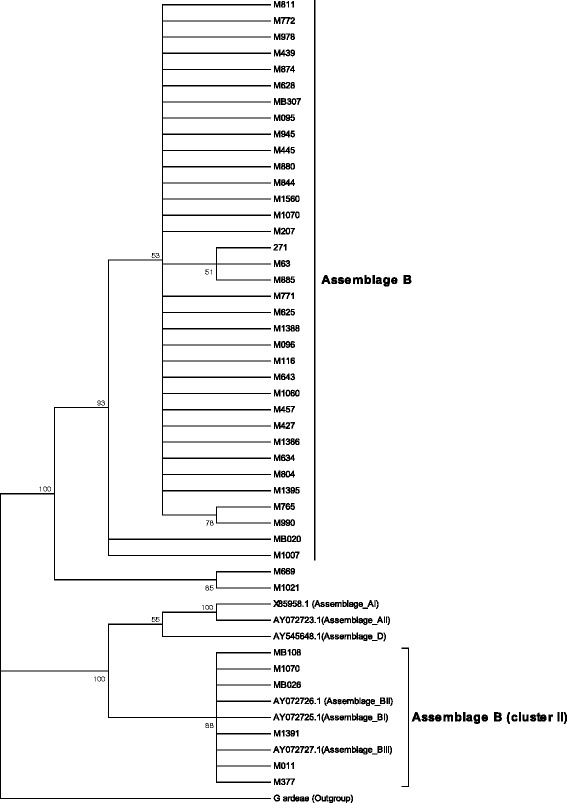
The three markers successfully genotyped 72 isolates and grouped 2 (1.4) isolates as Assemblage A, 64 (88.9) as Assemblage B and 7 (9.7%) consisted of mixed infections with assemblage A and B. A further analysis of 50 isolates using GDH Polymerase Chain Reaction and Restriction Fragment Length Polymorphism (PCR-RFLP) categorized 2 assemblage A isolates as sub-assemblage AII while 6 and 14 assemblage B isolates were categorized into sub-assemblage BIII and BIV respectively. A mixed infection with sub-assemblage BIII and BIV was recorded in 28 isolates. Over half (55.6%) of Giardia infections were recorded among the children between 13 to 48 months old.
This paper reports the first data on the assemblages and sub-assemblages of Giardia duodenalis in children representing with diarrhea in Kenya.
十二指肠贾第虫是一种在全球范围内对人类重要的肠道原生动物,在人口密集和资源匮乏地区感染率较高。该寄生虫已被记录可导致儿童腹泻。本研究旨在鉴定肯尼亚出现腹泻症状儿童中的十二指肠贾第虫组合和亚组合。
从年龄≤5岁的儿童中总共收集了2112份粪便样本,并通过显微镜检查筛选贾第虫囊肿的存在。总共96份(4.5%)样本被鉴定为贾第虫阳性样本,并使用谷氨酸脱氢酶(gdh)、磷酸丙糖异构酶(tpi)和β-贾第蛋白基因座进行基因分型。
这三个标记成功地对72个分离株进行了基因分型,将2个(1.4%)分离株归为A组合,64个(88.9%)归为B组合,7个(9.7%)为A和B组合的混合感染。使用GDH聚合酶链反应和限制性片段长度多态性(PCR-RFLP)对50个分离株进行的进一步分析将2个A组合分离株归类为AII亚组合,而6个和14个B组合分离株分别归类为BIII和BIV亚组合。在28个分离株中记录到BIII和BIV亚组合的混合感染。超过一半(55.6%)的贾第虫感染发生在13至48个月大的儿童中。
本文报告了肯尼亚出现腹泻症状儿童中十二指肠贾第虫组合和亚组合的首批数据。