Danilova Inna, Shkolnikov Vladimir M, Jdanov Dmitri A, Meslé France, Vallin Jacques
Max Planck Institute for Demographic Research, Konrad-Zuse-Strasse 1, 18057 Rostock, Germany ; National Research University Higher School of Economics, Myasnitskaya St. 20, 101000 Moscow, Russia.
Max Planck Institute for Demographic Research, Konrad-Zuse-Strasse 1, 18057 Rostock, Germany ; New Economic School, Novaya St. 100, Skolkovo, 143026 Moscow, Russia.
Popul Health Metr. 2016 Mar 22;14:8. doi: 10.1186/s12963-016-0078-0. eCollection 2016.
Reliable and comparable data on causes of death are crucial for public health analysis, but the usefulness of these data can be markedly diminished when the approach to coding is not standardized across territories and/or over time. Because the Russian system of producing information on causes of death is highly decentralized, there may be discrepancies in the coding practices employed across the country. In this study, we evaluate the uniformity of cause-of-death coding practices across Russian regions using an indirect method.
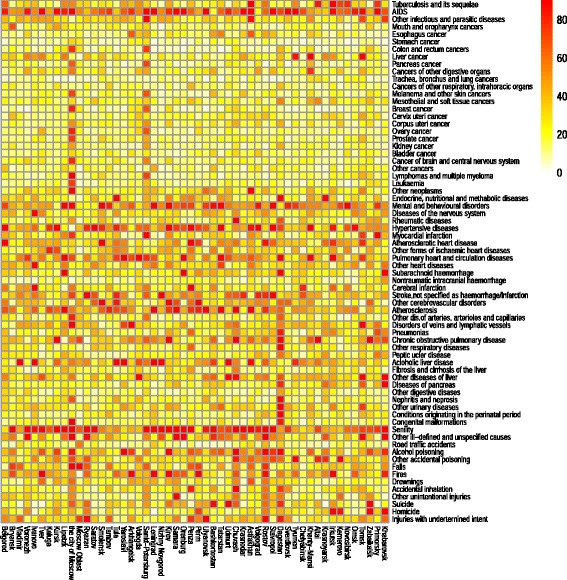
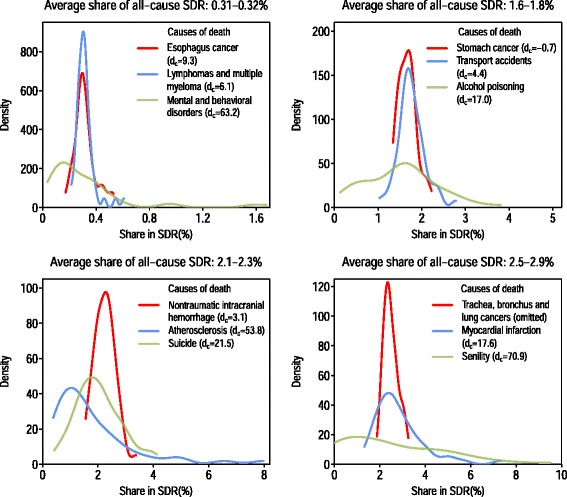
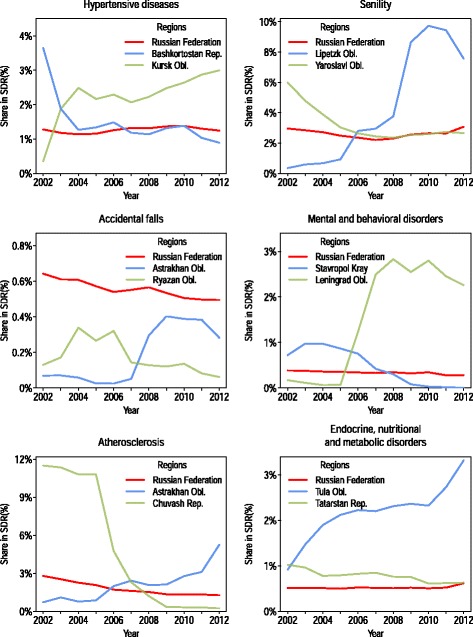
Based on 2002-2012 mortality data, we estimate the prevalence of the major causes of death (70 causes) in the mortality structures of 52 Russian regions. For each region-cause combination we measured the degree to which the share of a certain cause in the mortality structure of a certain region deviates from the respective inter-regional average share. We use heat map visualization and a regression model to determine whether there is regularity in the causes and the regions that is more likely to deviate from the average level across all regions. In addition to analyzing the comparability of cause-specific mortality structures in a spatial dimension, we examine the regional cause-of-death time series to identify the causes with temporal trends that vary greatly across regions.
A high level of consistency was found both across regions and over time for transport accidents, most of the neoplasms, congenital malformations, and perinatal conditions. However, a high degree of inconsistency was found for mental and behavioral disorders, diseases of the nervous system, endocrine disorders, ill-defined causes of death, and certain cardiovascular diseases. This finding suggests that the coding practices for these causes of death are not uniform across regions. The level of consistency improves when causes of death can be grouped into broader diagnostic categories.
This systematic analysis allows us to present a broader picture of the quality of cause-of-death coding at the regional level. For some causes of death, there is a high degree of variance across regions in the likelihood that these causes will be chosen as the underlying causes. In addition, for some causes of death the mortality statistics reflect the coding practices, rather than the real epidemiological situation.
可靠且具有可比性的死因数据对于公共卫生分析至关重要,但当编码方法在不同地区和/或不同时间未标准化时,这些数据的有用性可能会显著降低。由于俄罗斯的死因信息生成系统高度分散,全国各地采用的编码做法可能存在差异。在本研究中,我们使用一种间接方法评估俄罗斯各地区死因编码做法的一致性。
基于2002 - 2012年的死亡率数据,我们估计了俄罗斯52个地区死亡率结构中主要死因(70种死因)的患病率。对于每个地区 - 死因组合,我们测量了某一特定死因在某一地区死亡率结构中的占比偏离相应地区间平均占比的程度。我们使用热图可视化和回归模型来确定在死因和地区中是否存在更有可能偏离所有地区平均水平的规律。除了在空间维度分析特定死因死亡率结构的可比性之外,我们还检查了地区死因时间序列,以识别各地区间时间趋势差异很大的死因。
在交通事故、大多数肿瘤、先天性畸形和围产期疾病方面,发现地区间和不同时间都具有高度一致性。然而,在精神和行为障碍、神经系统疾病、内分泌失调、死因不明以及某些心血管疾病方面,发现存在高度不一致性。这一发现表明这些死因的编码做法在各地区并不统一。当死因可以归为更广泛的诊断类别时,一致性水平会提高。
这种系统分析使我们能够更全面地了解地区层面死因编码的质量。对于某些死因,这些死因被选为根本死因的可能性在各地区存在很大差异。此外,对于某些死因,死亡率统计反映的是编码做法,而非实际的流行病学情况。