Yang Hsin-Chou, Chu Shih-Kai, Huang Chieh-Liang, Kuo Hsiang-Wei, Wang Sheng-Chang, Liu Sheng-Wen, Ho Ing-Kang, Liu Yu-Li
Institute of Statistical Science, Academia Sinica, Taipei, Taiwan.
Bioinformatics Program, Taiwan International Graduate Program, Institute of Information Science, Academia Sinica, Taipei, Taiwan.
PLoS Genet. 2016 Mar 24;12(3):e1005910. doi: 10.1371/journal.pgen.1005910. eCollection 2016 Mar.
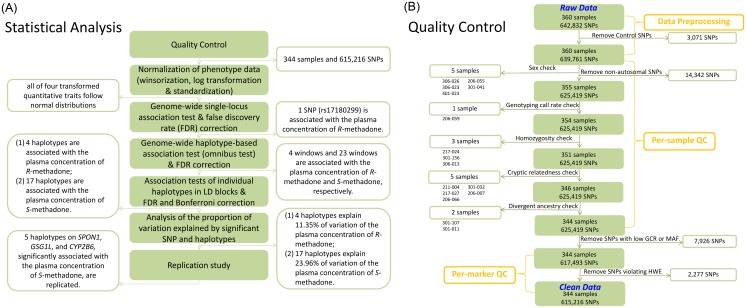
Methadone maintenance treatment (MMT) is commonly used for controlling opioid dependence, preventing withdrawal symptoms, and improving the quality of life of heroin-dependent patients. A steady-state plasma concentration of methadone enantiomers, a measure of methadone metabolism, is an index of treatment response and efficacy of MMT. Although the methadone metabolism pathway has been partially revealed, no genome-wide pharmacogenomic study has been performed to identify genetic determinants and characterize genetic mechanisms for the plasma concentrations of methadone R- and S-enantiomers. This study was the first genome-wide pharmacogenomic study to identify genes associated with the plasma concentrations of methadone R- and S-enantiomers and their respective metabolites in a methadone maintenance cohort. After data quality control was ensured, a dataset of 344 heroin-dependent patients in the Han Chinese population of Taiwan who underwent MMT was analyzed. Genome-wide single-locus and haplotype-based association tests were performed to analyze four quantitative traits: the plasma concentrations of methadone R- and S-enantiomers and their respective metabolites. A significant single nucleotide polymorphism (SNP), rs17180299 (raw p = 2.24 × 10(-8)), was identified, accounting for 9.541% of the variation in the plasma concentration of the methadone R-enantiomer. In addition, 17 haplotypes were identified on SPON1, GSG1L, and CYP450 genes associated with the plasma concentration of methadone S-enantiomer. These haplotypes accounted for approximately one-fourth of the variation of the overall S-methadone plasma concentration. The association between the S-methadone plasma concentration and CYP2B6, SPON1, and GSG1L were replicated in another independent study. A gene expression experiment revealed that CYP2B6, SPON1, and GSG1L can be activated concomitantly through a constitutive androstane receptor (CAR) activation pathway. In conclusion, this study revealed new genes associated with the plasma concentration of methadone, providing insight into the genetic foundation of methadone metabolism. The results can be applied to predict treatment responses and methadone-related deaths for individualized MMTs.
美沙酮维持治疗(MMT)常用于控制阿片类药物依赖、预防戒断症状以及改善海洛因依赖患者的生活质量。美沙酮对映体的稳态血浆浓度是美沙酮代谢的一种衡量指标,是MMT治疗反应和疗效的一个指标。尽管美沙酮代谢途径已部分揭示,但尚未进行全基因组药物基因组学研究来确定遗传决定因素并阐明美沙酮R-和S-对映体血浆浓度的遗传机制。本研究是首次在美沙酮维持治疗队列中进行的全基因组药物基因组学研究,以鉴定与美沙酮R-和S-对映体及其各自代谢物血浆浓度相关的基因。在确保数据质量控制后,对台湾汉族人群中344名接受MMT的海洛因依赖患者的数据集进行了分析。进行全基因组单基因座和基于单倍型的关联测试,以分析四个定量性状:美沙酮R-和S-对映体及其各自代谢物的血浆浓度。鉴定出一个显著的单核苷酸多态性(SNP),rs17180299(原始p = 2.24×10⁻⁸),占美沙酮R-对映体血浆浓度变异的9.541%。此外,在与美沙酮S-对映体血浆浓度相关的SPON1、GSG1L和CYP450基因上鉴定出17种单倍型。这些单倍型约占美沙酮S-对映体血浆总浓度变异的四分之一。美沙酮S-对映体血浆浓度与CYP2B6、SPON1和GSG1L之间的关联在另一项独立研究中得到了重复验证。一项基因表达实验表明,CYP2B6、SPON1和GSG1L可通过组成型雄甾烷受体(CAR)激活途径同时被激活。总之,本研究揭示了与美沙酮血浆浓度相关的新基因,为美沙酮代谢的遗传基础提供了见解。这些结果可用于预测个体化MMT的治疗反应和与美沙酮相关的死亡情况。