Zheleva-Dimitrova Dimitrina Zh, Balabanova Vessela, Gevrenova Reneta, Doichinova Irini, Vitkova Antonina
Department of Pharmacognosy, Faculty of Pharmacy, Medical University, Sofia, 1000 Sofia, Bulgaria.
Department of Chemistry, Faculty of Pharmacy, Medical University, Sofia, 1000 Sofia, Bulgaria.
Pharmacogn Mag. 2015 Oct;11(Suppl 4):S538-44. doi: 10.4103/0973-1296.172958.
Arnica montana flowers have a long history as herbal medicines for external use on injuries and rheumatic complaints.
To investigate Arnicae flos of cultivated accessions from Bulgaria, Poland, Germany, Finland, and Pharmacy store for phenolic derivatives and sesquiterpene lactones (STLs).
Samples of Arnica from nine origins were prepared by ultrasound-assisted extraction with 80% methanol for phenolic compounds analysis. Subsequent reverse-phase high-performance liquid chromatography (HPLC) separation of the analytes was performed using gradient elution and ultraviolet detection at 280 and 310 nm (phenolic acids), and 360 nm (flavonoids). Total STLs were determined in chloroform extracts by solid-phase extraction-HPLC at 225 nm. The HPLC generated chromatographic data were analyzed using principal component analysis (PCA) and hierarchical clustering (HC).
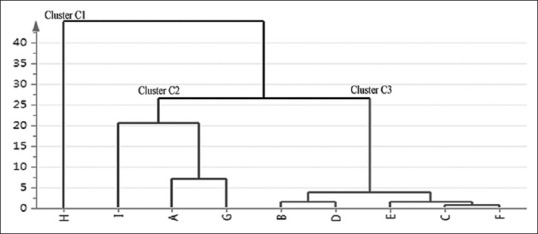
The highest total amount of phenolic acids was found in the sample from Botanical Garden at Joensuu University, Finland (2.36 mg/g dw). Astragalin, isoquercitrin, and isorhamnetin 3-glucoside were the main flavonol glycosides being present up to 3.37 mg/g (astragalin). Three well-defined clusters were distinguished by PCA and HC. Cluster C1 comprised of the German and Finnish accessions characterized by the highest content of flavonols. Cluster C2 included the Bulgarian and Polish samples presenting a low content of flavonoids. Cluster C3 consisted only of one sample from a pharmacy store.
A validated HPLC method for simultaneous determination of phenolic acids, flavonoid glycosides, and aglycones in A. montana flowers was developed. The PCA loading plot showed that quercetin, kaempferol, and isorhamnetin can be used to distinguish different Arnica accessions.
A principal component analysis (PCA) on 13 phenolic compounds and total amount of sesquiterpene lactones in Arnicae flos collection tended to cluster the studied 9 accessions into three main groups. The profiles obtained demonstrated that the samples from Germany and Finland are characterized by greater amounts of phenolic derivatives than the Bulgarian and Polish ones. The PCA loading plot showed that quercetin, kaemferol and isorhamnetin can be used to distinguish different arnica accessions.
山金车花作为用于治疗伤痛和风湿病症的草药有着悠久的历史。
研究来自保加利亚、波兰、德国、芬兰的栽培品种以及药店所售山金车花中的酚类衍生物和倍半萜内酯(STLs)。
采用80%甲醇超声辅助提取法制备来自9个产地的山金车花样品,用于酚类化合物分析。随后,使用梯度洗脱和在280和310 nm(酚酸)以及360 nm(黄酮类化合物)处的紫外检测对分析物进行反相高效液相色谱(HPLC)分离。通过固相萃取 - HPLC在225 nm处测定氯仿提取物中的总STLs。使用主成分分析(PCA)和层次聚类(HC)对HPLC生成的色谱数据进行分析。
在芬兰于韦斯屈莱大学植物园采集的样品中发现酚酸总量最高(2.36 mg/g干重)。黄芪苷、异槲皮苷和异鼠李素3 - 葡萄糖苷是主要的黄酮醇糖苷,含量高达3.37 mg/g(黄芪苷)。PCA和HC区分出三个明确的聚类。聚类C1由德国和芬兰的品种组成,其特征是黄酮醇含量最高。聚类C2包括黄酮类化合物含量低的保加利亚和波兰样品。聚类C3仅由药店的一个样品组成。
建立了一种经过验证的HPLC方法,用于同时测定山金车花中的酚酸、黄酮醇糖苷和苷元。PCA载荷图表明,槲皮素、山奈酚和异鼠李素可用于区分不同的山金车花品种。
对山金车花中13种酚类化合物和倍半萜内酯总量进行主成分分析(PCA),倾向于将所研究的9个品种聚为三个主要组。所得图谱表明,德国和芬兰的样品比保加利亚和波兰的样品具有更多的酚类衍生物。PCA载荷图表明,槲皮素、山奈酚和异鼠李素可用于区分不同的山金车花品种。