Keil Julian, Roa Romero Yadira, Balz Johanna, Henjes Melissa, Senkowski Daniel
Multisensory Integration Group, Department of Psychiatry and Psychotherapy, St. Hedwig Hospital, Charité - Universitätsmedizin Berlin Berlin, Germany.
Front Hum Neurosci. 2016 Mar 14;10:104. doi: 10.3389/fnhum.2016.00104. eCollection 2016.
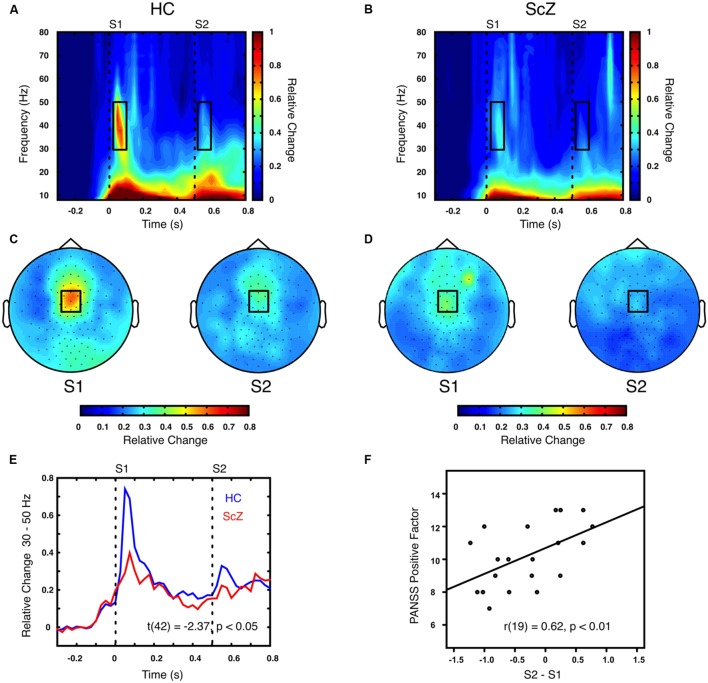
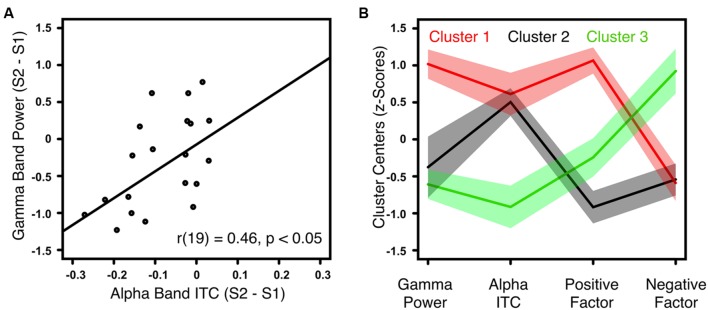
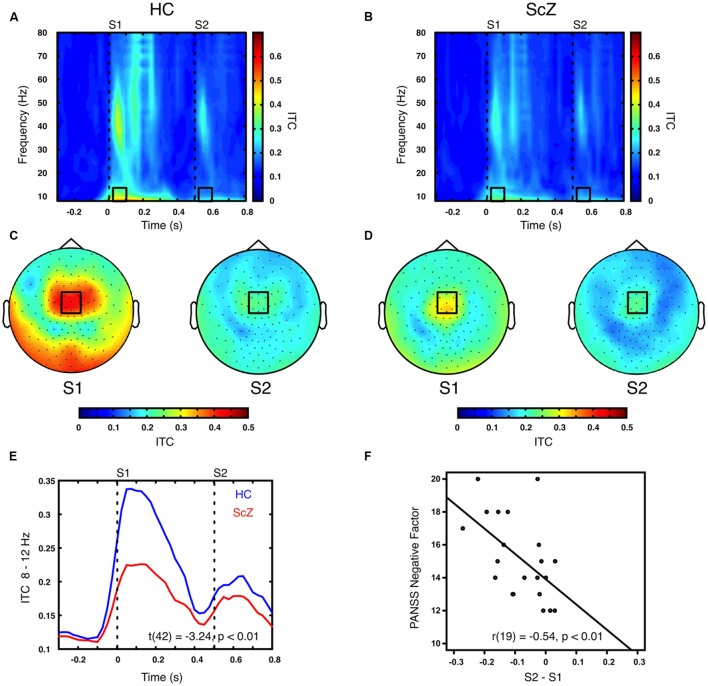
Oscillatory activity in neural populations and temporal synchronization within these populations are important mechanisms contributing to perception and cognition. In schizophrenia, perception and cognition are impaired. Aberrant gating of irrelevant sensory information, which has been related to altered oscillatory neural activity, presumably contributes to these impairments. However, the link between schizophrenia symptoms and sensory gating deficits, as reflected in oscillatory activity, is not clear. In this electroencephalography study, we used a paired-stimulus paradigm to investigate frequency-resolved oscillatory activity in 22 schizophrenia patients and 22 healthy controls. We found sensory gating deficits in patients compared to controls, as reflected in reduced gamma-band power and alpha-band phase synchrony difference between the first and the second auditory stimulus. We correlated these markers of neural activity with a five-factor model of the Positive and Negative Syndrome Scale. Gamma-band power sensory gating was positively correlated with positive symptoms. Moreover, alpha-band phase synchrony sensory gating was negatively correlated with negative symptoms. A cluster analysis revealed three schizophrenia phenotypes, characterized by (i) aberrant gamma-band power and high positive symptoms, (ii) aberrant alpha-band phase synchrony, low positive, and low negative symptom scores or (iii) by intact sensory gating and high negative symptoms. Our study demonstrates that aberrant neural synchronization, as reflected in gamma-band power and alpha-band phase synchrony, relates to the schizophrenia psychopathology. Different schizophrenia phenotypes express distinct levels of positive and negative symptoms as well as varying degrees of aberrant oscillatory neural activity. Identifying the individual phenotype might improve therapeutic interventions in schizophrenia.
神经群体中的振荡活动以及这些群体内部的时间同步是有助于感知和认知的重要机制。在精神分裂症中,感知和认知会受损。与振荡性神经活动改变相关的无关感觉信息的异常门控可能是导致这些损伤的原因。然而,精神分裂症症状与振荡活动所反映的感觉门控缺陷之间的联系尚不清楚。在这项脑电图研究中,我们使用配对刺激范式来研究22名精神分裂症患者和22名健康对照者的频率分辨振荡活动。我们发现,与对照组相比,患者存在感觉门控缺陷,这体现在第一和第二个听觉刺激之间的伽马波段功率降低以及阿尔法波段相位同步差异上。我们将这些神经活动标记与阳性和阴性症状量表的五因素模型进行了关联。伽马波段功率感觉门控与阳性症状呈正相关。此外,阿尔法波段相位同步感觉门控与阴性症状呈负相关。聚类分析揭示了三种精神分裂症表型,其特征分别为:(i)伽马波段功率异常且阳性症状高;(ii)阿尔法波段相位同步异常、阳性症状低且阴性症状分数低;或(iii)感觉门控正常但阴性症状高。我们的研究表明,伽马波段功率和阿尔法波段相位同步所反映的异常神经同步与精神分裂症的精神病理学有关。不同的精神分裂症表型表现出不同程度的阳性和阴性症状以及不同程度的异常振荡性神经活动。识别个体表型可能会改善精神分裂症的治疗干预。