Yang Jingwen, Yuan Guohua, Chen Zhi
The State Key Laboratory Breeding Base of Basic Science of Stomatology (Hubei-MOST) and Key Laboratory of Oral Biomedicine Ministry of Education, School and Hospital of Stomatology, Wuhan UniversityWuhan, China; Department of Pediatric Dentistry, School and Hospital of Stomatology, Wuhan UniversityWuhan, China.
The State Key Laboratory Breeding Base of Basic Science of Stomatology (Hubei-MOST) and Key Laboratory of Oral Biomedicine Ministry of Education, School and Hospital of Stomatology, Wuhan University Wuhan, China.
Front Physiol. 2016 Mar 7;7:58. doi: 10.3389/fphys.2016.00058. eCollection 2016.
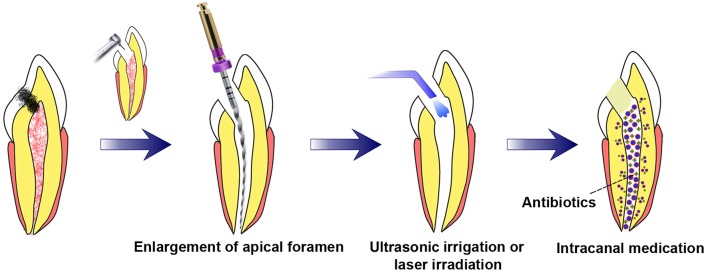
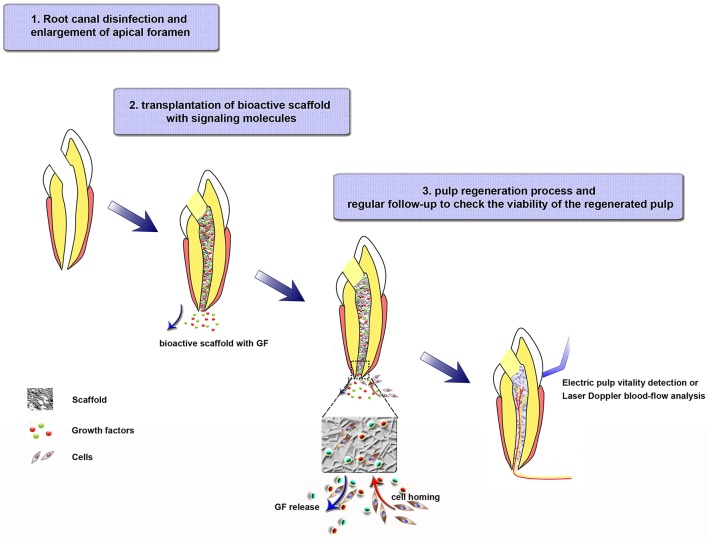
Regenerative endodontics aims to replace inflamed/necrotic pulp tissues with regenerated pulp-like tissues to revitalize teeth and improve life quality. Pulp revascularization case reports, which showed successful clinical and radiographic outcomes, indicated the possible clinical application of pulp regeneration via cell homing strategy. From a clinical point of view, functional pulp-like tissues should be regenerated with the characterization of vascularization, re-innervation, and dentin deposition with a regulated rate similar to that of normal pulp. Efficient root canal disinfection and proper size of the apical foramen are the two requisite preconditions for pulp regeneration. Progress has been made on pulp regeneration via cell homing strategies. This review focused on the requisite preconditions and cell homing strategies for pulp regeneration. In addition to the traditionally used mechanical preparation and irrigation, antibiotics, irrigation assisted with EndoVac apical negative-pressure system, and ultrasonic and laser irradiation are now being used in root canal disinfection. In addition, pulp-like tissues could be formed with the apical foramen less than 1 mm, although more studies are needed to determine the appropriate size. Moreover, signaling molecules including stromal cell derived factor (SDF-1α), basic Fibroblast Growth Factor (bFGF), Platelet Derived Growth Factor (PDGF), stem cell factor (SCF), and Granulocyte Colony-Stimulating Factor (G-CSF) were used to achieve pulp-like tissue formation via a cell homing strategy. Studies on the cell sources of pulp regeneration might give some indications on the signaling molecular selection. The active recruitment of endogenous cells into root canals to regenerate pulp-like tissues is a novel concept that may offer an unprecedented opportunity for the near-term clinical translation of current biology-based therapies for dental pulp regeneration.
再生牙髓治疗旨在用再生的牙髓样组织替代发炎/坏死的牙髓组织,从而使牙齿恢复活力并提高生活质量。牙髓血运重建的病例报告显示了成功的临床和影像学结果,表明通过细胞归巢策略进行牙髓再生具有临床应用的可能性。从临床角度来看,应再生具有血管化、重新神经支配以及牙本质沉积特征且沉积速率与正常牙髓相似的功能性牙髓样组织。有效的根管消毒和合适大小的根尖孔是牙髓再生的两个必要前提条件。通过细胞归巢策略在牙髓再生方面已取得进展。本综述聚焦于牙髓再生的必要前提条件和细胞归巢策略。除了传统使用的机械预备和冲洗外,抗生素、EndoVac根尖负压系统辅助冲洗以及超声和激光照射目前也被用于根管消毒。此外,根尖孔小于1毫米时可形成牙髓样组织,不过还需要更多研究来确定合适的大小。此外,包括基质细胞衍生因子(SDF-1α)、碱性成纤维细胞生长因子(bFGF)、血小板衍生生长因子(PDGF)、干细胞因子(SCF)和粒细胞集落刺激因子(G-CSF)在内的信号分子被用于通过细胞归巢策略实现牙髓样组织的形成。关于牙髓再生细胞来源的研究可能为信号分子的选择提供一些线索。将内源性细胞主动募集到根管中以再生牙髓样组织是一个新的概念,这可能为当前基于生物学的牙髓再生疗法的近期临床转化提供前所未有的机会。