van Schaik Johanna E, Endedijk Hinke M, Stapel Janny C, Hunnius Sabine
Donders Institute for Brain, Cognition and Behaviour, Radboud University Nijmegen Nijmegen, Netherlands.
Front Psychol. 2016 Mar 8;7:321. doi: 10.3389/fpsyg.2016.00321. eCollection 2016.
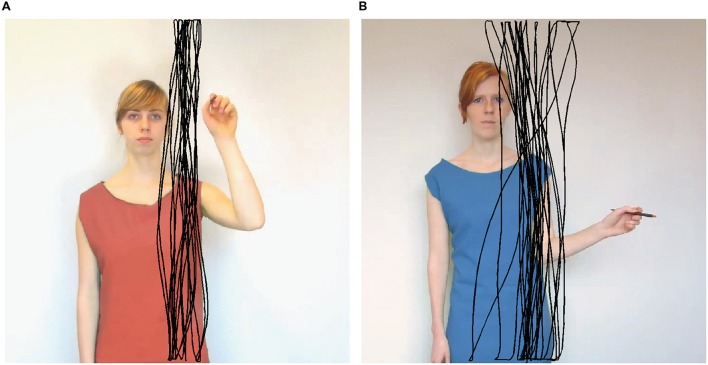
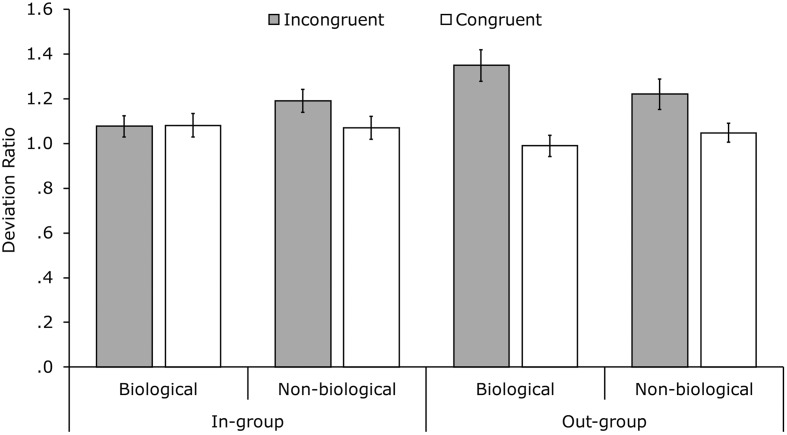
From early childhood onward, individuals use behavior copying to communicate liking and belonging. This non-verbal signal of affiliation is especially relevant in the context of social groups and indeed both children and adults copy in-group more than out-group members. Given the societal importance of inter-group interactions, it is imperative to understand the mechanistic level at which group modulations of copying occur early in development. The current study was designed to investigate the effect of novel group membership on young children's motor behavior during a simultaneous movement-observation and -execution task. Four- to six-year-olds (n = 65) first gained membership to one of two novel groups based on their color preference and put on a vest in their chosen color. Subsequently, they were instructed to draw a straight line back-and-forth on a tablet computer that was concurrently displaying a stimulus video in which a model moved her arm congruently or incongruently to the child's instructed direction. In half of the stimulus videos the model belonged to the in-group, while in the other half the model belonged to the out-group, as identified by the color of her dress. The deviations into the uninstructed direction of the children's drawings were quantified as a measure of how much observing the models' behaviors interfered with executing their own behaviors. The motor interference effect, namely higher deviations in the incongruent trials than in the congruent trials, was found only for the out-group condition. An additional manipulation of whether the models' arms followed a biological or non-biological velocity profile had little effect on children's motor interference. The results are interpreted in the context of the explicit coordinative nature of the task as an effect of heightened attention toward interacting with an out-group member. This study demonstrates that already during early childhood, novel group membership dynamically influences behavior processing as a function of interaction context.
从幼儿期开始,个体就通过行为模仿来传达喜爱和归属感。这种非语言的归属信号在社会群体背景中尤为重要,事实上,儿童和成人模仿内群体成员的行为都多于外群体成员。鉴于群体间互动在社会中的重要性,了解在发展早期群体对模仿的调节发生的机制层面至关重要。本研究旨在调查新的群体成员身份对幼儿在同步运动观察和执行任务期间运动行为的影响。4至6岁的儿童(n = 65)首先根据他们的颜色偏好加入两个新群体中的一个,并穿上他们所选颜色的背心。随后,他们被要求在平板电脑上前后画一条直线,与此同时,平板电脑上正在播放一段刺激视频,视频中一个模型的手臂按照与孩子指示方向一致或不一致的方向移动。在一半的刺激视频中,模型属于内群体,而在另一半视频中,根据模型衣服的颜色,模型属于外群体。将儿童绘画偏离未指示方向的程度量化,以此作为衡量观察模型行为对执行自身行为干扰程度的指标。仅在外群体条件下发现了运动干扰效应,即在不一致试验中的偏差高于一致试验。对模型手臂是遵循生物速度曲线还是非生物速度曲线的额外操作对儿童的运动干扰影响不大。在任务明确的协调性质背景下,这些结果被解释为对与外群体成员互动的关注度提高的一种效应。这项研究表明,早在幼儿期,新的群体成员身份就会根据互动背景动态地影响行为处理。