Hagmann-von Arx Priska, Manicolo Olivia, Lemola Sakari, Grob Alexander
Department of Psychology, University of Basel , Basel, Switzerland.
Department of Psychology, University of Warwick , Coventry, UK.
Front Psychol. 2016 Mar 10;7:352. doi: 10.3389/fpsyg.2016.00352. eCollection 2016.
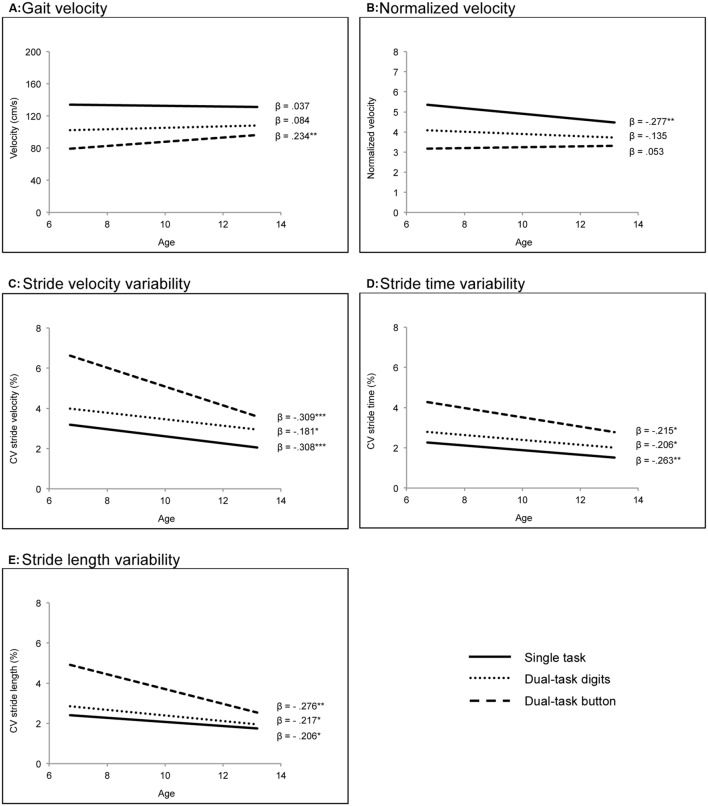
Age-dependent gait characteristics and associations with cognition, motor behavior, injuries, and psychosocial functioning were investigated in 138 typically developing children aged 6.7-13.2 years (M = 10.0 years). Gait velocity, normalized velocity, and variability were measured using the walkway system GAITRite without an additional task (single task) and while performing a motor or cognitive task (dual task). Assessment of children's cognition included tests for intelligence and executive functions; parents reported on their child's motor behavior, injuries, and psychosocial functioning. Gait variability (an index of gait regularity) decreased with increasing age in both single- and dual-task walking. Dual-task gait decrements were stronger when children walked in the motor compared to the cognitive dual-task condition and decreased with increasing age in both dual-task conditions. Gait alterations from single- to dual-task conditions were not related to children's cognition, motor behavior, injuries, or psychosocial functioning.
对138名年龄在6.7至13.2岁(平均年龄10.0岁)的发育正常儿童进行了研究,以探讨年龄依赖性步态特征及其与认知、运动行为、损伤和心理社会功能的关系。使用GAITRite步道系统在无额外任务(单任务)以及执行运动或认知任务(双任务)时测量步态速度、标准化速度和变异性。对儿童认知的评估包括智力和执行功能测试;父母报告孩子的运动行为、损伤和心理社会功能。在单任务和双任务行走中,步态变异性(步态规律性指标)均随年龄增长而降低。与认知双任务条件相比,当儿童在运动双任务条件下行走时,双任务步态下降更为明显,且在两种双任务条件下均随年龄增长而降低。从单任务到双任务条件下的步态改变与儿童的认知、运动行为、损伤或心理社会功能无关。