Abdel Latef Arafat A, Tran Lam-Son P
Botany Department, Faculty of Science, South Valley UniversityQena, Egypt; Biology Department, College of Applied Medical Science, Taif UniversityTaif, Saudi Arabia.
Plant Abiotic Stress Research Group & Faculty of Applied Sciences, Ton Duc Thang UniversityHo Chi Minh City, Vietnam; Signaling Pathway Research Unit, RIKEN Center for Sustainable Resource ScienceYokohama, Japan.
Front Plant Sci. 2016 Mar 10;7:243. doi: 10.3389/fpls.2016.00243. eCollection 2016.
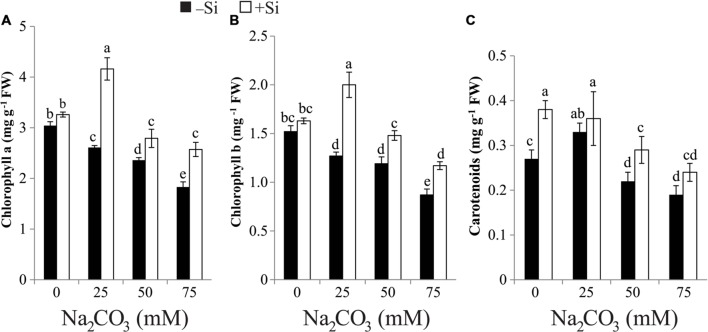
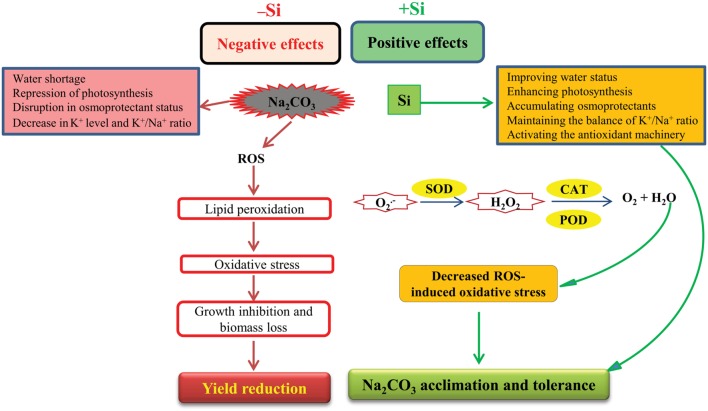
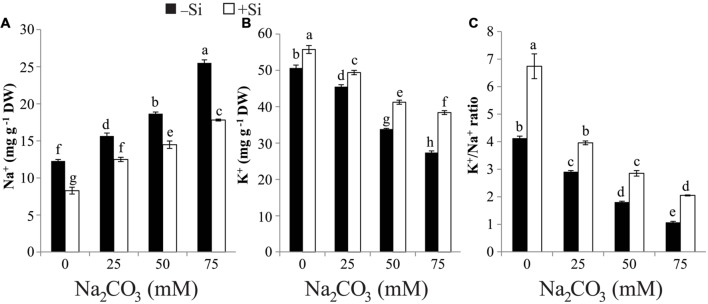
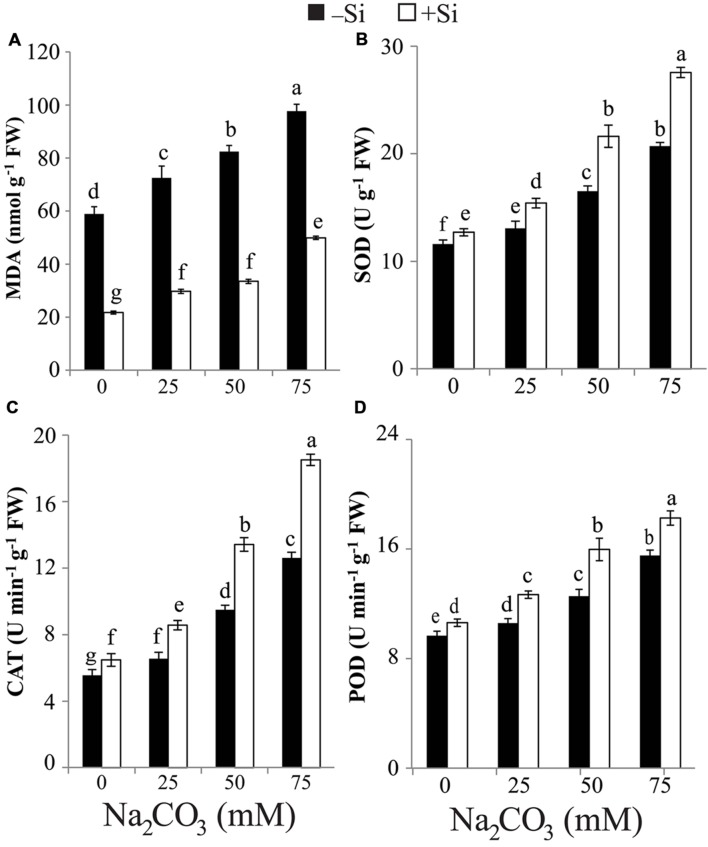
Silicon (Si) has been known to augment plant defense against biotic and abiotic pressures. Maize (Zea maize L.) is classified as a Si accumulator and is relatively susceptible to alkaline stress. In this study, seeds of maize were grown in pots and exposed to various concentrations of Na2CO3 (0, 25, 50, and 75 mM) with or without 1.5 mM Si in the form of sodium metasilicate Na2O3Si.5H2O for 25 days. Alkaline-stressed plants showed a decrease in growth parameters, leaf relative water content (LRWC), and the contents of photosynthetic pigments, soluble sugars, total phenols and potassium ion (K(+)), as well as potassium/sodium ion (K(+)/Na(+)) ratio. By contrast, alkaline stress increased the contents of soluble proteins, total free amino acids, proline, Na(+) and malondialdehyde (MDA), as well as the activities of superoxide dismutase (SOD), catalase (CAT), and peroxidase (POD) in stressed plants. On the other hand, application of Si by seed-priming improved growth of stressed plants, which was accompanied by the enhancement in LRWC, and levels of photosynthetic pigments, soluble sugars, soluble proteins, total free amino acids and K(+), as well as activities of SOD, CAT, and POD enzymes. Furthermore, Si supplement resulted in a decrease in the contents of proline, MDA and Na(+), which together with enhanced K(+) level led to a favorable adjustment of K(+)/Na(+) ratio, in stressed plants relative to plants treated with alkaline stress alone. Taken together, these results indicate that Si plays a pivotal role in alleviating the negative effects of alkaline stress on maize growth by improving water status, enhancing photosynthetic pigments, accumulating osmoprotectants rather than proline, activating the antioxidant machinery, and maintaining the balance of K(+)/Na(+) ratio. Thus, our findings demonstrate that seed-priming with Si is an efficient strategy that can be used to boost tolerance of maize plants to alkaline stress.
已知硅(Si)可增强植物抵御生物和非生物胁迫的能力。玉米(Zea maize L.)被归类为硅积累植物,且相对易受碱性胁迫影响。在本研究中,将玉米种子种植在花盆中,使其暴露于不同浓度的Na2CO3(0、25、50和75 mM)下,有或没有以偏硅酸钠Na2O3Si·5H2O形式存在的1.5 mM硅,处理25天。碱性胁迫的植物生长参数、叶片相对含水量(LRWC)、光合色素含量、可溶性糖、总酚和钾离子(K(+))含量以及钾/钠离子(K(+)/Na(+))比值均下降。相比之下,碱性胁迫增加了胁迫植物中可溶性蛋白质、总游离氨基酸、脯氨酸、Na(+)和丙二醛(MDA)的含量,以及超氧化物歧化酶(SOD)、过氧化氢酶(CAT)和过氧化物酶(POD)的活性。另一方面,通过种子引发施用硅可改善胁迫植物的生长,这伴随着LRWC、光合色素水平、可溶性糖、可溶性蛋白质、总游离氨基酸和K(+)含量的提高,以及SOD、CAT和POD酶的活性增强。此外,补充硅导致胁迫植物中脯氨酸、MDA和Na(+)含量下降,这与K(+)水平的提高一起导致K(+)/Na(+)比值得到有利调节,相对于仅用碱性胁迫处理的植物而言。综上所述,这些结果表明,硅通过改善水分状况、增强光合色素、积累渗透保护剂而非脯氨酸、激活抗氧化机制以及维持K(+)/Na(+)比值平衡,在减轻碱性胁迫对玉米生长的负面影响方面发挥着关键作用。因此,我们的研究结果表明,用硅进行种子引发是一种有效的策略,可用于提高玉米植株对碱性胁迫的耐受性。