Hamam Ahmed M, Britto Dev T, Flam-Shepherd Rubens, Kronzucker Herbert J
Canadian Centre for World Hunger Research, University of Toronto Toronto, ON, Canada.
Front Plant Sci. 2016 Mar 8;7:272. doi: 10.3389/fpls.2016.00272. eCollection 2016.
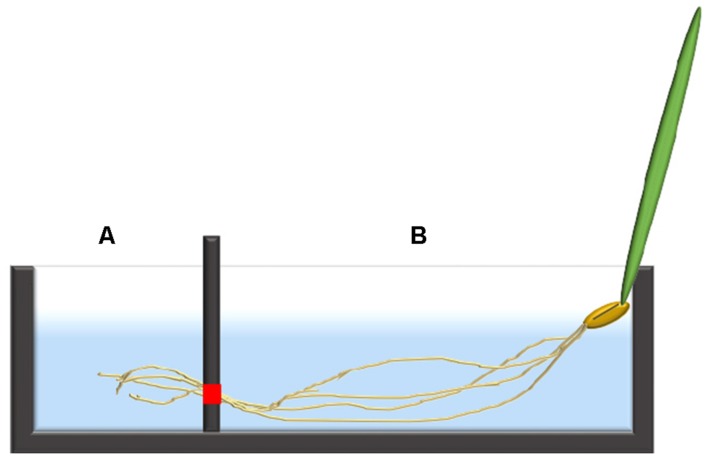
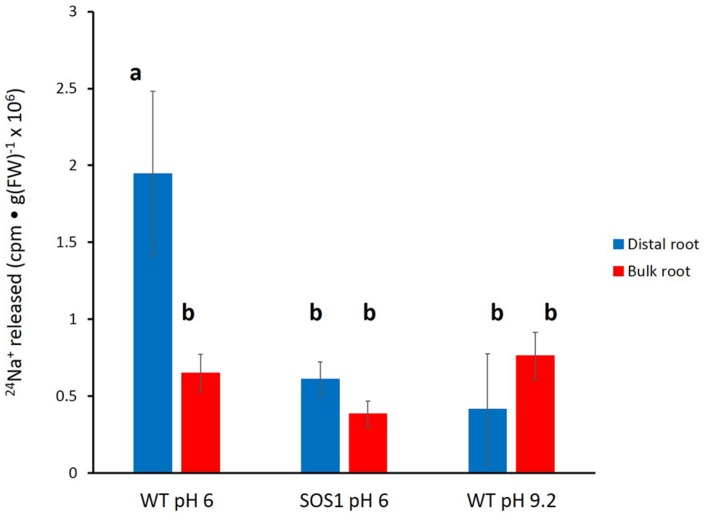
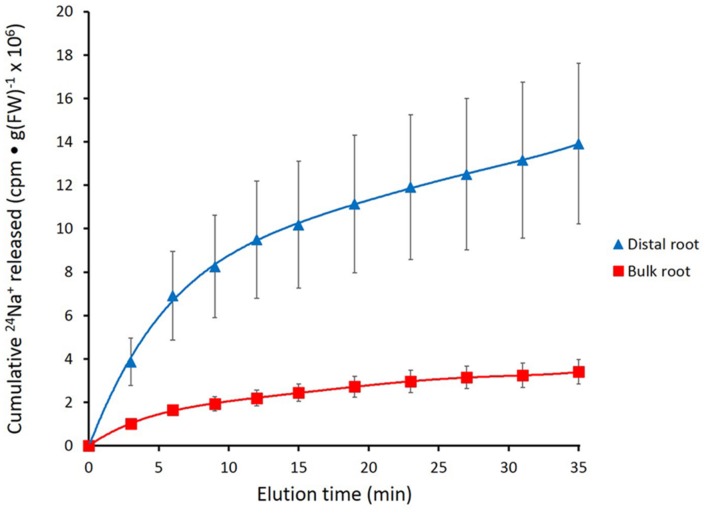
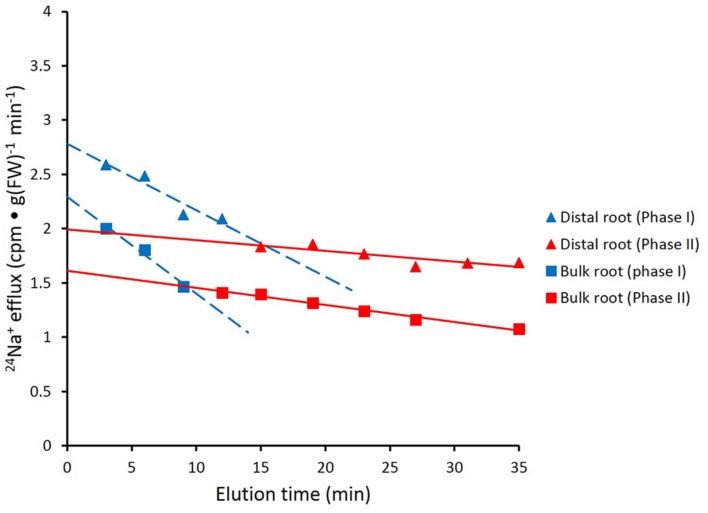
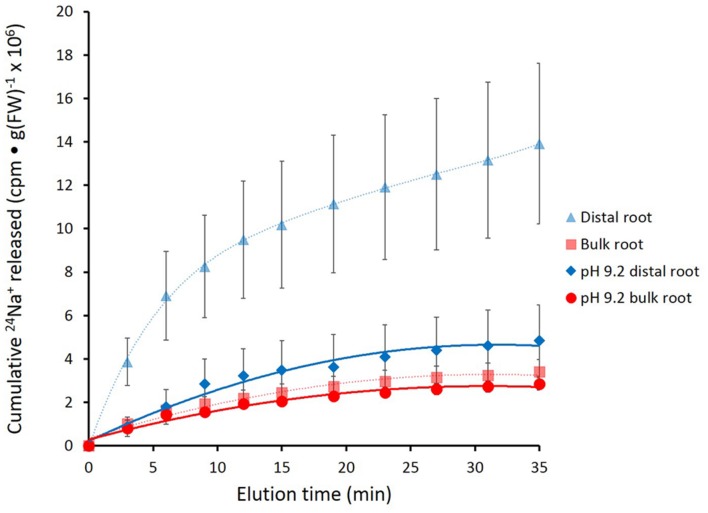
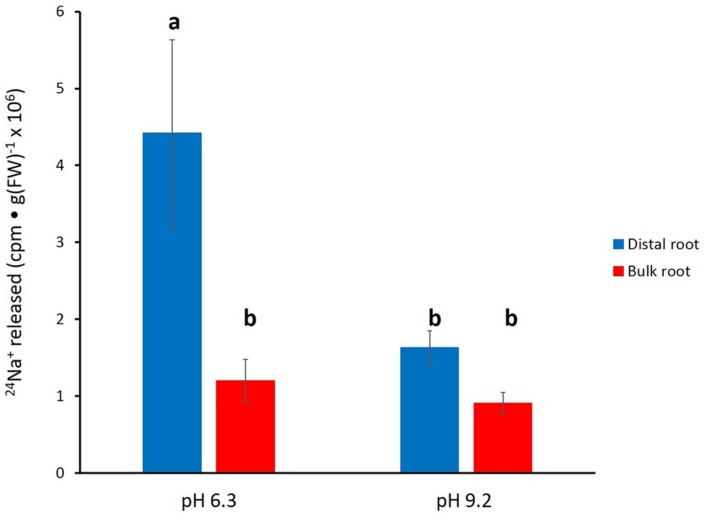
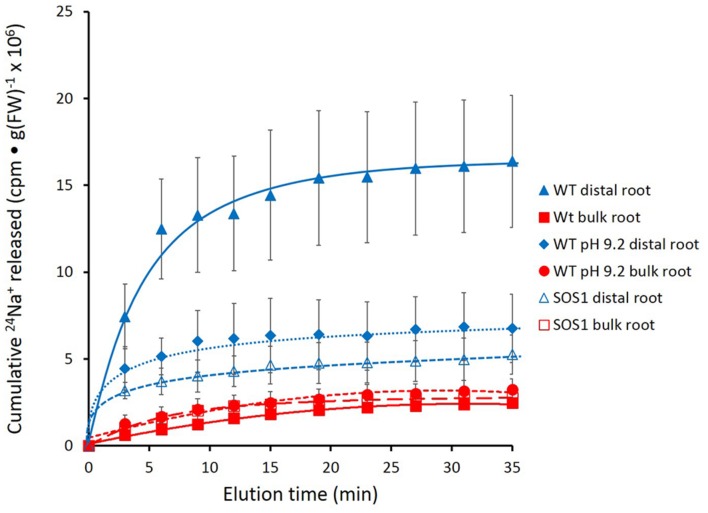
Rapid sodium cycling across the plasma membrane of root cells is widely thought to be associated with Na(+) toxicity in plants. However, the efflux component of this cycling is not well understood. Efflux of Na(+) from root cells is believed to be mediated by Salt Overly-Sensitive-1, although expression of this Na(+)/H(+) antiporter has been localized to the vascular tissue and root meristem. Here, we used a chambered cuvette system in which the distal root of intact salinized barley and Arabidopsis thaliana plants (wild-type and sos1) were isolated from the bulk of the root by a silicone-acrylic barrier, so that we could compare patterns of (24)Na(+) efflux in these two regions of root. In barley, steady-state release of (24)Na(+) was about four times higher from the distal root than from the bulk roots. In the distal root, (24)Na(+) release was pronouncedly decreased by elevated pH (9.2), while the bulk-root release was not significantly affected. In A. thaliana, tracer efflux was about three times higher from the wild-type distal root than from the wild-type bulk root and also three to four times higher than both distal- and bulk-root fluxes of Atsos1 mutants. Elevated pH also greatly reduced the efflux from wild-type roots. These findings support a significant role of SOS1-mediated Na(+) efflux in the distal root, but not in the bulk root.
人们普遍认为,根细胞跨质膜的快速钠循环与植物中的钠(Na⁺)毒性有关。然而,这种循环的外流成分尚未得到充分了解。尽管这种Na⁺/H⁺反向转运蛋白的表达已定位在维管组织和根分生组织中,但根细胞中Na⁺的外流被认为是由盐过度敏感蛋白1(Salt Overly-Sensitive-1,SOS1)介导的。在这里,我们使用了一种分腔比色皿系统,通过硅丙烯酸屏障将完整盐渍化大麦和拟南芥植株(野生型和sos1突变体)的根尖与根的其他部分隔离开来,以便我们能够比较根的这两个区域中²⁴Na⁺的外流模式。在大麦中,根尖的²⁴Na⁺稳态释放量比根的其他部分高约四倍。在根尖,pH升高(9.2)会显著降低²⁴Na⁺的释放,而根的其他部分的释放则没有受到显著影响。在拟南芥中,野生型根尖的示踪剂外流比野生型根的其他部分高约三倍,也比Atsos1突变体的根尖和根的其他部分的通量高3至4倍。pH升高也大大降低了野生型根的外流。这些发现支持了SOS1介导的Na⁺外流在根尖中起重要作用,但在根的其他部分不起作用。