Han Seung Hwan, Nicholls Stephen J, Sakuma Ichiro, Zhao Dong, Koh Kwang Kon
Department of Cardiology, Gachon University Gil Medical Center, Incheon, Korea.
Department of Cardiology, South Australian Health and Medical Research Institute, University of Adelaide, Adelaide, Australia.
Korean Circ J. 2016 Mar;46(2):135-44. doi: 10.4070/kcj.2016.46.2.135. Epub 2016 Mar 21.
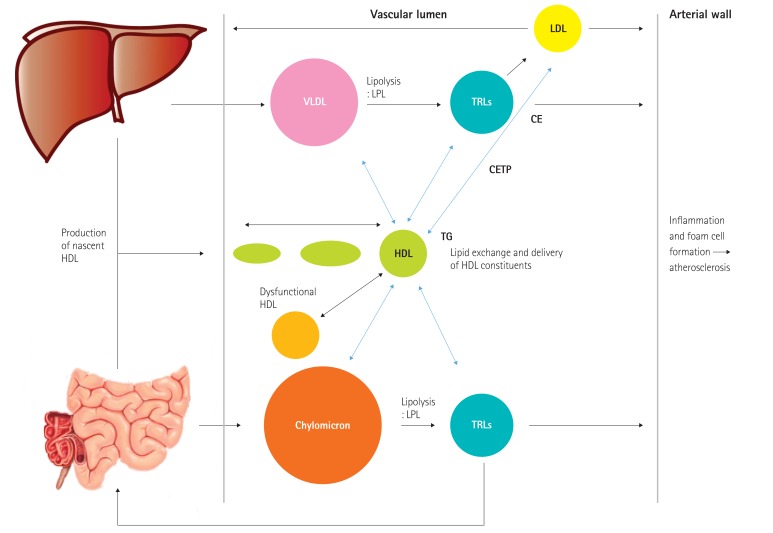
Residual cardiovascular risk and failure of high density lipoprotein cholesterol raising treatment have refocused interest on targeting hypertriglyceridemia. Hypertriglyceridemia, triglyceride-rich lipoproteins, and remnant cholesterol have demonstrated to be important risk factors for cardiovascular disease; this has been demonstrated in experimental, genetic, and epidemiological studies. Fibrates can reduce cardiovascular event rates with or without statins. High dose omega-3 fatty acids continue to be evaluated and new specialized targeting treatment modulating triglyceride pathways, such as inhibition of apolipoprotein C-III and angiopoietin-like proteins, are being tested with regard to their effects on lipid profiles and cardiovascular outcomes. In this review, we will discuss the role of hypertriglyceridemia, triglyceride-rich lipoproteins and remnant cholesterol on cardiovascular disease, and the potential implications for treatment stargeting hypertriglyceridemia.
残余心血管风险以及高密度脂蛋白胆固醇升高治疗的失败,使人们将关注重点重新转向针对高甘油三酯血症。高甘油三酯血症、富含甘油三酯的脂蛋白和残余胆固醇已被证明是心血管疾病的重要危险因素;这在实验、遗传学和流行病学研究中均得到了证实。贝特类药物无论是否与他汀类药物联用,均可降低心血管事件发生率。高剂量ω-3脂肪酸仍在评估中,而调节甘油三酯途径的新型特异性靶向治疗,如抑制载脂蛋白C-III和血管生成素样蛋白,正在就其对血脂谱和心血管结局的影响进行测试。在本综述中,我们将讨论高甘油三酯血症、富含甘油三酯的脂蛋白和残余胆固醇在心血管疾病中的作用,以及针对高甘油三酯血症治疗的潜在意义。