Henning Joerg, Pfeiffer Dirk U, Stevenson Mark, Yulianto Didik, Priyono Walujo, Meers Joanne
School of Veterinary Science, University of Queensland, Gatton, Queensland, Australia.
Royal Veterinary College, University of London, London, United Kingdom.
PLoS One. 2016 Mar 28;11(3):e0152123. doi: 10.1371/journal.pone.0152123. eCollection 2016.
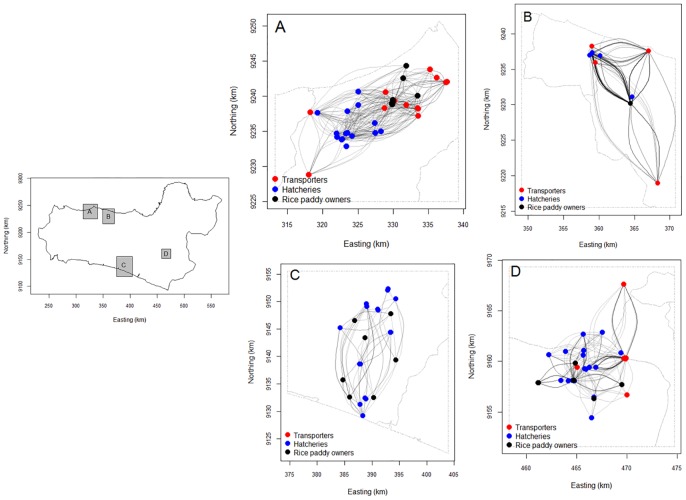
Duck populations are considered to be a reservoir of Highly pathogenic avian influenza (HPAI) virus H5N1 in some agricultural production systems, as they are able to shed the virus for several days without clinical signs. Countries endemically affected with HPAI in Asia are characterised by production systems where ducks are fed on post-harvest spilled rice. During this scavenging process it is common for ducks to come into contact with other duck flocks or wild birds, thereby providing opportunities for virus spread. Effective risk management for HPAI has been significantly compromised by a limited understanding of management of moving duck flocks in these countries, despite of a small number of recent investigations. Here, for the first time, we described the management of moving duck flocks and the structure of the moving duck flock network in quantitative terms so that factors influencing the risk of HPAIV transmission can be identified. By following moving duck flock farmers over a period of 6 months in Java, Indonesia, we were able to describe the movement of flocks and to characterise the network of various types of actors associated with the production system. We used these data to estimate the basic reproductive number for HPAI virus spread. Our results suggest that focussing HPAI prevention measures on duck flocks alone will not be sufficient. Instead, the role of transporters of moving duck flocks, hatcheries and rice paddy owners, in the spread of the HPAI virus needs to be recognised.
在一些农业生产系统中,鸭群被认为是高致病性禽流感(HPAI)病毒H5N1的宿主,因为它们能够在数天内排出病毒而不表现出临床症状。亚洲受HPAI地方流行影响的国家,其生产系统的特点是用收获后的撒落稻谷喂养鸭子。在这种觅食过程中,鸭子经常与其他鸭群或野生鸟类接触,从而为病毒传播提供了机会。尽管最近有一些调查,但由于对这些国家流动鸭群管理的了解有限,HPAI的有效风险管理受到了严重影响。在此,我们首次以定量方式描述了流动鸭群的管理情况以及流动鸭群网络的结构,以便能够识别影响HPAIV传播风险的因素。通过在印度尼西亚爪哇跟踪流动鸭群养殖户6个月,我们得以描述鸭群的流动情况,并刻画与生产系统相关的各类行为主体的网络。我们利用这些数据估算了HPAI病毒传播的基本再生数。我们的结果表明,仅将HPAI预防措施集中在鸭群上是不够的。相反,需要认识到流动鸭群运输者、孵化场和稻田所有者在HPAI病毒传播中的作用。