van de Vijver Steven, Oti Samuel Oji, Gomez Gabriela B, Agyemang Charles, Egondi Thaddaeus, Moll van Charante Eric, Brewster Lizzy M, Hankins Catherine, Tanovic Zlata, Ezeh Alex, Kyobutungi Catherine, Stronks Karien
African Population and Health Research Center, Nairobi, Kenya.
Department of Global Health, Academic Medical Center, University of Amsterdam and Amsterdam Institute for Global Health and Development, Amsterdam, The Netherlands;
Glob Health Action. 2016 Mar 24;9:30922. doi: 10.3402/gha.v9.30922. eCollection 2016.
A combination of increasing urbanization, behaviour change, and lack of health services in slums put the urban poor specifically at risk of cardiovascular disease (CVD). This study aimed to evaluate the impact of a community-based CVD prevention intervention on blood pressure (BP) and other CVD risk factors in a slum setting in Nairobi, Kenya.
Prospective intervention study includes awareness campaigns, household visits for screening, and referral and treatment of people with hypertension. The primary outcome was overall change in mean systolic blood pressure (SBP), while secondary outcomes were changes in awareness of hypertension and other CVD risk factors. We evaluated the intervention's impact through consecutive cross-sectional surveys at baseline and after 18 months, comparing outcomes of intervention and control group, through a difference-in-difference method.
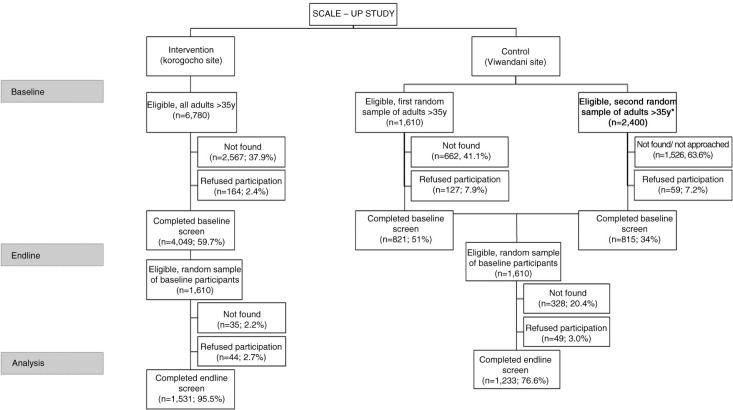
We screened 1,531 and 1,233 participants in the intervention and control sites. We observed a significant reduction in mean SBP when comparing before and after measurements in both intervention and control groups, -2.75 mmHg (95% CI -4.33 to -1.18, p=0.001) and -1.67 mmHg (95% CI -3.17 to -0.17, p=0.029), respectively. Among people with hypertension at baseline, SBP was reduced by -14.82 mmHg (95% CI -18.04 to -11.61, p<0.001) in the intervention and -14.05 (95% CI -17.71 to -10.38, p<0.001) at the control site. However, comparing these two groups, we found no difference in changes in mean SBP or hypertension prevalence.
We found significant declines in SBP over time in both intervention and control groups. However, we found no additional effect of a community-based intervention involving awareness campaigns, screening, referral, and treatment. Possible explanations include the beneficial effect of baseline measurements in the control group on behaviour and related BP levels, and the limited success of treatment and suboptimal adherence in the intervention group.
城市化进程加快、行为方式改变以及贫民窟缺乏医疗服务等因素综合起来,使城市贫困人口尤其面临心血管疾病(CVD)的风险。本研究旨在评估一项基于社区的心血管疾病预防干预措施对肯尼亚内罗毕一个贫民窟地区的血压(BP)及其他心血管疾病风险因素的影响。
前瞻性干预研究包括开展宣传活动、进行家庭筛查访视以及为高血压患者提供转诊和治疗。主要结局是平均收缩压(SBP)的总体变化,次要结局是高血压及其他心血管疾病风险因素知晓率的变化。我们通过在基线时和18个月后进行连续横断面调查,采用差分法比较干预组和对照组的结局,来评估干预措施的影响。
我们在干预点和对照点分别筛查了1531名和1233名参与者。在比较干预组和对照组测量前后的情况时,我们观察到两组的平均收缩压均有显著下降,分别下降了-2.75 mmHg(95%置信区间-4.33至-1.18,p = 0.001)和-1.67 mmHg(95%置信区间-3.17至-0.17,p = 0.029)。在基线时患有高血压的人群中,干预组收缩压下降了-14.82 mmHg(95%置信区间-18.04至-11.61,p < 0.001),对照点收缩压下降了-14.05(95%置信区间-17.71至-10.38,p < 0.001)。然而,比较这两组时,我们发现平均收缩压变化或高血压患病率没有差异。
我们发现干预组和对照组的收缩压随时间均有显著下降。然而,我们发现一项包括宣传活动、筛查、转诊和治疗的基于社区的干预措施没有额外效果。可能的解释包括对照组基线测量对行为及相关血压水平的有益影响,以及干预组治疗效果有限和依从性欠佳。