Oti Samuel Oji, van de Vijver Steven, Gomez Gabriela B, Agyemang Charles, Egondi Thaddaeus, Kyobutungi Catherine, Stronks Karien
African Population and Health Research Center, PO Box 10787-00100, Nairobi, Kenya .
Amsterdam Institute for Global Health and Development, Amsterdam, Netherlands .
Bull World Health Organ. 2016 Jul 1;94(7):501-9. doi: 10.2471/BLT.15.156513. Epub 2016 Apr 26.
To describe the processes, outcomes and costs of implementing a multi-component, community-based intervention for hypertension among adults aged > 35 years in a large slum in Nairobi, Kenya.
The intervention in 2012-2013 was based on four components: awareness-raising; improved access to screening; standardized clinical management of hypertension; and long-term retention in care. Using multiple sources of data, including administrative records and surveys, we described the inputs and outputs of each intervention activity and estimated the outcomes of each component and the impact of the intervention. We also estimated the costs associated with implementation, using a top-down costing approach.
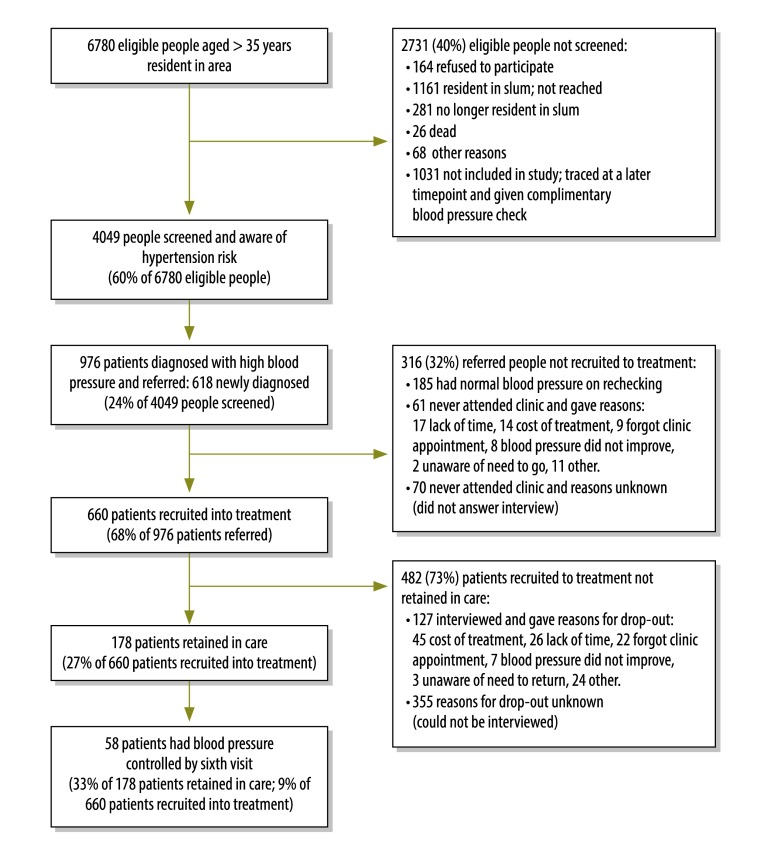
The intervention reached 60% of the target population (4049/6780 people), at a cost of 17 United States dollars (US$) per person screened and provided access to treatment for 68% (660/976) of people referred, at a cost of US$ 123 per person with hypertension who attended the clinic. Of the 660 people who attended the clinic, 27% (178) were retained in care, at a cost of US$ 194 per person retained; and of those patients, 33% (58/178) achieved blood pressure control. The total intervention cost per patient with blood pressure controlled was US$ 3205.
With moderate implementation costs, it was possible to achieve hypertension awareness and treatment levels comparable to those in high-income settings. However, retention in care and blood pressure control were challenges in this slum setting. For patients, the costs and lack of time or forgetfulness were barriers to retention in care.
描述在肯尼亚内罗毕一个大型贫民窟中,针对35岁以上成年人实施多组分社区高血压干预措施的过程、结果及成本。
2012 - 2013年的干预措施基于四个组分:提高认知;改善筛查可及性;高血压标准化临床管理;以及长期维持治疗。利用包括行政记录和调查在内的多种数据来源,我们描述了每项干预活动的投入和产出,并估计了每个组分的结果以及干预措施的影响。我们还采用自上而下的成本核算方法估计了实施相关成本。
该干预措施覆盖了60%的目标人群(4049/6780人),筛查每人成本为17美元,为68%(660/976)转诊者提供了治疗,到诊所就诊的高血压患者每人成本为123美元。在660名到诊所就诊的患者中,27%(178人)维持了治疗,维持治疗每人成本为194美元;在这些患者中,33%(58/178)实现了血压控制。血压得到控制的每位患者的总干预成本为3205美元。
尽管实施成本适中,但有可能实现与高收入环境相当的高血压认知和治疗水平。然而,在这个贫民窟环境中,维持治疗和血压控制是挑战。对患者而言,成本以及时间不足或遗忘是维持治疗的障碍。