Kaczmarek Marlena C, Ware Robert S, Coulthard Mark G, McEniery Julie, Lambert Stephen B
Child Health Research Centre, School of Medicine, The University of Queensland, Brisbane, Australia.
The University of Queensland, School of Public Health, Brisbane, Australia.
PLoS One. 2016 Mar 29;11(3):e0152305. doi: 10.1371/journal.pone.0152305. eCollection 2016.
Influenza virus predictably causes an annual epidemic resulting in a considerable burden of illness in Australia. Children are disproportionately affected and can experience severe illness and complications, which occasionally result in death.
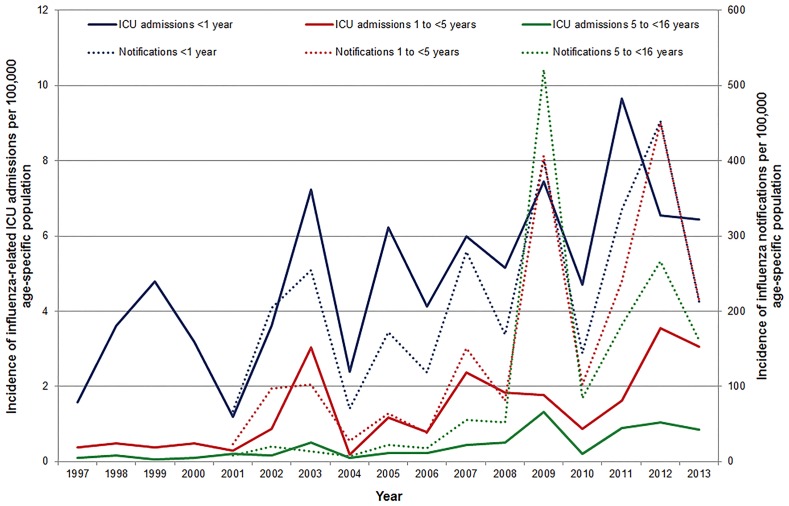
We conducted a retrospective descriptive study using data collated in the Australian and New Zealand Paediatric Intensive Care (ANZPIC) Registry of influenza-related intensive care unit (ICU) admissions over a 17-year period (1997-2013, inclusive) in children <16 years old. National laboratory-confirmed influenza notifications were used for comparison.
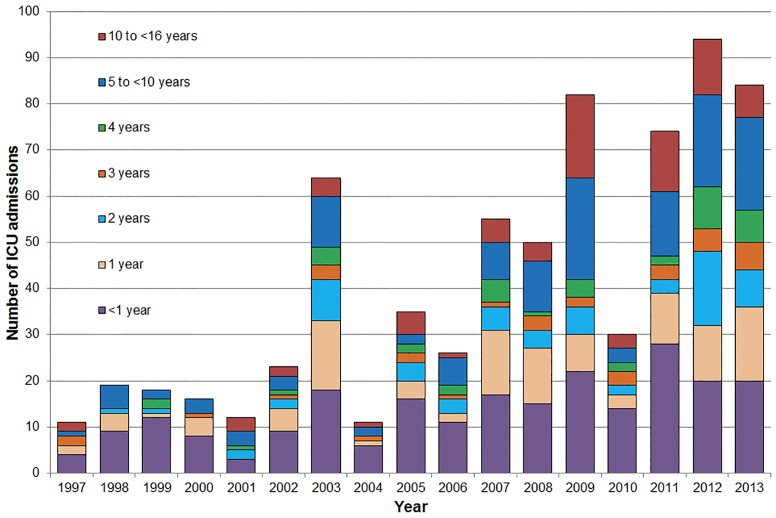
Between 1997 and 2013, a total of 704 influenza-related ICU admissions were recorded, at a rate of 6.2 per 1,000 all-cause ICU admissions. Age at admission ranged from 0 days and 15.9 years (median = 2.1 years), with 135 (19.2%) aged <6 months. Pneumonia/pneumonitis and bronchiolitis were the most common primary diagnoses among influenza-related admissions (21.9% and 13.6%, respectively). More than half of total cases (59.2%) were previously healthy (no co-morbidities recorded), and in the remainder, chronic lung disease (16.7%) and asthma (12.5%) were the most common co-morbidities recorded. Pathogen co-detection occurred in 24.7% of cases, most commonly with respiratory syncytial virus or a staphylococcal species. Median length of all ICU admissions was 3.2 days (range 2.0 hours- 107.4 days) and 361 (51.3%) admissions required invasive respiratory support for a median duration of 4.3 days (range 0.2 hours- 107.5 days). There were 27 deaths recorded, 14 (51.9%) in children without a recorded co-morbidity.
Influenza causes a substantial number of ICU admissions in Australian children each year with the majority occurring in previously healthy children.
流感病毒每年都会引发疫情,给澳大利亚带来相当大的疾病负担。儿童受影响尤为严重,可能会患上重病并出现并发症,偶尔还会导致死亡。
我们进行了一项回顾性描述性研究,使用了澳大利亚和新西兰儿科重症监护(ANZPIC)登记处整理的17年间(1997年至2013年,含)16岁以下儿童流感相关重症监护病房(ICU)入院数据。将全国实验室确诊的流感通报用于比较。
1997年至2013年期间,共记录了704例与流感相关的ICU入院病例,占所有病因导致的ICU入院病例的比例为每1000例中有6.2例。入院年龄从0天至15.9岁(中位数=2.1岁),其中135例(19.2%)年龄小于6个月。肺炎/肺炎性病变和细支气管炎是流感相关入院病例中最常见的主要诊断(分别为21.9%和13.6%)。超过一半的病例(59.2%)此前健康(未记录合并症),其余病例中,慢性肺病(16.7%)和哮喘(12.5%)是最常见的合并症。24.7%的病例检测到病原体合并感染,最常见的是呼吸道合胞病毒或葡萄球菌属。所有ICU入院病例的中位住院时间为3.2天(范围为2.0小时至107.4天),361例(51.3%)入院病例需要有创呼吸支持,中位持续时间为4.3天(范围为0.2小时至107.5天)。记录到27例死亡病例,其中14例(51.9%)为无合并症记录的儿童。
流感每年导致大量澳大利亚儿童入住ICU,大多数病例发生在之前健康的儿童中。