Feng Chunsheng, Luo Tianfei, Zhang Shuyan, Liu Kai, Zhang Yanhong, Luo Yinan, Ge Pengfei
Department of Anesthesiology, First Hospital of Jilin University, Changchun, Jilin 130021, P.R. China.
Department of Neurology, First Hospital of Jilin University, Changchun, Jilin 130021, P.R. China.
Mol Med Rep. 2016 May;13(5):4205-14. doi: 10.3892/mmr.2016.5056. Epub 2016 Mar 28.
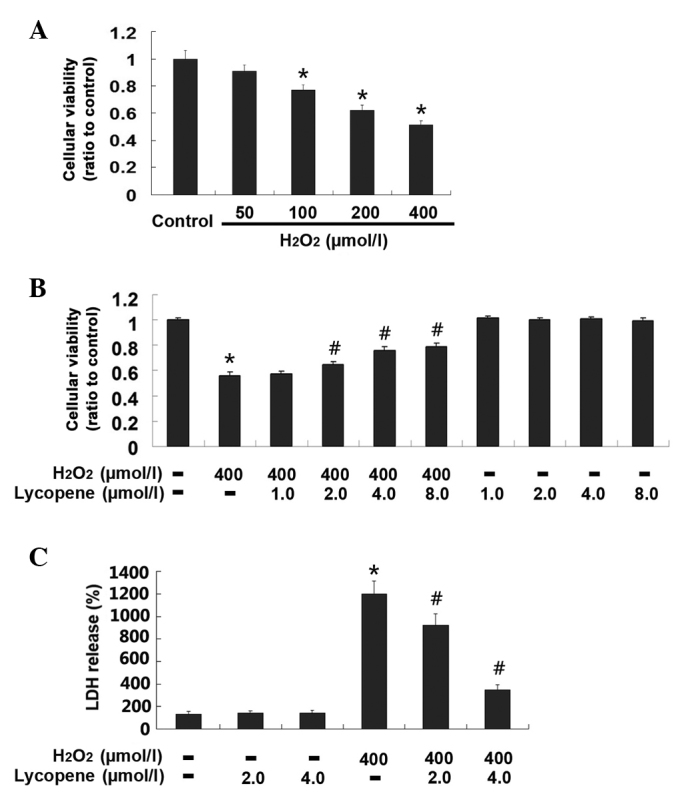
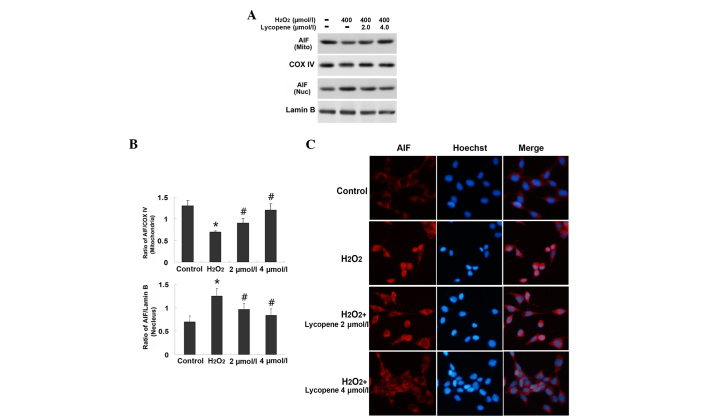
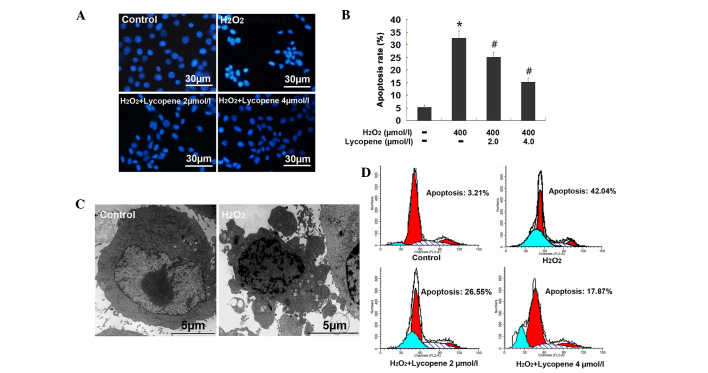
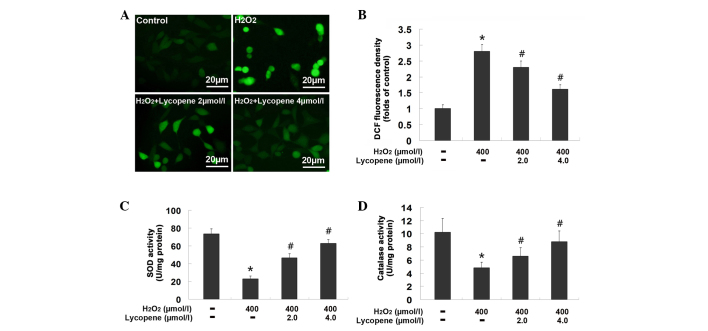
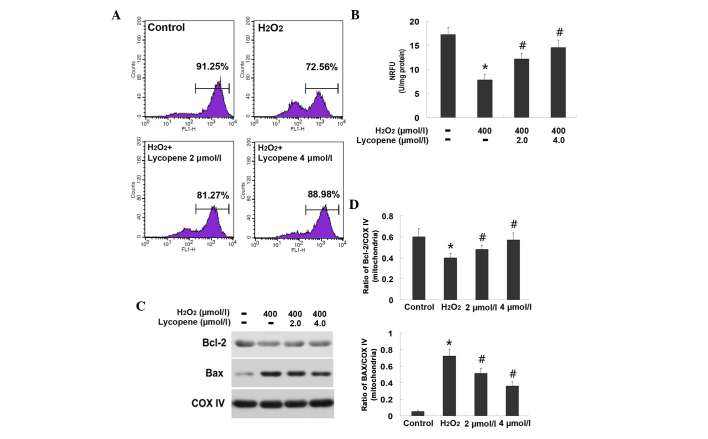
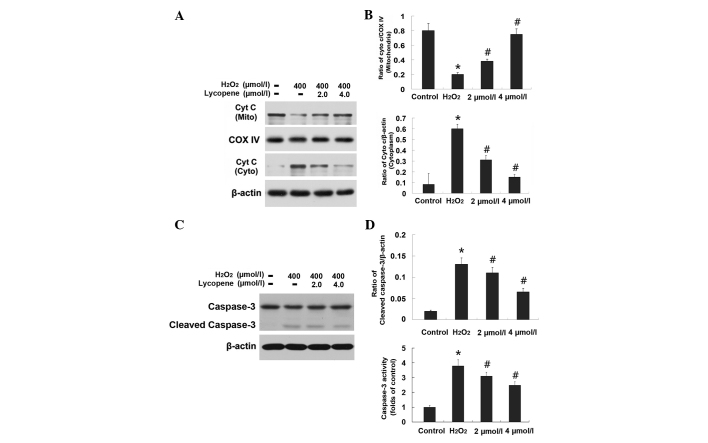
Oxidative stress, which is characterized by excessive production of reactive oxygen species (ROS), is a common pathway that results in neuronal injury or death due to various types of pathological stress. Although lycopene has been identified as a potent antioxidant, its effect on hydrogen peroxide (H2O2)‑induced neuronal damage remains unclear. In the present study, pretreatment with lycopene was observed to protect SH‑SY5Y neuroblastoma cells against H2O2‑induced death via inhibition of apoptosis resulting from activation of caspase‑3 and translocation of apoptosis inducing factor (AIF) to the nucleus. Furthermore, the over‑produced ROS, as well as the reduced activities of anti‑oxidative enzymes, superoxide dismutase and catalase, were demonstrated to be alleviated by lycopene. Additionally, lycopene counteracted H2O2‑induced mitochondrial dysfunction, which was evidenced by suppression of mitochondrial permeability transition pore opening, attenuation of the decline of the mitochondrial membrane potential, and inhibition of the increase of Bax and decrease of Bcl‑2 levels within the mitochondria. The release of cytochrome c and AIF from the mitochondria was also reduced. These results indicate that lycopene is a potent neuroprotectant against apoptosis, oxidative stress and mitochondrial dysfunction, and could be administered to prevent neuronal injury or death.
氧化应激以活性氧(ROS)的过度产生为特征,是由于各种类型的病理应激导致神经元损伤或死亡的常见途径。尽管番茄红素已被确定为一种有效的抗氧化剂,但其对过氧化氢(H2O2)诱导的神经元损伤的影响仍不清楚。在本研究中,观察到用番茄红素预处理可通过抑制由半胱天冬酶-3激活和凋亡诱导因子(AIF)转位至细胞核所导致的凋亡,来保护SH-SY5Y神经母细胞瘤细胞免受H2O2诱导的死亡。此外,番茄红素可减轻过量产生的ROS以及抗氧化酶超氧化物歧化酶和过氧化氢酶活性的降低。此外,番茄红素可对抗H2O2诱导的线粒体功能障碍,这表现为线粒体通透性转换孔开放的抑制、线粒体膜电位下降的减轻以及线粒体中Bax增加和Bcl-2水平降低的抑制。线粒体细胞色素c和AIF的释放也减少。这些结果表明,番茄红素是一种有效的抗凋亡、抗氧化应激和线粒体功能障碍的神经保护剂,可用于预防神经元损伤或死亡。