Bassah Nahyeni, Cox Karen, Seymour Jane
School of Health Sciences, University of Nottingham, Queen's Medical Centre, Nottingham, UK.
BMC Palliat Care. 2016 Mar 31;15:37. doi: 10.1186/s12904-016-0106-7.
Current evidence suggests that palliative care education can improve preregistration nursing students' competencies in palliative care. However, it is not known whether these competencies are translated into students' practice in the care of patients who are approaching the end of life. This paper seeks to contribute to the palliative care evidence base by examining how nursing students in receipt of education report transfer of learning to practice, and what the barriers and facilitators may be, in a resource-poor country.
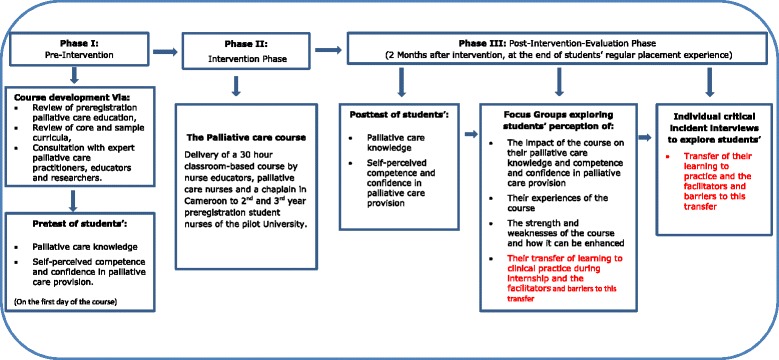
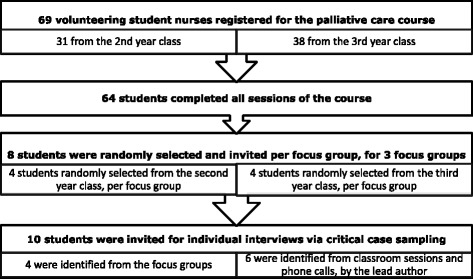
We utilised focus groups and individual critical incident interviews to explore nursing students' palliative care learning transfer. Three focus groups, consisting of 23 participants and 10 individual critical incident interviews were conducted with preregistration nursing student who had attended a palliative care course in Cameroon and had experience caring for a patient approaching the end of life. Data was analysed thematically, using the framework approach.
The results suggest that nursing students in receipt of palliative care education can transfer their learning to practice. Students reported recognizing patients with palliative care needs, providing patients with physical, psychosocial and spiritual support and communicating patient information to the wider care team. They did however perceive some barriers to this transfer which were either related to themselves, qualified nurses, the practice setting or family caregivers and patients.
The findings from this study suggest that nursing student in receipt of palliative care education can use their learning in practice to provide care to patients and their families approaching the end of life. Nevertheless, these findings need to be treated with some caution given the self-reported nature of the data. Demonstrating the link between preregistration palliative care education and patient care is vital to ensuring that newly acquired knowledge and skills are translated and embedded into clinical practice. This study also has implications for advocating for palliative care policies and adequately preparing clinical placement sites for students' learning and transfer of learning.
目前的证据表明,姑息治疗教育可以提高预注册护理专业学生在姑息治疗方面的能力。然而,尚不清楚这些能力是否会转化为学生在照顾临终患者时的实际操作。本文旨在通过研究在资源匮乏国家接受教育的护理专业学生如何报告学习向实践的转化,以及可能存在的障碍和促进因素,为姑息治疗证据库做出贡献。
我们利用焦点小组和个人关键事件访谈来探索护理专业学生的姑息治疗学习转化情况。对喀麦隆参加过姑息治疗课程且有照顾临终患者经验的预注册护理专业学生进行了3个焦点小组讨论(共23名参与者)和10次个人关键事件访谈。使用框架法对数据进行了主题分析。
结果表明,接受姑息治疗教育的护理专业学生能够将所学知识转化为实践。学生们报告称,他们能够识别有姑息治疗需求的患者,为患者提供身体、心理社会和精神支持,并将患者信息传达给更广泛的护理团队。然而,他们确实意识到这种转化存在一些障碍,这些障碍与他们自己、合格护士、实践环境或家庭护理人员及患者有关。
本研究结果表明,接受姑息治疗教育的护理专业学生可以在实践中运用所学知识为临终患者及其家人提供护理。然而,鉴于数据的自我报告性质,这些发现需要谨慎对待。证明预注册姑息治疗教育与患者护理之间的联系对于确保新获得的知识和技能转化并融入临床实践至关重要。本研究还对倡导姑息治疗政策以及为学生的学习和学习转化充分准备临床实习地点具有启示意义。