Paltsev Mikhail, Kiselev Vsevolod, Drukh Vadim, Muyzhnek Ekaterina, Kuznetsov Igor, Andrianova Evgeniya, Baranovskiy Pavel
National Research Centre (NRC "Kurchatov Institute"), 1, Akademika Kurchatova Pl., Moscow, 123182 Russia.
Peoples' Friendship University of Russia, Miklukho-Maklaya St., 6, Moscow, 117198 Russia.
EPMA J. 2016 Apr 2;7(1):5. doi: 10.1186/s13167-016-0057-3. eCollection 2016.
Targeted pharmacological correction is used extensively in medical practice today. 3,3'-Diindolylmethane (DIM) is known as a substance with various anticancer properties. An interim study of the efficacy of a new drug Infemin on the basis of diindolylmethane (DIM) with improved bioavalability has been conducted.
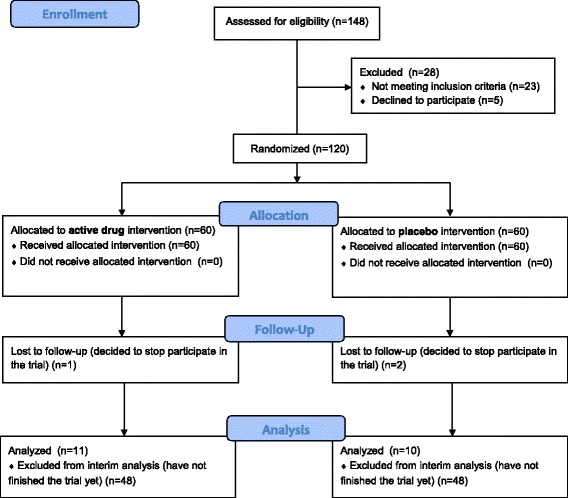
The clinical trial had a multicenter, randomized, placebo-controlled, double-blind design and was carried out in two parallel groups. The interim analysis of data included 21 patients diagnosed with a high-grade prostatic intraepithelial neoplasia (PIN). Group 1 (11 patients) received Infemin in a dose of 900 mg of DIM a day, and group 2 (10 patients) received placebo. To assess the efficacy of therapy, the analysis of morphological index (MI) changes based on the results of histological examinations of prostate biopsy specimens was performed, and a proportion of patients with persistent PIN in 12 months after Infemin initiation was calculated. Researchers also evaluated prostate size, urodynamic parameters (Qmax, Qave, Vres), IPSS, and QoL (quality of life) indices and International Index of Erectile Function (IIEF) at 3, 6, 9, and 12 months after the Infemin administration start.
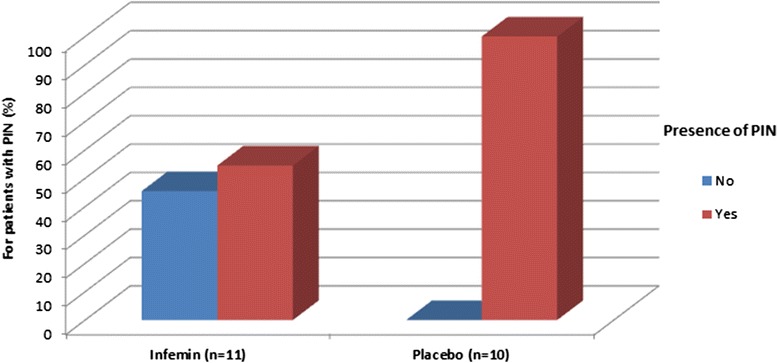
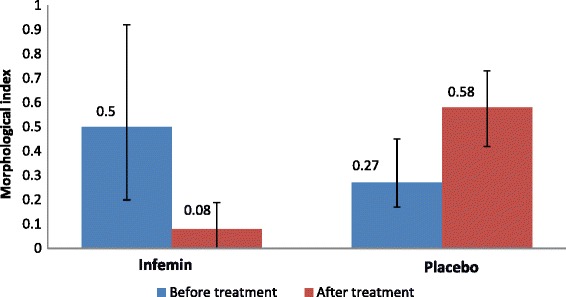
After 12 months of treatment in the Infemin group, MI decreased from 0.50 to 0.08, while in the placebo group, it increased from 0.27 to 0.58; the difference between the groups was statistically significant (p = 0.0003, Mann-Whitney test). In 45.5 % of patients in the Infemin group, a complete regression of PIN was also observed, while in the placebo group, PIN regression was not observed in any patients (p = 0.053, Yates' corrected chi-square). Study results in the Infemin group show improvement of maximal urinary flow rate Qmax (53.3 % increase compared to the initial value); however, the statistical significance was not reached (p = 0.180, Mann-Whitney test) due to the small sample size. Evaluation of other urodynamic parameters, prostate volume, quality of life, symptoms reflecting urination disorder, and erectile dysfunction symptoms did not reveal significant differences between the Infemin and placebo groups either which is probably due to the small sample size.
The intermediate results of the 21 patients in this multicenter, randomized, placebo-controlled, double-blind study show that Infemin may be a promising drug candidate in patients with high-grade PIN.
靶向药理纠正如今在医学实践中被广泛应用。3,3'-二吲哚基甲烷(DIM)是一种具有多种抗癌特性的物质。已开展一项基于二吲哚基甲烷(DIM)且生物利用度得到改善的新药Infemin疗效的中期研究。
该临床试验采用多中心、随机、安慰剂对照、双盲设计,分为两个平行组进行。数据的中期分析纳入了21例被诊断为高级别前列腺上皮内瘤变(PIN)的患者。第1组(11例患者)每天接受900毫克DIM剂量的Infemin治疗,第2组(10例患者)接受安慰剂治疗。为评估治疗效果,基于前列腺活检标本的组织学检查结果对形态学指数(MI)变化进行分析,并计算Infemin开始治疗12个月后持续存在PIN的患者比例。研究人员还在Infemin给药开始后的3、6、9和12个月评估了前列腺大小、尿动力学参数(最大尿流率Qmax、平均尿流率Qave、残余尿量Vres)、国际前列腺症状评分(IPSS)、生活质量(QoL)指数以及国际勃起功能指数(IIEF)。
Infemin组治疗12个月后,MI从0.50降至0.08,而安慰剂组则从0.27升至0.58;两组间差异具有统计学意义(p = 0.0003,曼-惠特尼检验)。Infemin组45.5%的患者还观察到PIN完全消退,而安慰剂组无任何患者出现PIN消退(p = 0.053,耶茨校正卡方检验)。Infemin组的研究结果显示最大尿流率Qmax有所改善(相较于初始值增加了53.3%);然而,由于样本量小,未达到统计学显著性(p = 0.180,曼-惠特尼检验)。对其他尿动力学参数、前列腺体积、生活质量、反映排尿障碍的症状以及勃起功能障碍症状的评估也未显示Infemin组与安慰剂组之间存在显著差异,这可能也是由于样本量小所致。
这项多中心、随机、安慰剂对照、双盲研究中21例患者的中期结果表明,Infemin可能是高级别PIN患者中有前景的候选药物。