Neckerman Kathryn M, Garfinkel Irwin, Teitler Julien O, Waldfogel Jane, Wimer Christopher
Columbia Population Research Center, Columbia University School of Social Work, New York, NY.
Columbia Population Research Center, Columbia University School of Social Work, New York, NY.
Acad Pediatr. 2016 Apr;16(3 Suppl):S52-9. doi: 10.1016/j.acap.2016.01.015.
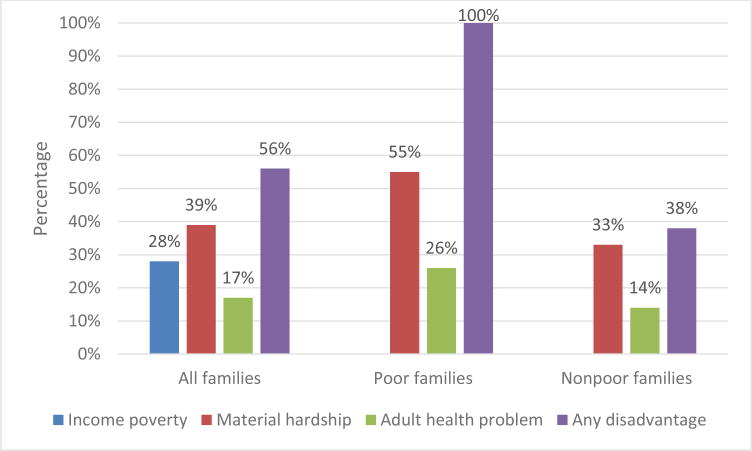
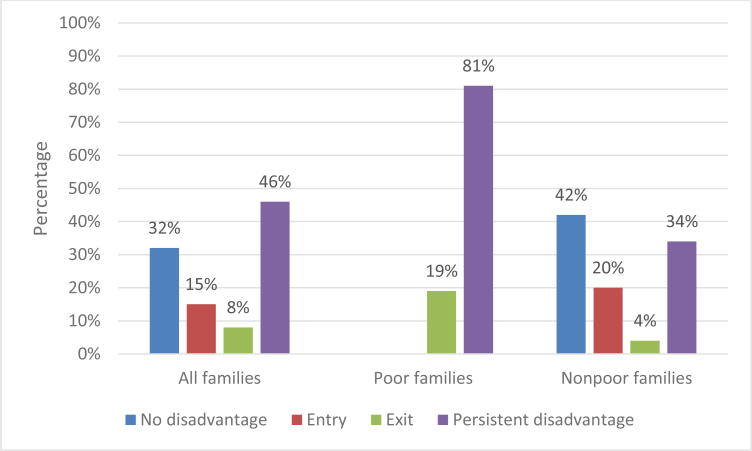
The New York City (NYC) Longitudinal Study of Wellbeing, or "Poverty Tracker," is a survey of approximately 2300 NYC residents. Its purpose is to provide a multidimensional and dynamic understanding of economic disadvantage in NYC. Measures of disadvantage were collected at baseline and a 12-month follow-up, and include 3 types of disadvantage: 1) income poverty, using a measure on the basis of the new Supplemental Poverty Measure; 2) material hardship, including indicators of food insecurity, housing hardship, unmet medical needs, utility cutoffs, and financial insecurity; and 3) adult health problems, which can drain family time and resources. In this article initial results for NYC families with children younger than the age of 18 years are presented. At baseline, 56% of families with children had 1 or more type of disadvantage, including 28% with income poverty, 39% with material hardship, and 17% with an adult health problem. Even among nonpoor families, 33% experienced material hardship and 14% reported an adult health problem. Two-thirds of all families faced disadvantage at either baseline or follow-up, with 46% experiencing some kind of disadvantage at both time points. Respondents with a college education were much less likely to face disadvantage. Even after adjusting for educational attainment and family characteristics, the families of black and Hispanic respondents had increased rates of disadvantage. Considering income poverty alone the extent of disadvantage among families with children in NYC is greatly understated. These results suggest that in addition to addressing income poverty, policymakers should give priority to efforts to reduce material hardship and help families cope with chronic physical or mental illness. The need for these resources extends far above the poverty line.
纽约市幸福纵向研究,即“贫困追踪器”,是一项针对约2300名纽约市居民的调查。其目的是对纽约市的经济劣势进行多维度、动态的了解。在基线和12个月随访时收集了劣势衡量指标,包括3种劣势类型:1)收入贫困,采用基于新补充贫困衡量标准的指标;2)物质困难,包括粮食不安全、住房困难、未满足的医疗需求、公用事业中断和财务不安全等指标;3)成人健康问题,这可能消耗家庭时间和资源。本文展示了针对有18岁以下子女的纽约市家庭的初步结果。在基线时,56%有子女的家庭存在1种或更多类型的劣势,其中28%有收入贫困,39%有物质困难,17%有成人健康问题。即使在非贫困家庭中,33%经历了物质困难,14%报告有成人健康问题。三分之二的家庭在基线或随访时面临劣势,46%在两个时间点都经历了某种劣势。受过大学教育的受访者面临劣势的可能性要小得多。即使在调整了教育程度和家庭特征之后,黑人和西班牙裔受访者的家庭劣势发生率仍有所上升。仅考虑收入贫困,纽约市有子女家庭的劣势程度被大大低估了。这些结果表明,除了解决收入贫困问题外,政策制定者还应优先努力减少物质困难,并帮助家庭应对慢性身体或精神疾病。对这些资源的需求远远超出了贫困线。