Lee Sonny T M, Davy Simon K, Tang Sen-Lin, Kench Paul S
School of Environment, The University of Auckland Auckland, New Zealand.
School of Biological Sciences, Victoria University of Wellington Wellington, New Zealand.
Front Microbiol. 2016 Mar 24;7:371. doi: 10.3389/fmicb.2016.00371. eCollection 2016.
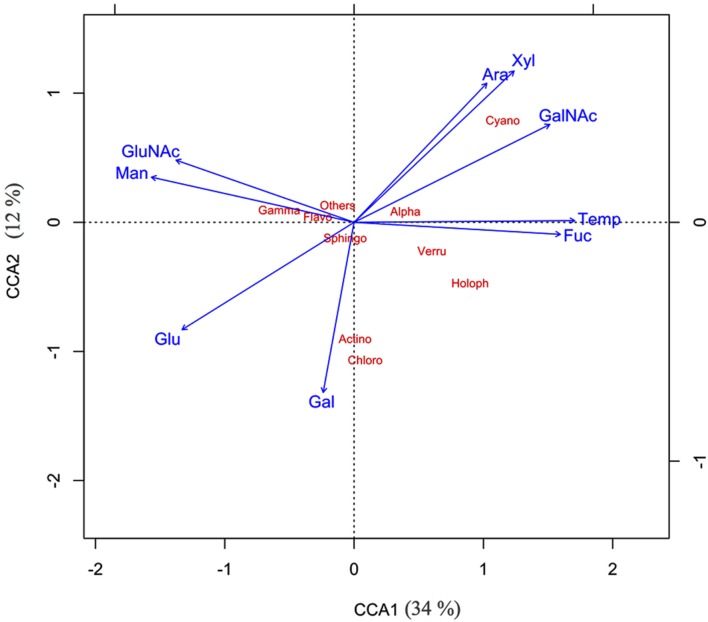
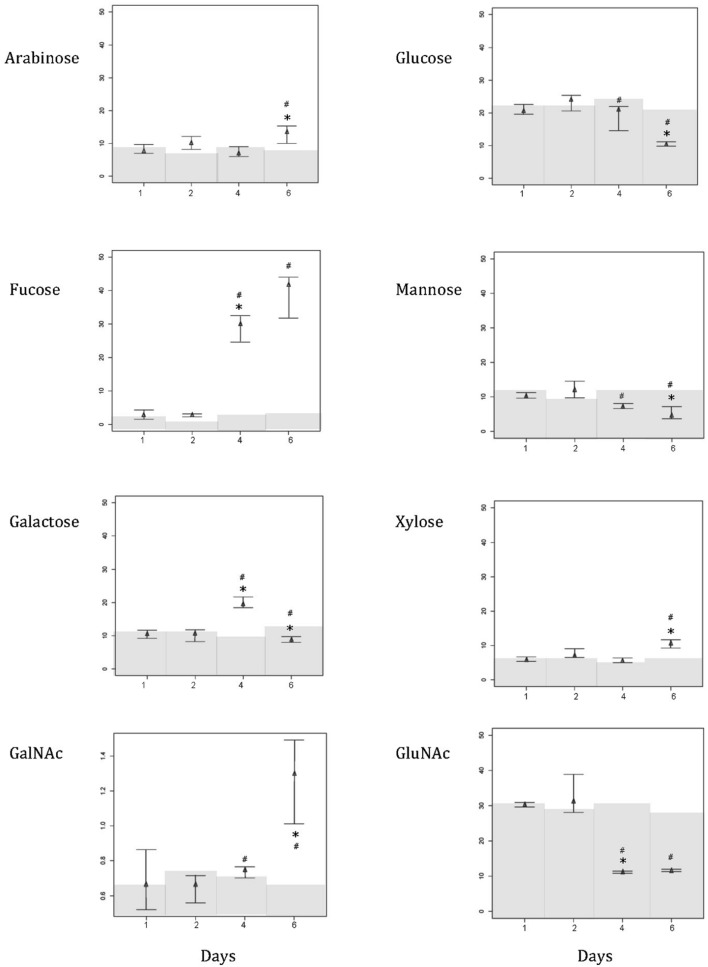
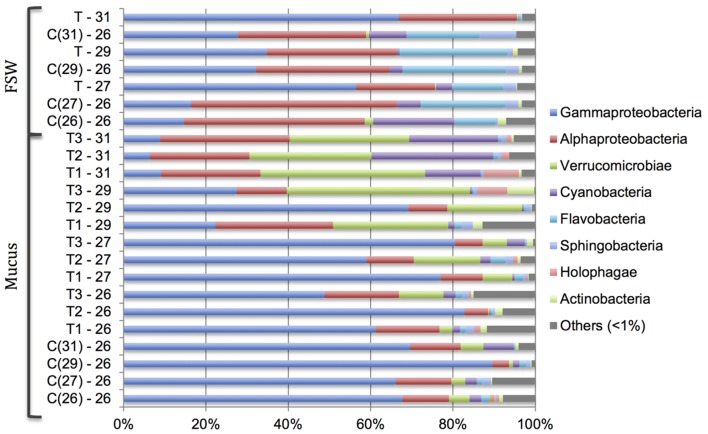
It has been proposed that the chemical composition of a coral's mucus can influence the associated bacterial community. However, information on this topic is rare, and non-existent for corals that are under thermal stress. This study therefore compared the carbohydrate composition of mucus in the coral Acropora muricata when subjected to increasing thermal stress from 26 to 31°C, and determined whether this composition correlated with any changes in the bacterial community. Results showed that, at lower temperatures, the main components of mucus were N-acetyl glucosamine and C6 sugars, but these constituted a significantly lower proportion of the mucus in thermally stressed corals. The change in the mucus composition coincided with a shift from a γ-Proteobacteria- to a Verrucomicrobiae- and α-Proteobacteria-dominated community in the coral mucus. Bacteria in the class Cyanobacteria also started to become prominent in the mucus when the coral was thermally stressed. The increase in the relative abundance of the Verrucomicrobiae at higher temperature was strongly associated with a change in the proportion of fucose, glucose, and mannose in the mucus. Increase in the relative abundance of α-Proteobacteria were associated with GalNAc and glucose, while the drop in relative abundance of γ-Proteobacteria at high temperature coincided with changes in fucose and mannose. Cyanobacteria were highly associated with arabinose and xylose. Changes in mucus composition and the bacterial community in the mucus layer occurred at 29°C, which were prior to visual signs of coral bleaching at 31°C. A compositional change in the coral mucus, induced by thermal stress could therefore be a key factor leading to a shift in the associated bacterial community. This, in turn, has the potential to impact the physiological function of the coral holobiont.
有人提出,珊瑚黏液的化学成分会影响其相关细菌群落。然而,关于这一主题的信息很少,对于处于热应激状态下的珊瑚来说更是不存在。因此,本研究比较了鹿角珊瑚在26至31°C热应激增加时黏液中的碳水化合物组成,并确定这种组成是否与细菌群落的任何变化相关。结果表明,在较低温度下,黏液的主要成分是N-乙酰葡糖胺和C6糖,但在热应激珊瑚的黏液中,这些成分所占比例显著降低。黏液组成的变化与珊瑚黏液中从以γ-变形菌为主的群落向疣微菌门和α-变形菌为主的群落转变相吻合。当珊瑚受到热应激时,蓝细菌纲的细菌在黏液中也开始变得突出。疣微菌门在较高温度下相对丰度的增加与黏液中岩藻糖、葡萄糖和甘露糖比例的变化密切相关。α-变形菌相对丰度的增加与N-乙酰半乳糖胺和葡萄糖有关,而γ-变形菌在高温下相对丰度的下降与岩藻糖和甘露糖的变化相吻合。蓝细菌与阿拉伯糖和木糖高度相关。黏液组成和黏液层中细菌群落的变化发生在29°C,这早于31°C时珊瑚白化的可见迹象。因此,热应激引起的珊瑚黏液组成变化可能是导致相关细菌群落转变的关键因素。反过来,这有可能影响珊瑚共生体的生理功能。