Pónyai Györgyi, Németh Ilona, Temesvári Erzsébet
Department of Dermatology, Venereology and Dermatooncology, Semmelweis University, Budapest 1085, Hungary.
Dermatol Res Pract. 2016;2016:4579071. doi: 10.1155/2016/4579071. Epub 2016 Mar 7.
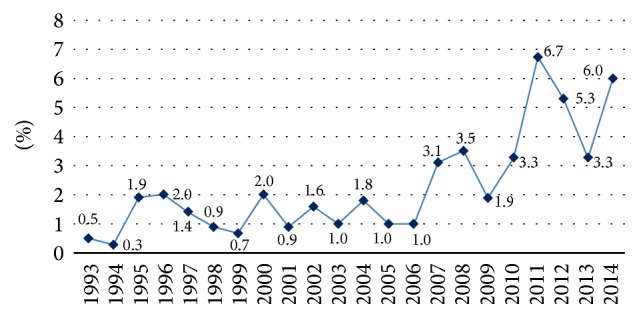
Background. Due to allowing of methylisothiazolinone (MI) in cosmetics, cleaning products, and paints, an epidemic of MI-hypersensitivity emerged. Patch testing Kathon CG® (3:1 mixture of methylchloroisothiazolinone and methylisothiazolinone, MCI/MI) does not correctly detect MI contact allergy, due to the low concentration of MI in the test material. Methods. A retrospective survey was performed to estimate the prevalence of MCI/MI hypersensitivity in 14693 patients tested consecutively between 1993 and 2014. Moreover, currently 314 patients were prospectively tested with the allergens MCI/MI and with MI during one year. Results. MCI/MI hypersensitivity increased retrospectively from 0.5% to 6.0%. By current prospective testing we detected 25 patients (8%) with MCI/MI and/or MI positive reactions. Out of the 25 patients 10 were only MCI/MI positive, 9 were only MI positive, and 6 were MCI/MI and MI positive. If MI had not been tested separately, MI contact allergy would have missed in 36% of all detected cases and in 2.8% of the total 314 patients. Conclusions. The frequency of MCI/MI hypersensitivity is increasing also in Hungary. We confirm that, in order to detect MI contact allergy, it needs to be tested separately. A further increase of MI hypersensitivity might be expected in the future as products containing MI are still widely available.
背景。由于化妆品、清洁产品和油漆中允许使用甲基异噻唑啉酮(MI),出现了MI超敏反应的流行。由于测试材料中MI浓度较低,对凯松CG®(甲基氯异噻唑啉酮和甲基异噻唑啉酮的3:1混合物,MCI/MI)进行斑贴试验不能正确检测MI接触性过敏。方法。进行了一项回顾性调查,以估计1993年至2014年间连续检测的14693例患者中MCI/MI超敏反应的患病率。此外,目前对314例患者进行了为期一年的前瞻性过敏原MCI/MI和MI检测。结果。回顾性分析显示,MCI/MI超敏反应从0.5%增加到6.0%。通过当前的前瞻性检测,我们发现25例患者(8%)对MCI/MI和/或MI有阳性反应。在这25例患者中,10例仅对MCI/MI呈阳性,9例仅对MI呈阳性,6例对MCI/MI和MI均呈阳性。如果未单独检测MI,在所有检测出的病例中,36%的MI接触性过敏将会漏诊,在314例患者总数中,2.8%的患者会漏诊。结论。在匈牙利,MCI/MI超敏反应的发生率也在增加。我们证实,为了检测MI接触性过敏,需要单独进行检测。由于含有MI的产品仍然广泛存在,预计未来MI超敏反应会进一步增加。