Suraweera Chathurie, de Silva Varuni, Hanwella Raveen
University Psychological Medicine Unit, National Hospital of Sri Lanka, Colombo, Sri Lanka.
Department of Psychological Medicine, Faculty of Medicine, Kynsey Road, Colombo 8, Sri Lanka.
J Med Case Rep. 2016 Apr 5;10:83. doi: 10.1186/s13256-016-0877-8.
Simvastatin is commonly prescribed for hypercholesterolemia to reduce vascular risk in patients. Some of these patients have dementia with cognitive defects of several domains. Although protective effects seem to be present, there is emerging evidence that statins cause cognitive impairment. The role of cholesterol in cognitive function is complex. This is reflected in the effects that statins show on cognition functions. The reduction in cholesterol levels seen with statins is effective in improving learning and memory in some patients. However, there is emerging evidence that statins may worsen cognitive function. Similarly, there are major concerns over whether statins alleviate or worsen cognitive problems. The correlation between cholesterol levels and cognitive function is still controversial, mainly due to a lack of robust evidence.
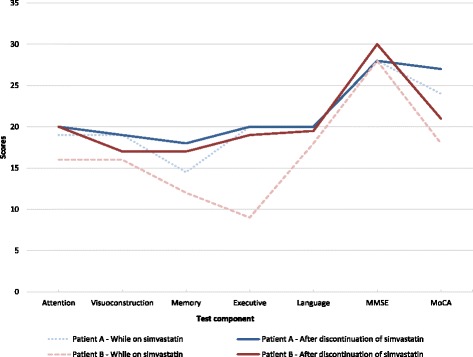
We report the cases of two Asian patients who developed cognitive deficits after starting simvastatin. A 32-year-old man and a 54-year-old woman developed different but clear cognitive deficits that reversed after stopping simvastatin.
The possibility of new-onset cognitive dysfunction and the deterioration of existing cognitive deficits should be considered when prescribing simvastatin to patients.
辛伐他汀常用于治疗高胆固醇血症,以降低患者的血管风险。这些患者中有一些患有痴呆症,存在多个领域的认知缺陷。尽管似乎存在保护作用,但越来越多的证据表明他汀类药物会导致认知障碍。胆固醇在认知功能中的作用很复杂。这反映在他汀类药物对认知功能的影响上。他汀类药物使胆固醇水平降低,在一些患者中对改善学习和记忆有效。然而,越来越多的证据表明他汀类药物可能会使认知功能恶化。同样,对于他汀类药物是缓解还是加重认知问题也存在重大担忧。胆固醇水平与认知功能之间的相关性仍存在争议,主要是由于缺乏有力证据。
我们报告了两名亚洲患者在开始服用辛伐他汀后出现认知缺陷的病例。一名32岁男性和一名54岁女性出现了不同但明显的认知缺陷,在停用辛伐他汀后这些缺陷得到了逆转。
在给患者开辛伐他汀处方时,应考虑新发认知功能障碍以及现有认知缺陷恶化的可能性。