Kang Junsu, Hu Jianxin, Karra Ravi, Dickson Amy L, Tornini Valerie A, Nachtrab Gregory, Gemberling Matthew, Goldman Joseph A, Black Brian L, Poss Kenneth D
Department of Cell Biology, Duke University Medical Center, Durham, North Carolina 27710, USA.
Cardiovascular Research Institute, University of California, San Francisco, San Francisco, California 94143, USA.
Nature. 2016 Apr 14;532(7598):201-6. doi: 10.1038/nature17644. Epub 2016 Apr 6.
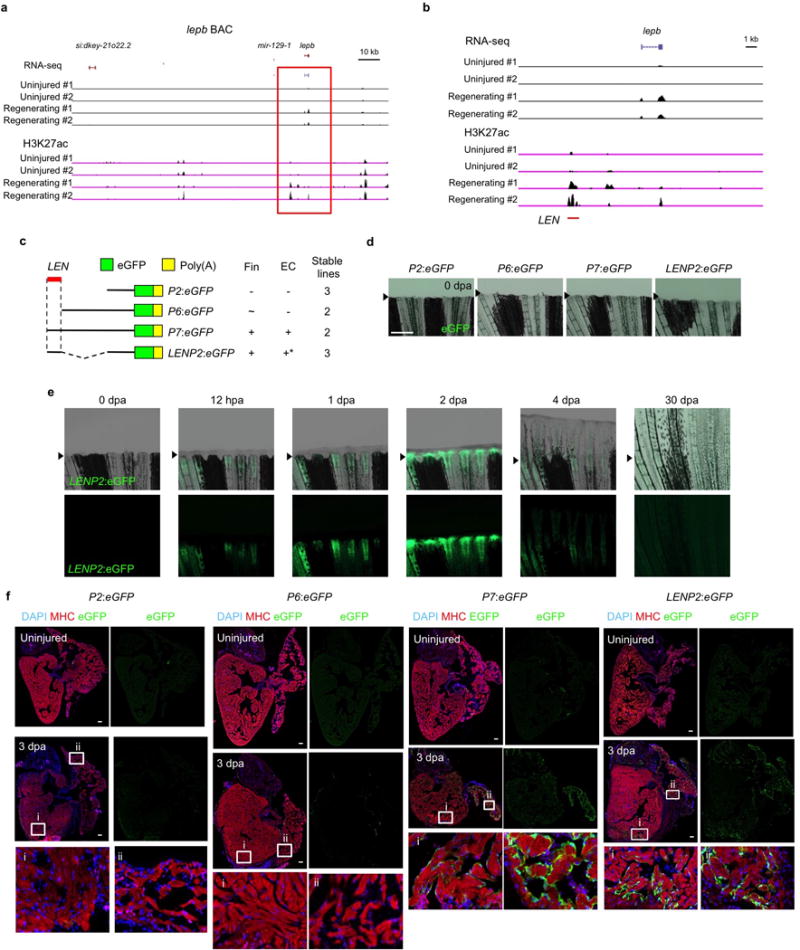
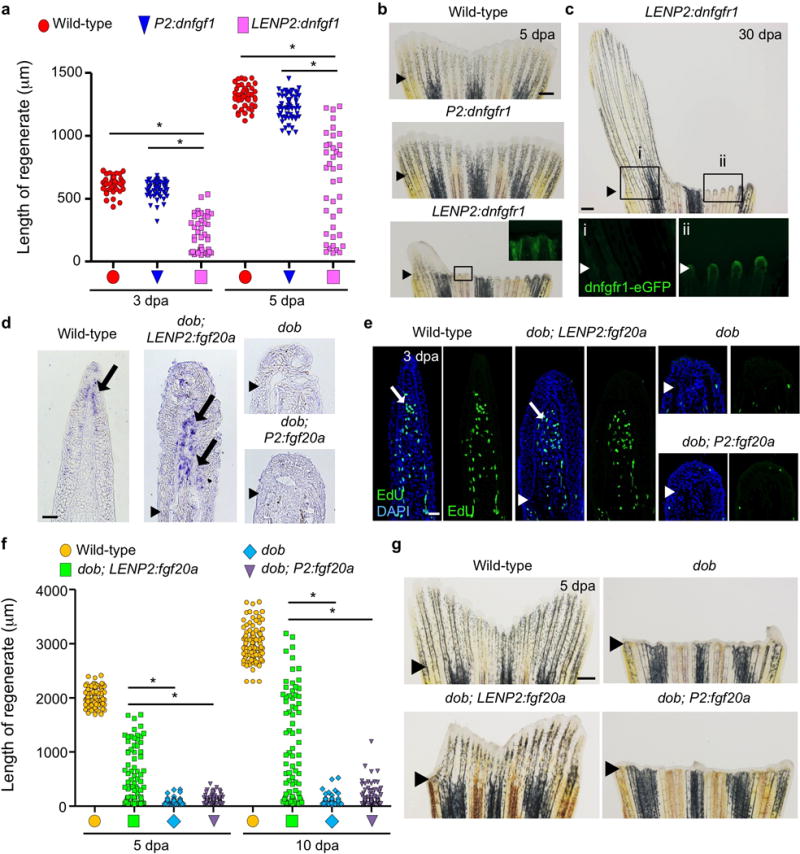
How tissue regeneration programs are triggered by injury has received limited research attention. Here we investigate the existence of enhancer regulatory elements that are activated in regenerating tissue. Transcriptomic analyses reveal that leptin b (lepb) is highly induced in regenerating hearts and fins of zebrafish. Epigenetic profiling identified a short DNA sequence element upstream and distal to lepb that acquires open chromatin marks during regeneration and enables injury-dependent expression from minimal promoters. This element could activate expression in injured neonatal mouse tissues and was divisible into tissue-specific modules sufficient for expression in regenerating zebrafish fins or hearts. Simple enhancer-effector transgenes employing lepb-linked sequences upstream of pro- or anti-regenerative factors controlled the efficacy of regeneration in zebrafish. Our findings provide evidence for 'tissue regeneration enhancer elements' (TREEs) that trigger gene expression in injury sites and can be engineered to modulate the regenerative potential of vertebrate organs.
组织再生程序如何由损伤触发,这方面的研究关注有限。在此,我们研究了在再生组织中被激活的增强子调控元件的存在情况。转录组分析表明,瘦素b(lepb)在斑马鱼再生的心脏和鳍中高度诱导表达。表观遗传分析确定了lepb上游和远端的一段短DNA序列元件,该元件在再生过程中获得开放染色质标记,并能使最小启动子实现损伤依赖性表达。该元件可在新生小鼠损伤组织中激活表达,并可分为足以在斑马鱼再生鳍或心脏中表达的组织特异性模块。采用促再生或抗再生因子上游与lepb相连序列的简单增强子-效应子转基因,可控制斑马鱼的再生效果。我们的研究结果为“组织再生增强子元件”(TREEs)提供了证据,这些元件在损伤部位触发基因表达,并且可以进行工程设计以调节脊椎动物器官的再生潜力。