Collin Amandine, Le Marec Fabien, Vandenhende Marie-Anne, Lazaro Estibaliz, Duffau Pierre, Cazanave Charles, Gérard Yann, Dabis François, Bruyand Mathias, Bonnet Fabrice
Centre Hospitalier Universitaire (CHU) Bordeaux, Coordination régionale de la lutte contre l'infection à VIH (COREVIH), Bordeaux, France.
CHU Bordeaux, Services de médecine interne et maladies infectieuses, Bordeaux, France.
PLoS One. 2016 Apr 6;11(4):e0152970. doi: 10.1371/journal.pone.0152970. eCollection 2016.
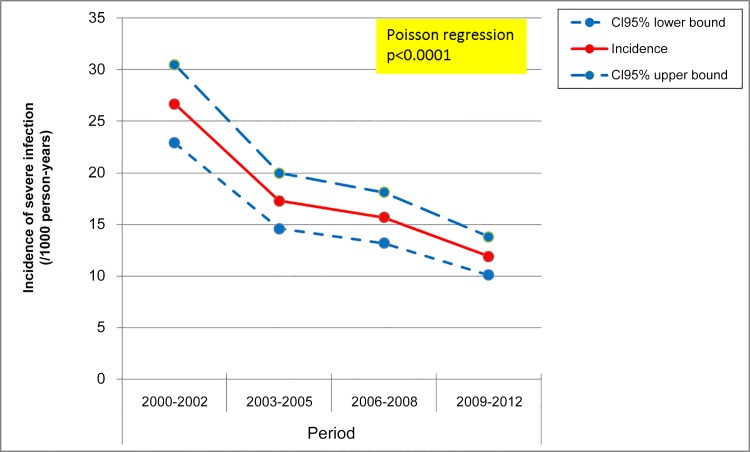
Severe non-AIDS bacterial infections (SBI) are the leading cause of hospital admissions among people living with HIV (PLHIV) in industrialized countries. We aimed to estimate the incidence of SBI and their risk factors in a large prospective cohort of PLHIV patients over a 13-year period in France. Patients followed up in the ANRS CO3 Aquitaine cohort between 2000 and 2012 were eligible; SBI was defined as a clinical diagnosis associated with hospitalization of ≥48 hours or death. Survival analysis was conducted to identify risk factors for SBI.Total follow-up duration was 39,256 person-years [PY] (31,370 PY on antiretroviral treatment [ART]). The incidence of SBI decreased from 26.7/1000 PY [95% CI: 22.9-30.5] over the period 2000-2002 to 11.9/1000 PY [10.1-13.8] in 2009-2012 (p <0.0001). Factors independently associated to increased risk of SBI were: plasma HIVRNA>50 copies/mL (Hazard Ratio [HR] = 5.1, 95% Confidence Interval: 4.2-6.2), CD4 count <500 cells/mm3 and CD4/CD8 ratio <0.8 (with a dose-response relationship for both markers), history of cancer (HR = 1.4 [1.0-1.9]), AIDS stage (HR = 1.7 [1.3-2.1]) and HCV coinfection (HR = 1.4, [1.1-1.6]). HIV-positive patients with diabetes were more prone to SBI (HR = 1.6 [0.9-2.6]). Incidence of SBI decreased over a 13-year period due to the improvement in the virological and immune status of PLHIV on ART. Risk factors for SBI include low CD4 count and detectable HIV RNA, but also CD4/CD8 ratio, HCV coinfection, history of cancer and diabetes, comorbid conditions that have been frequent among PLHIV in recent years.
在工业化国家,严重非艾滋病细菌性感染(SBI)是艾滋病毒感染者(PLHIV)住院的主要原因。我们旨在估计法国一个大型PLHIV患者前瞻性队列在13年期间SBI的发病率及其危险因素。2000年至2012年在ANRS CO3阿基坦队列中接受随访的患者符合条件;SBI被定义为与住院≥48小时或死亡相关的临床诊断。进行生存分析以确定SBI的危险因素。总随访时间为39256人年[PY](31370 PY接受抗逆转录病毒治疗[ART])。SBI的发病率从2000 - 2002年期间的26.7/1000 PY[95%CI:22.9 - 30.5]降至2009 - 2012年的11.9/1000 PY[10.1 - 13.8](p<0.0001)。与SBI风险增加独立相关的因素包括:血浆HIVRNA>50拷贝/mL(风险比[HR]=5.1,95%置信区间:4.2 - 6.2)、CD4细胞计数<500个/mm3以及CD4/CD8比值<0.8(两种标志物均存在剂量反应关系)、癌症病史(HR = 1.4[1.0 - 1.9])、艾滋病分期(HR = 1.7[1.3 - 2.1])和丙型肝炎病毒合并感染(HR = 1.4,[1.1 - 1.6])。感染艾滋病毒的糖尿病患者更易发生SBI(HR = 1.6[0.9 - 2.6])。由于接受ART的PLHIV的病毒学和免疫状态改善,SBI的发病率在13年期间有所下降。SBI的危险因素包括低CD4细胞计数和可检测到的HIV RNA,还有CD4/CD8比值、丙型肝炎病毒合并感染、癌症病史和糖尿病,这些合并症近年来在PLHIV中很常见。