Janssen D J A, Wouters E F M, Parra Y Lozano, Stakenborg K, Franssen F M E
Department of Research & Education, CIRO, Centre of expertise for chronic organ failure, PO Box 4009, 6080 AA HAELEN, Hornerheide 1, 6085, Horn, NM, The Netherlands.
Centre of Expertise for Palliative Care, Maastricht University Medical Centre (MUMC+), Maastricht, The Netherlands.
BMC Pulm Med. 2016 Apr 6;16:47. doi: 10.1186/s12890-016-0210-8.
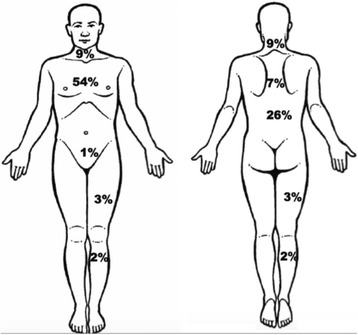
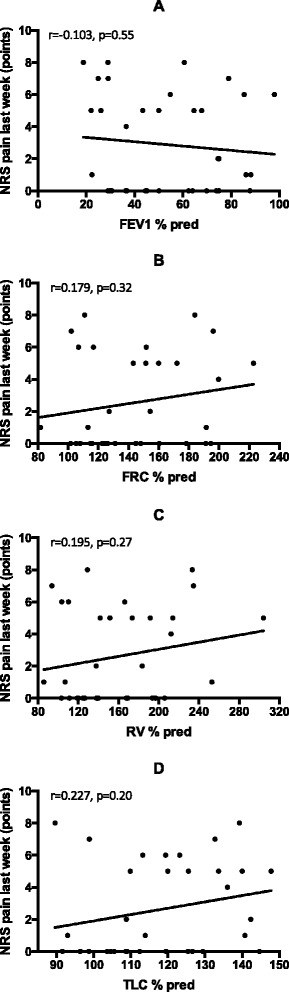
Objectives of this study were to evaluate the prevalence of thoracic pain in patients with chronic obstructive pulmonary disease (COPD) and its relationship with Forced Expiratory Volume in the first second (FEV1), static hyperinflation, dyspnoea, functional exercise capacity, disease-specific health status, anxiety, and depression.
This cross-sectional observational study included patients with COPD entering pulmonary rehabilitation. Participants underwent spirometry, plethysmography, and measurement of single breath diffusion capacity. Pain was assessed using a multidimensional, structured pain interview. In addition, dyspnoea severity (Modified Medical Research Council Dyspnoea Scale (mMRC)), functional exercise capacity (six-minute walking distance (6MWD)), disease-specific health status (COPD Assessment Test (CAT)), and symptoms of anxiety and depression (Hospital Anxiety Depression Scale (HADS)) were recorded.
55 of the included 67 participants reported chronic pain (82.1%). 53.7% had thoracic pain. After considering multiple comparisons, only younger age and worse CAT scores were related with the presence of thoracic pain (p = 0.01). There were no relationships between thoracic pain and FEV1, static lung hyperinflation, diffusion capacity, mMRC score, 6MWD, anxiety or depression.
Thoracic pain is highly prevalent in COPD patients and is related to impaired disease-specific health status, but there is no relationship with FEV1, static hyperinflation, dyspnoea severity or functional exercise capacity.
本研究的目的是评估慢性阻塞性肺疾病(COPD)患者胸痛的患病率及其与第一秒用力呼气量(FEV1)、静态肺过度充气、呼吸困难、功能运动能力、疾病特异性健康状况、焦虑和抑郁之间的关系。
这项横断面观察性研究纳入了进入肺康复治疗的COPD患者。参与者接受了肺功能测定、体积描记法和单次呼吸弥散能力测量。使用多维结构化疼痛访谈评估疼痛。此外,记录呼吸困难严重程度(改良医学研究委员会呼吸困难量表(mMRC))、功能运动能力(六分钟步行距离(6MWD))、疾病特异性健康状况(COPD评估测试(CAT))以及焦虑和抑郁症状(医院焦虑抑郁量表(HADS))。
纳入的67名参与者中有55名报告有慢性疼痛(82.1%)。53.7%的人有胸痛。在考虑多重比较后,只有年龄较小和CAT评分较差与胸痛的存在有关(p = 0.01)。胸痛与FEV1、静态肺过度充气、弥散能力、mMRC评分、6MWD、焦虑或抑郁之间没有关系。
胸痛在COPD患者中非常普遍,并且与疾病特异性健康状况受损有关,但与FEV1、静态肺过度充气、呼吸困难严重程度或功能运动能力无关。