Crawford Hayley, Moss Joanna, Oliver Chris, Elliott Natasha, Anderson Giles M, McCleery Joseph P
Centre for Research in Psychology, Behaviour and Achievement, Coventry University, James Starley Building (JSG12), Priory Street, CV1 5FB Coventry, UK ; Cerebra Centre for Neurodevelopmental Disorders, School of Psychology, University of Birmingham, Birmingham, UK.
Cerebra Centre for Neurodevelopmental Disorders, School of Psychology, University of Birmingham, Birmingham, UK ; Institute of Cognitive Neuroscience, University College London, London, UK.
Mol Autism. 2016 Apr 5;7:24. doi: 10.1186/s13229-016-0084-x. eCollection 2016.
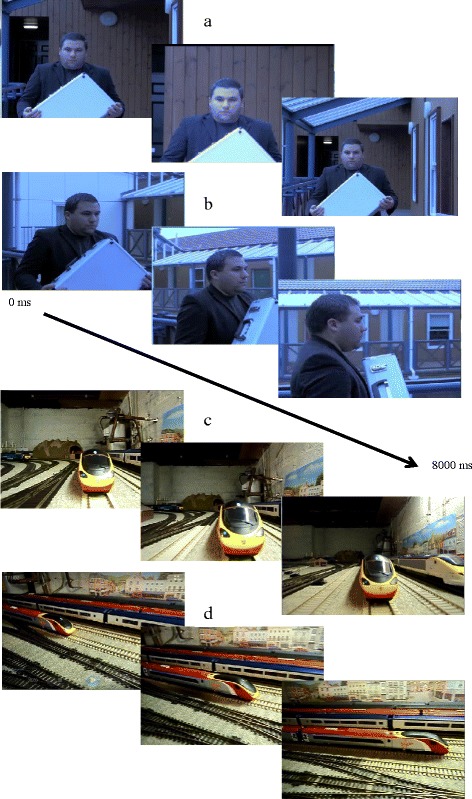
Recent research has identified differences in relative attention to competing social versus non-social video stimuli in individuals with autism spectrum disorder (ASD). Whether attentional allocation is influenced by the potential threat of stimuli has yet to be investigated. This is manipulated in the current study by the extent to which the stimuli are moving towards or moving past the viewer. Furthermore, little is known about whether such differences exist across other neurodevelopmental disorders. This study aims to determine if adolescents with ASD demonstrate differences in attentional allocation to competing pairs of social and non-social video stimuli, where the actor or object either moves towards or moves past the viewer, in comparison to individuals without ASD, and to determine if individuals with three genetic syndromes associated with differing social phenotypes demonstrate differences in attentional allocation to the same stimuli.
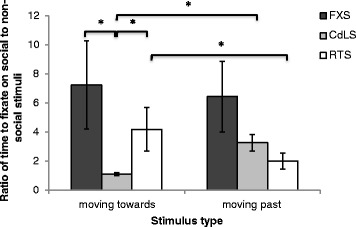
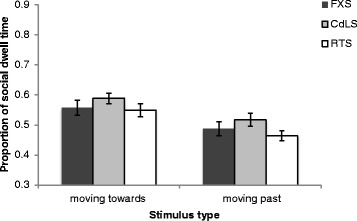
In study 1, adolescents with ASD and control participants were presented with social and non-social video stimuli in two formats (moving towards or moving past the viewer) whilst their eye movements were recorded. This paradigm was then employed with groups of individuals with fragile X, Cornelia de Lange, and Rubinstein-Taybi syndromes who were matched with one another on chronological age, global adaptive behaviour, and verbal adaptive behaviour (study 2).
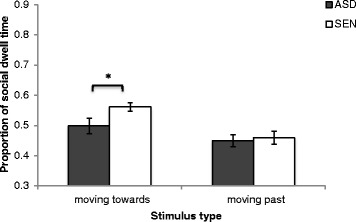
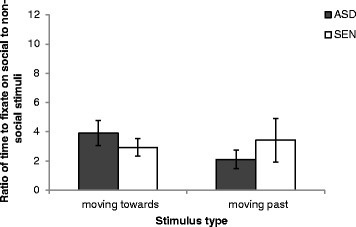
Adolescents with ASD demonstrated reduced looking-time to social versus non-social videos only when stimuli were moving towards them. Individuals in the three genetic syndrome groups showed similar looking-time but differences in fixation latency for social stimuli moving towards them. Across both studies, we observed within- and between-group differences in attention to social stimuli that were moving towards versus moving past the viewer.
Taken together, these results provide strong evidence to suggest differential visual attention to competing social versus non-social video stimuli in populations with clinically relevant, genetically mediated differences in socio-behavioural phenotypes.
最近的研究已经确定,自闭症谱系障碍(ASD)患者在对竞争性社交与非社交视频刺激的相对关注度上存在差异。注意力分配是否受到刺激潜在威胁的影响尚待研究。在本研究中,这是通过刺激朝着观看者移动或远离观看者的程度来操控的。此外,对于其他神经发育障碍患者是否存在此类差异知之甚少。本研究旨在确定与无ASD的个体相比,患有ASD的青少年在对竞争性社交和非社交视频刺激对的注意力分配上是否存在差异,其中演员或物体朝着观看者移动或远离观看者,并确定患有三种与不同社交表型相关的遗传综合征的个体在对相同刺激的注意力分配上是否存在差异。
在研究1中,向患有ASD的青少年和对照参与者呈现两种格式(朝着观看者移动或远离观看者)的社交和非社交视频刺激,同时记录他们的眼动。然后对脆性X综合征、科妮莉亚·德朗热综合征和鲁宾斯坦-泰比综合征患者群体采用这种范式,这些患者群体在实际年龄、整体适应性行为和语言适应性行为方面相互匹配(研究2)。
只有当刺激朝着患有ASD的青少年移动时,他们对社交视频与非社交视频的注视时间才会减少。三个遗传综合征组的个体表现出相似的注视时间,但对于朝着他们移动的社交刺激,注视潜伏期存在差异。在两项研究中,我们都观察到了对朝着观看者移动与远离观看者的社交刺激的注意力在组内和组间的差异。
综上所述,这些结果提供了有力证据,表明在具有临床相关的、由基因介导的社会行为表型差异的人群中,对竞争性社交与非社交视频刺激存在不同的视觉注意力。