
粘附微图案上细胞集合体的动力学:弥合单细胞铺展与集体细胞迁移之间的差距
Dynamics of Cell Ensembles on Adhesive Micropatterns: Bridging the Gap between Single Cell Spreading and Collective Cell Migration.
作者信息
Albert Philipp J, Schwarz Ulrich S
机构信息
Institute for Theoretical Physics and BioQuant, Heidelberg University, Heidelberg, Germany.
出版信息
PLoS Comput Biol. 2016 Apr 7;12(4):e1004863. doi: 10.1371/journal.pcbi.1004863. eCollection 2016 Apr.
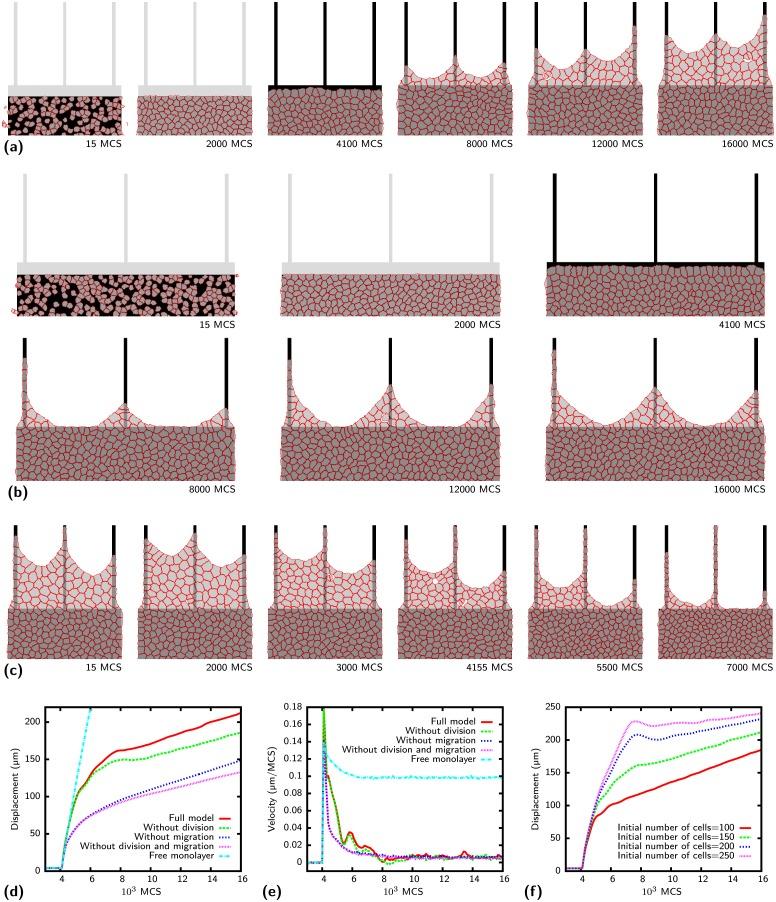
The collective dynamics of multicellular systems arise from the interplay of a few fundamental elements: growth, division and apoptosis of single cells; their mechanical and adhesive interactions with neighboring cells and the extracellular matrix; and the tendency of polarized cells to move. Micropatterned substrates are increasingly used to dissect the relative roles of these fundamental processes and to control the resulting dynamics. Here we show that a unifying computational framework based on the cellular Potts model can describe the experimentally observed cell dynamics over all relevant length scales. For single cells, the model correctly predicts the statistical distribution of the orientation of the cell division axis as well as the final organisation of the two daughters on a large range of micropatterns, including those situations in which a stable configuration is not achieved and rotation ensues. Large ensembles migrating in heterogeneous environments form non-adhesive regions of inward-curved arcs like in epithelial bridge formation. Collective migration leads to swirl formation with variations in cell area as observed experimentally. In each case, we also use our model to predict cell dynamics on patterns that have not been studied before.
多细胞系统的集体动力学源于几个基本要素的相互作用
单细胞的生长、分裂和凋亡;它们与相邻细胞及细胞外基质的机械和粘附相互作用;以及极化细胞移动的趋势。微图案化基质越来越多地用于剖析这些基本过程的相对作用,并控制由此产生的动力学。在这里,我们表明基于细胞Potts模型的统一计算框架可以描述在所有相关长度尺度上实验观察到的细胞动力学。对于单细胞,该模型正确地预测了细胞分裂轴方向的统计分布以及两个子细胞在大范围微图案上的最终组织形式,包括那些未达到稳定构型并发生旋转的情况。在异质环境中迁移的大量细胞形成向内弯曲弧的非粘附区域,就像上皮桥形成时那样。集体迁移导致如实验观察到的那样随细胞面积变化的漩涡形成。在每种情况下,我们还使用我们的模型来预测之前未研究过的图案上的细胞动力学。


 Zotero 插件