OuYang Pu-Yun, Shi Dingbo, Sun Rui, Zhu Yu-Jia, Xiao Yao, Zhang Lu-Ning, Zhang Xu-Hui, Chen Ze-Ying, Lan Xiao-Wen, Tang Jie, Gao Yuan-Hong, Ma Jun, Deng Wuguo, Xie Fang-Yun
Department of Radiation Oncology, Sun Yat-sen University Cancer Center, State Key Laboratory of Oncology in South China, Collaborative Innovation Center for Cancer Medicine, Guangzhou, Guangdong, China.
Department of Experimental Research, Sun Yat-sen University Cancer Center, State Key Laboratory of Oncology in South China, Collaborative Innovation Center for Cancer Medicine, Guangzhou, Guangdong, China.
Oncotarget. 2016 May 31;7(22):33408-17. doi: 10.18632/oncotarget.8573.
Albeit intensity-modulated radiotherapy (IMRT) is currently the recommended radiation technique in treating nasopharyngeal carcinoma, the effect of IMRT versus two-dimensional conventional radiotherapy (2DCRT) alone is still contradictory.
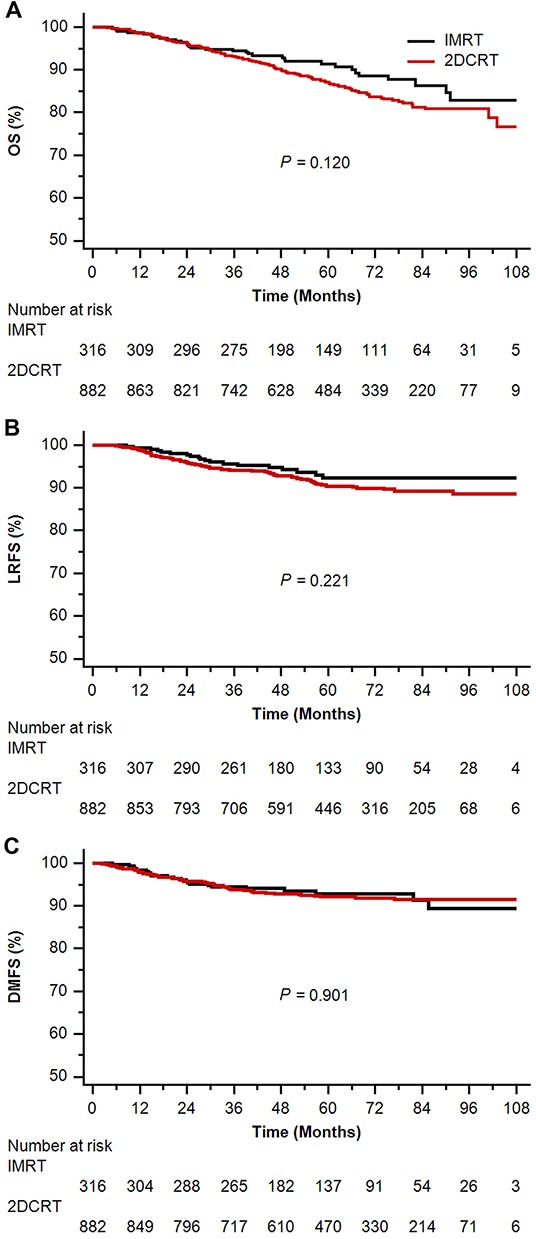
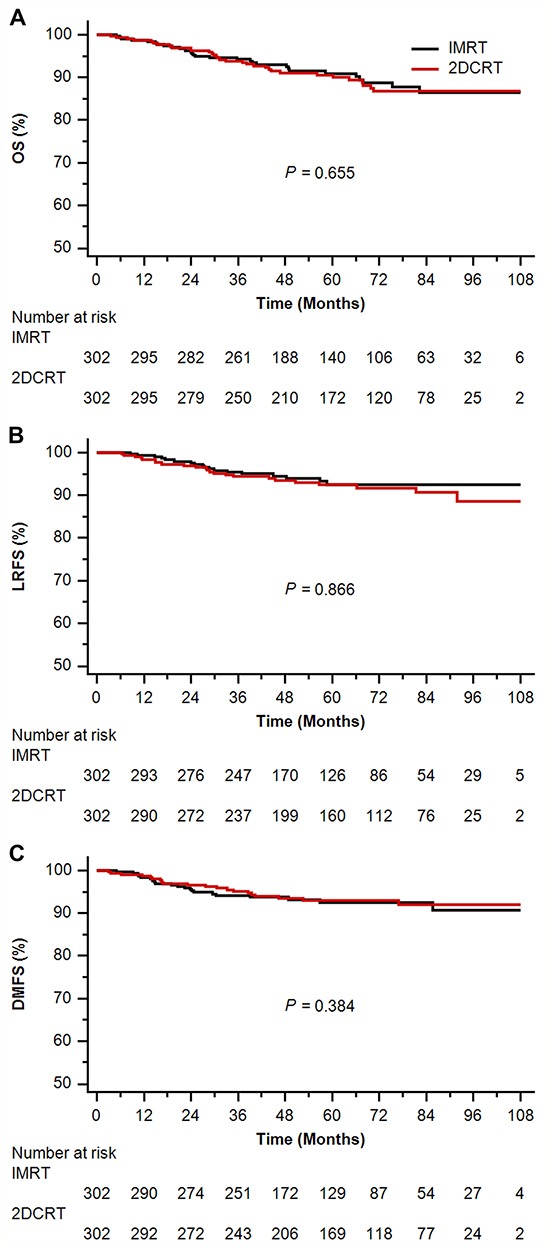
In the original unmatched cohort of 1198 patients, IMRT obtained comparable 5-year overall survival (OS) (91.3% vs 87.1%, P = 0.120), locoregional relapse-free survival (LRFS) (92.3% vs 90.4%, P = 0.221) and distant metastasis-free survival (DMFS) (92.9% vs 92.1%, P = 0.901) to 2DCRT. In the propensity-matched cohort of 604 patients, no significant survival differences were observed between the two arms (5-year OS 90.9% vs 90.5%, P = 0.655; LRFS 92.5% vs 92.4%, P = 0.866; DMFS 92.5% vs 92.9%, P = 0.384). In multivariate analysis, IMRT did not significantly lower the risk of death, locoregional relapse or distant metastasis, irrespective of tumor stage.
Overall, 1198 patients who underwent IMRT (316 patients) or 2DCRT (882 patients) without any chemotherapy was retrospectively analyzed. Patients in both arms were matched at equal ratio using propensity-score matching method. OS, LRFS and DMFS were assessed with Kaplan-Meier method, log-rank test and Cox regression.
In this propensity-matched study, IMRT showed no survival advantage over 2DCRT alone in nasopharyngeal carcinoma.
尽管调强放射治疗(IMRT)目前是治疗鼻咽癌的推荐放射技术,但IMRT与单纯二维常规放射治疗(2DCRT)的效果仍存在矛盾。
在最初未匹配的1198例患者队列中,IMRT的5年总生存率(OS)(91.3%对87.1%,P = 0.120)、局部区域无复发生存率(LRFS)(92.3%对90.4%,P = 0.221)和远处转移无复发生存率(DMFS)(92.9%对92.1%,P = 0.901)与2DCRT相当。在倾向评分匹配的604例患者队列中,两组之间未观察到显著的生存差异(5年OS为90.9%对90.5%,P = 0.655;LRFS为92.5%对92.4%,P = 0.866;DMFS为92.5%对92.9%,P = 0.384)。在多变量分析中,无论肿瘤分期如何,IMRT均未显著降低死亡、局部区域复发或远处转移的风险。
总体而言,对1198例接受IMRT(316例患者)或2DCRT(882例患者)且未进行任何化疗的患者进行了回顾性分析。使用倾向评分匹配法按相等比例对两组患者进行匹配。采用Kaplan-Meier法、对数秩检验和Cox回归评估OS、LRFS和DMFS。
在这项倾向评分匹配研究中,IMRT在鼻咽癌治疗中相较于单纯2DCRT未显示出生存优势。