Curtis Kelly K, Ross Helen J, Garrett Ashley L, Jizba Theresa A, Patel Ajay B, Patel Samir H, Wong William W, Halyard Michele Y, Ko Stephen J, Kosiorek Heidi E, Foote Robert L
Department of Internal Medicine, Division of Hematology/Medical Oncology, Mayo Clinic, 13400 East Shea Blvd., Scottsdale, AZ, 85259, USA.
Department of Radiation Oncology, Mayo Clinic, Jacksonville, FL, USA.
Radiat Oncol. 2016 Apr 9;11:55. doi: 10.1186/s13014-016-0630-x.
We reviewed outcomes of patients with loco-regionally recurrent (LRR) or new primary (NP) squamous cell carcinoma of the head and neck (SCCHN) treated at our institution with reirradiation (RRT).
Patients received definitive RRT (DRRT) or post-operative RRT following salvage surgery (PRRT) from 2003 to 2011. Measured survival outcomes included loco-regional relapse free survival (LRFS) and overall survival (OS).
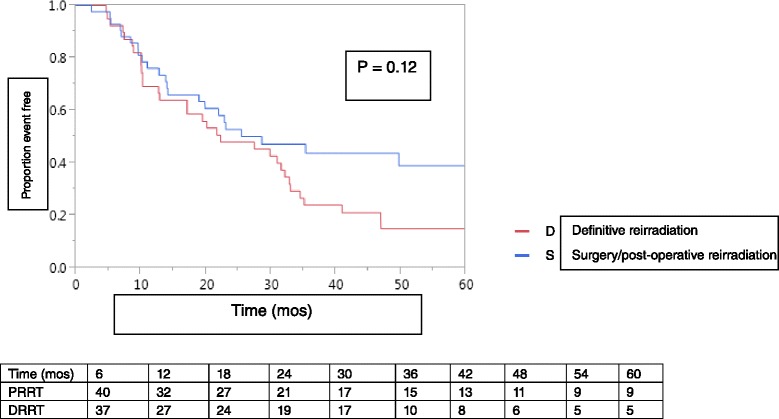
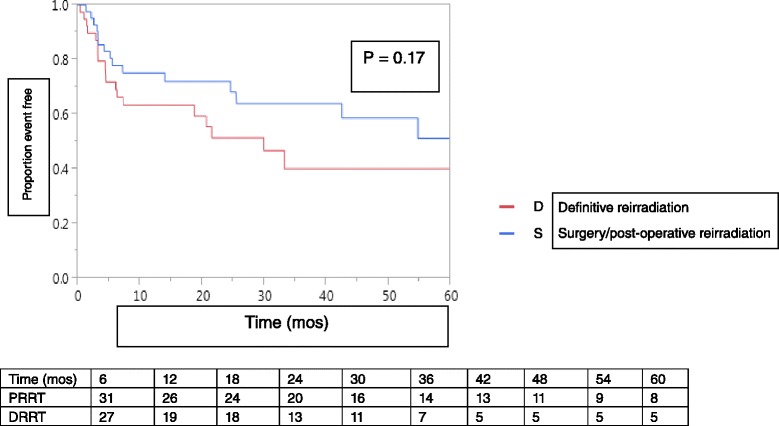
Among 81 patients (PRRT, 42; DRRT, 39), median PRRT and DRRT doses were 60 Gy (12-70 Gy) and 69.6 Gy (48-76.8 Gy). The majority of patients received IMRT-based RRT (n = 77, 95 %). With median follow-up of 78.1 months (95 % CI, 56-96.8 months), 2-year OS was 53 % with PRRT and 48 % with DRRT (p = 0.12); 23 % of patients were alive at last follow-up. LRFS at 2 years was 60 %, and did not differ significantly between PRRT and DRRT groups. A trend toward inferior LRFS was noted among patients receiving chemotherapy with RRT versus RRT alone (p = 0.06). Late serious toxicities were uncommon, including osteoradionecrosis (2 patients) and carotid artery bleeding (1 patient, non-fatal).
OS of PRRT- and DRRT-treated patients in this series appears superior to the published literature. We used IMRT for the majority of patients, in contrast to several series and trials previously reported, which may account in part for this difference. Future studies should seek to improve outcomes among patients with LRR/NP SCCHN via alternative therapeutic modalities such as proton radiotherapy and by incorporating novel systemic agents.
我们回顾了在我院接受再程放疗(RRT)治疗的局部区域复发(LRR)或新发原发性(NP)头颈部鳞状细胞癌(SCCHN)患者的治疗结果。
2003年至2011年期间,患者接受了根治性再程放疗(DRRT)或挽救性手术后的术后再程放疗(PRRT)。测量的生存结果包括局部区域无复发生存率(LRFS)和总生存率(OS)。
81例患者中(PRRT组42例,DRRT组39例),PRRT和DRRT的中位剂量分别为60 Gy(12 - 70 Gy)和69.6 Gy(48 - 76.8 Gy)。大多数患者接受基于调强放疗(IMRT)的再程放疗(n = 77,95%)。中位随访78.1个月(95%CI,56 - 96.8个月),PRRT组2年总生存率为53%,DRRT组为48%(p = 0.12);23%的患者在最后一次随访时仍存活。2年时LRFS为60%,PRRT组和DRRT组之间无显著差异。接受化疗联合再程放疗的患者与单纯再程放疗的患者相比,LRFS有下降趋势(p = 0.06)。晚期严重毒性反应不常见,包括放射性骨坏死(2例患者)和颈动脉出血(1例患者,非致命)。
本系列中接受PRRT和DRRT治疗患者的总生存率似乎优于已发表的文献。与先前报道的几个系列研究和试验不同,我们对大多数患者使用了IMRT,这可能部分解释了这种差异。未来的研究应寻求通过质子放疗等替代治疗方式以及纳入新型全身治疗药物来改善LRR/NP SCCHN患者的治疗结果。