Fritschi Lin, Crewe Julie, Darcey Ellie, Reid Alison, Glass Deborah C, Benke Geza P, Driscoll Tim, Peters Susan, Si Si, Abramson Michael J, Carey Renee N
School of Public Health, Curtin University, GPO Box U1987, Perth, Western Australia, 6845, Australia.
Monash Centre for Occupational and Environmental Health, School of Public Health & Preventive Medicine, Monash University, Melbourne, Victoria, Australia.
BMC Pulm Med. 2016 Apr 9;16:48. doi: 10.1186/s12890-016-0212-6.
There is very little information available on a national level as to the number of people exposed to specific asthmagens in workplaces.
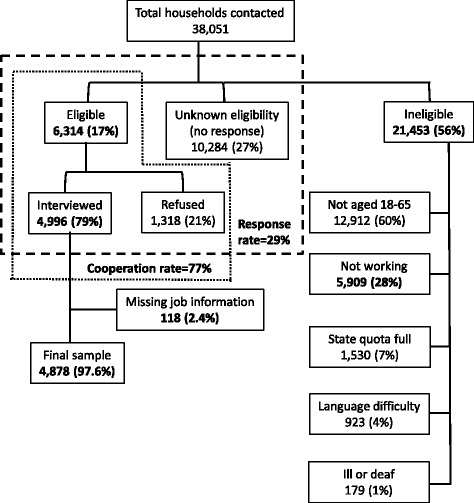
We conducted a national telephone survey in Australia to investigate the prevalence of current occupational exposure to 277 asthmagens, assembled into 27 groups. Demographic and current job information were obtained. A web-based tool, OccIDEAS, was used to collect job task information and assign exposure to each asthmagen group.
In the Australian Workplace Exposure Study - Asthma (AWES- Asthma) we interviewed 4878 participants (2441 male and 2437 female). Exposure to at least one asthmagen was more common among men (47%) than women (40%). Extrapolated to the Australian population, approximately 2.8 million men and 1.7 million women were estimated to be exposed. Among men, the most common exposures were bioaerosols (29 %) and metals (27%), whilst the most common exposures among women were latex (25%) and industrial cleaning and sterilising agents (20%).
This study provides information about the prevalence of exposure to asthmagens in Australian workplaces which will be useful in setting priorities for control and prevention of occupational asthma.
在国家层面上,关于工作场所中接触特定哮喘诱发剂的人数信息非常少。
我们在澳大利亚开展了一项全国性电话调查,以调查当前职业接触277种哮喘诱发剂的患病率,这些诱发剂被归为27组。获取了人口统计学和当前工作信息。使用基于网络的工具OccIDEAS收集工作任务信息,并将接触情况分配到每个哮喘诱发剂组。
在澳大利亚工作场所接触研究——哮喘(AWES-哮喘)中,我们采访了4878名参与者(2441名男性和2437名女性)。接触至少一种哮喘诱发剂在男性(47%)中比在女性(40%)中更常见。推算至澳大利亚人口,估计约有280万男性和170万女性接触过。在男性中,最常见的接触物是生物气溶胶(29%)和金属(27%),而在女性中,最常见的接触物是乳胶(25%)和工业清洁及消毒剂(20%)。
本研究提供了澳大利亚工作场所接触哮喘诱发剂患病率的信息,这将有助于确定职业性哮喘控制和预防的优先事项。