Girón María D, Vílchez José D, Salto Rafael, Manzano Manuel, Sevillano Natalia, Campos Nefertiti, Argilés Josep M, Rueda Ricardo, López-Pedrosa José M
Department of Biochemistry and Molecular Biology II School of Pharmacy, University of Granada Granada Spain.
Abbott Nutrition R&D Granada Spain.
J Cachexia Sarcopenia Muscle. 2016 Mar;7(1):68-78. doi: 10.1002/jcsm.12032. Epub 2015 May 14.
L-Leu and its metabolite β-hydroxy-β-methylbutyrate (HMB) stimulate muscle protein synthesis enhancing the phosphorylation of proteins that regulate anabolic signalling pathways. Alterations in these pathways are observed in many catabolic diseases, and HMB and L-Leu have proven their anabolic effects in in vivo and in vitro models. The aim of this study was to compare the anabolic effects of L-Leu and HMB in myotubes grown in the absence of any catabolic stimuli.
Studies were conducted in vitro using rat L6 myotubes under normal growth conditions (non-involving L-Leu-deprived conditions). Protein synthesis and mechanistic target of rapamycin signalling pathway were determined.
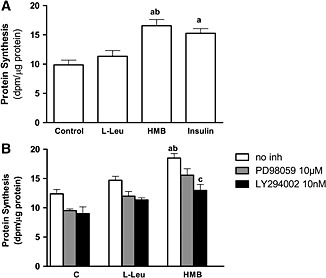
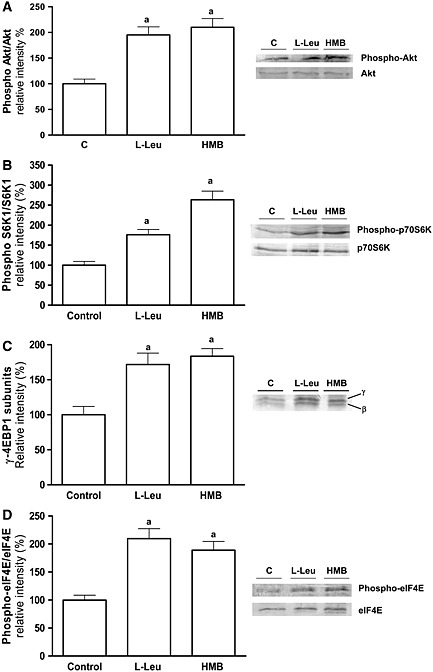
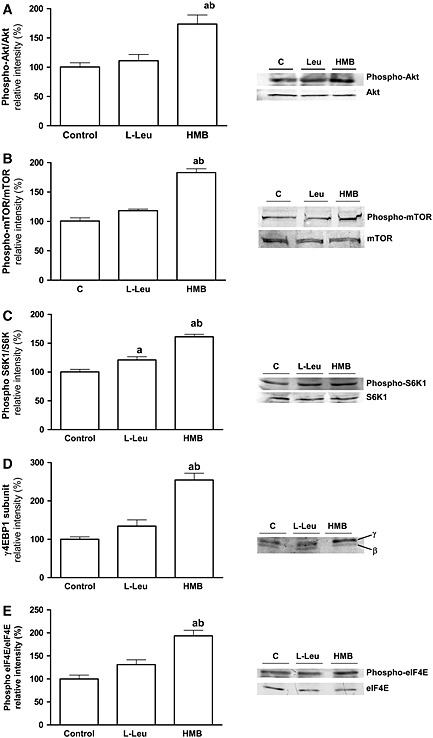
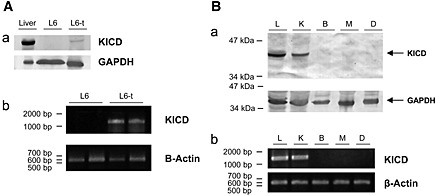
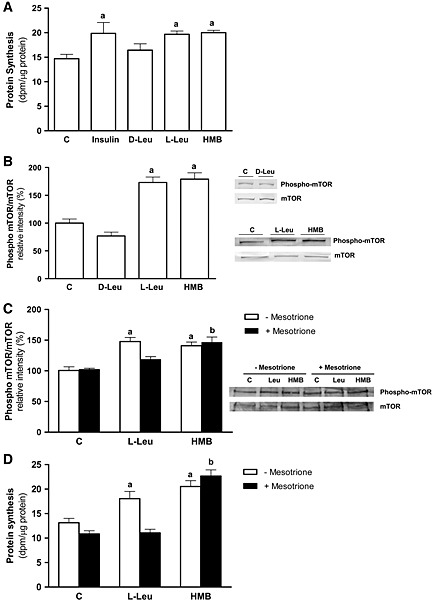
Only HMB was able to increase protein synthesis through a mechanism that involves the phosphorylation of the mechanistic target of rapamycin as well as its downstream elements, pS6 kinase, 4E binding protein-1, and eIF4E. HMB was significantly more effective than L-Leu in promoting these effects through an activation of protein kinase B/Akt. Because the conversion of L-Leu to HMB is limited in muscle, L6 cells were transfected with a plasmid that codes for α-keto isocaproate dioxygenase, the key enzyme involved in the catabolic conversion of α-keto isocaproate into HMB. In these transfected cells, L-Leu was able to promote protein synthesis and mechanistic target of rapamycin regulated pathway activation equally to HMB. Additionally, these effects of leucine were reverted to a normal state by mesotrione, a specific inhibitor of α-keto isocaproate dioxygenase.
Our results suggest that HMB is an active L-Leu metabolite able to maximize protein synthesis in skeletal muscle under conditions, in which no amino acid deprivation occurred. It may be proposed that supplementation with HMB may be very useful to stimulate protein synthesis in wasting conditions associated with chronic diseases, such as cancer or chronic heart failure.
L-亮氨酸及其代谢产物β-羟基-β-甲基丁酸酯(HMB)可刺激肌肉蛋白质合成,增强调节合成代谢信号通路的蛋白质的磷酸化。在许多分解代谢疾病中都观察到这些信号通路的改变,并且HMB和L-亮氨酸已在体内和体外模型中证实了它们的合成代谢作用。本研究的目的是比较L-亮氨酸和HMB在无任何分解代谢刺激条件下生长的肌管中的合成代谢作用。
在正常生长条件下(不涉及L-亮氨酸缺乏条件)使用大鼠L6肌管进行体外研究。测定蛋白质合成和雷帕霉素信号通路的机制靶点。
只有HMB能够通过一种机制增加蛋白质合成,该机制涉及雷帕霉素机制靶点及其下游元件pS6激酶、4E结合蛋白-1和eIF4E的磷酸化。通过激活蛋白激酶B/Akt,HMB在促进这些作用方面比L-亮氨酸显著更有效。由于肌肉中L-亮氨酸向HMB的转化有限,用编码α-酮异己酸双加氧酶的质粒转染L6细胞,α-酮异己酸双加氧酶是参与α-酮异己酸分解代谢转化为HMB的关键酶。在这些转染细胞中,L-亮氨酸能够促进蛋白质合成以及雷帕霉素调节的信号通路激活,其效果与HMB相当。此外,亮氨酸的这些作用被甲基磺草酮(α-酮异己酸双加氧酶的特异性抑制剂)恢复到正常状态。
我们的结果表明,HMB是一种活性L-亮氨酸代谢产物,能够在未发生氨基酸缺乏的条件下使骨骼肌中的蛋白质合成最大化。可以提出,补充HMB可能对刺激与慢性疾病(如癌症或慢性心力衰竭)相关的消瘦状态下的蛋白质合成非常有用。