Jiang Zhenzhou, Huang Xiao, Huang Shan, Guo Hongli, Wang Lu, Li Xiaojiaoyang, Huang Xin, Wang Tao, Zhang Luyong, Sun Lixin
Jiangsu Key Laboratory of Drug Screening and Jiangsu Center for Pharmacodynamics Research and Evaluation, China Pharmaceutical UniversityNanjing, China; Key Laboratory of Drug Quality Control and Pharmacovigilance, Ministry of Education, China Pharmaceutical UniversityNanjing, China.
Jiangsu Key Laboratory of Drug Screening and Jiangsu Center for Pharmacodynamics Research and Evaluation, China Pharmaceutical University Nanjing, China.
Front Pharmacol. 2016 Mar 31;7:87. doi: 10.3389/fphar.2016.00087. eCollection 2016.
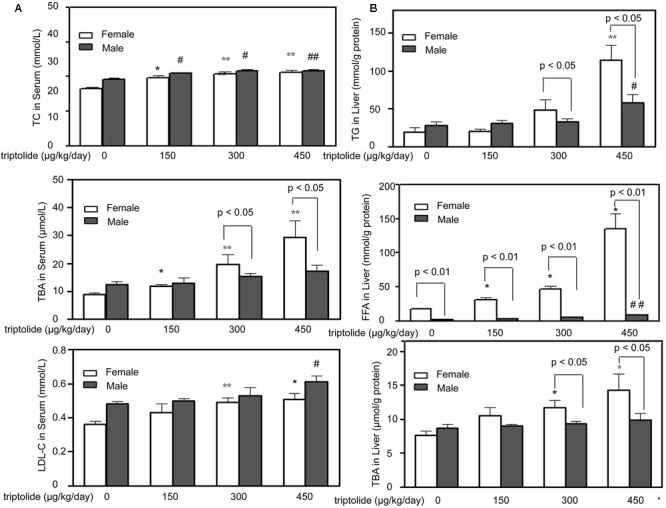
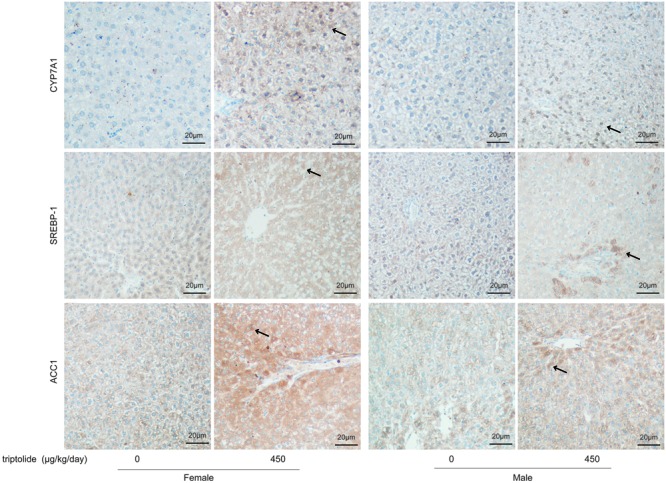
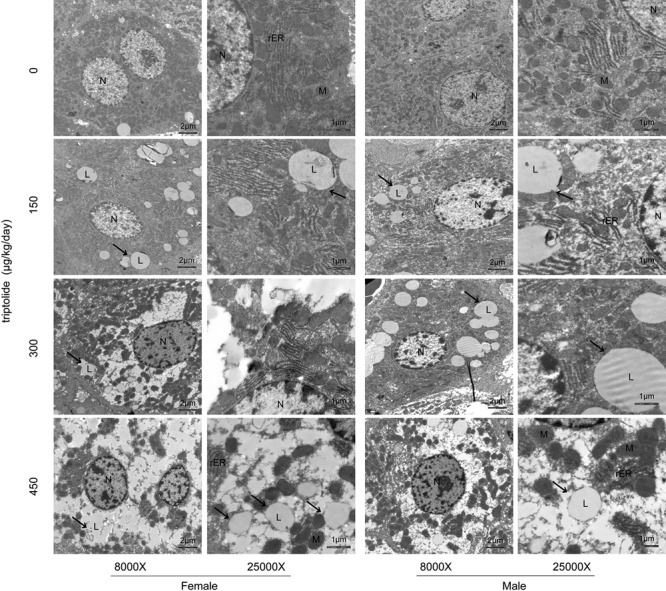
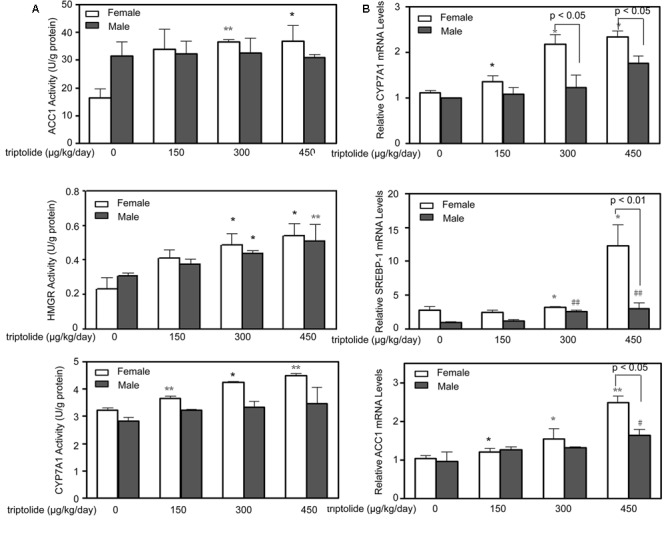
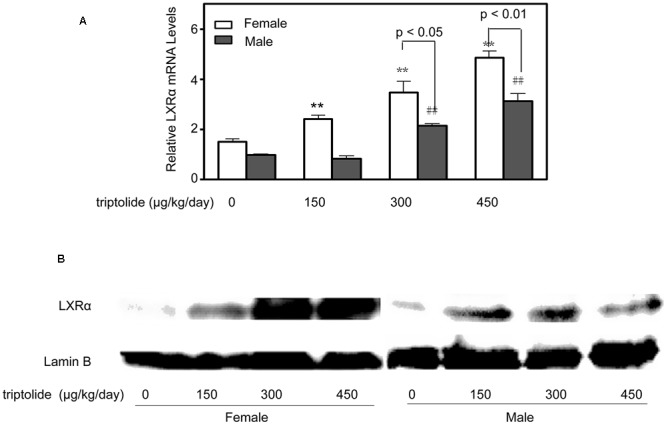
Triptolide, a diterpenoid isolated from the plant Tripterygium wilfordii Hook. f., exerts a unique bioactive spectrum of anti-inflammatory and anticancer activities. However, triptolide's clinical applications are limited due to its severe toxicities. Fatty liver toxicity occurs in response to triptolide, and this toxic response significantly differs between males and females. This report investigated the pathogenesis underlying the sex-related differences in the dyslipidosis induced by triptolide in rats. Wistar rats were administered 0, 150, 300, or 450 μg triptolide/kg/day by gavage for 28 days. Ultrastructural examination revealed that more lipid droplets were present in female triptolide-treated rats than in male triptolide-treated rats. Furthermore, liver triglyceride, total bile acid and free fatty acid levels were significantly increased in female rats in the 300 and 450 μg/kg dose groups. The expression of liver X receptor α (LXRα) and its target genes, cholesterol 7α-hydroxylase (CYP7A1) and Sterol regulatory element-binding transcription factor 1(SREBP-1), increased following triptolide treatment in both male and female rats; however, the female rats were more sensitive to triptolide than the male rats. In addition, the expression of acetyl-CoA carboxylase 1(ACC1), a target gene of SREBP-1, increased in the female rats treated with 450 μg triptolide/kg/day, and ACC1 expression contributed to the sex-related differences in the triptolide-induced dysfunction of lipid metabolism. Our results demonstrate that the sex-related differences in LXR/SREBP-1-mediated regulation of gene expression in rats are responsible for the sex-related differences in lipid metabolism induced by triptolide, which likely underlie the sex-related differences in triptolide hepatotoxicity. This study will be important for predicting sex-related effects on the pharmacokinetics and toxicity of triptolide and for improving its safety.
雷公藤甲素是从植物雷公藤中分离出的一种二萜类化合物,具有独特的抗炎和抗癌生物活性谱。然而,由于其严重的毒性,雷公藤甲素的临床应用受到限制。雷公藤甲素会引发脂肪肝毒性,且这种毒性反应在雄性和雌性之间存在显著差异。本报告研究了雷公藤甲素诱导大鼠血脂异常的性别差异背后的发病机制。将Wistar大鼠通过灌胃给予0、150、300或450μg雷公藤甲素/千克/天,持续28天。超微结构检查显示,雷公藤甲素处理的雌性大鼠比雄性大鼠存在更多脂滴。此外,在300和450μg/千克剂量组的雌性大鼠中,肝脏甘油三酯、总胆汁酸和游离脂肪酸水平显著升高。雷公藤甲素处理后,雄性和雌性大鼠肝脏X受体α(LXRα)及其靶基因胆固醇7α-羟化酶(CYP7A1)和甾醇调节元件结合转录因子1(SREBP-1)的表达均增加;然而,雌性大鼠对雷公藤甲素比雄性大鼠更敏感。此外,在每天接受450μg雷公藤甲素/千克处理的雌性大鼠中,SREBP-1的靶基因乙酰辅酶A羧化酶1(ACC1)的表达增加,并且ACC1的表达导致了雷公藤甲素诱导的脂质代谢功能障碍中的性别差异。我们的结果表明,大鼠中LXR/SREBP-1介导的基因表达调节中的性别差异是雷公藤甲素诱导的脂质代谢性别差异的原因,这可能是雷公藤甲素肝毒性性别差异的基础。这项研究对于预测性别对雷公藤甲素药代动力学和毒性的影响以及提高其安全性具有重要意义。