Hu Yeqing, Wu Qiguo, Wang Yulin, Zhang Haibo, Liu Xueying, Zhou Hua, Yang Tao
Institute of Cardiovascular Disease, Shuguang Hospital Affiliated to Shanghai University of Traditional Chinese Medicine, Shanghai, China.
Institute of Cardiovascular Disease of Integrated Traditional Chinese Medicine and Western Medicine, Shuguang Hospital Affiliated to Shanghai University of Traditional Chinese Medicine, Shanghai, China.
Front Pharmacol. 2022 Aug 24;13:979307. doi: 10.3389/fphar.2022.979307. eCollection 2022.
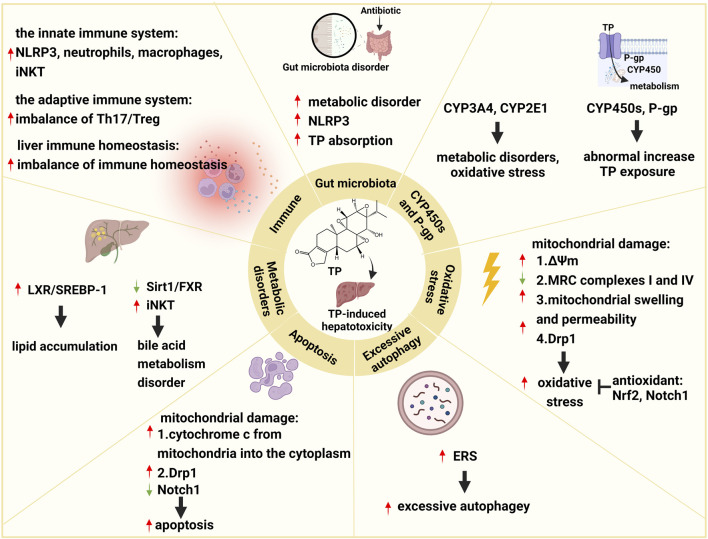
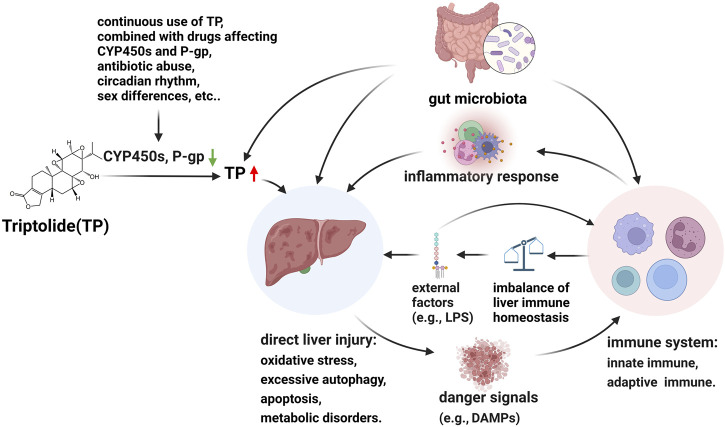
Triptolide (TP) is the major pharmacologically active ingredient and toxic component of Hook. f. However, its clinical potential is limited by a narrow therapeutic window and multiple organ toxicity, especially hepatotoxicity. Furthermore, TP-induced hepatotoxicity shows significant inter-individual variability. Over the past few decades, research has been devoted to the study of TP-induced hepatotoxicity and its mechanism. In this review, we summarized the mechanism of TP-induced hepatotoxicity. Studies have demonstrated that TP-induced hepatotoxicity is associated with CYP450s, P-glycoprotein (P-gp), oxidative stress, excessive autophagy, apoptosis, metabolic disorders, immunity, and the gut microbiota. These new findings provide a comprehensive understanding of TP-induced hepatotoxicity and detoxification.
雷公藤甲素(TP)是雷公藤的主要药理活性成分和毒性成分。然而,其临床应用潜力受到治疗窗狭窄和多器官毒性(尤其是肝毒性)的限制。此外,TP诱导的肝毒性存在显著的个体间差异。在过去几十年中,研究一直致力于TP诱导的肝毒性及其机制的研究。在本综述中,我们总结了TP诱导肝毒性的机制。研究表明,TP诱导的肝毒性与细胞色素P450(CYP450s)、P-糖蛋白(P-gp)、氧化应激、过度自噬、凋亡、代谢紊乱、免疫以及肠道微生物群有关。这些新发现为全面理解TP诱导的肝毒性和解毒作用提供了依据。