Schmidt Jennifer E, Bowles Timothy M, Gaudin Amélie C M
Department of Plant Sciences, University of California at Davis Davis, CA, USA.
Department of Natural Resources and the Environment, University of New Hampshire Durham, NH, USA.
Front Plant Sci. 2016 Mar 30;7:373. doi: 10.3389/fpls.2016.00373. eCollection 2016.
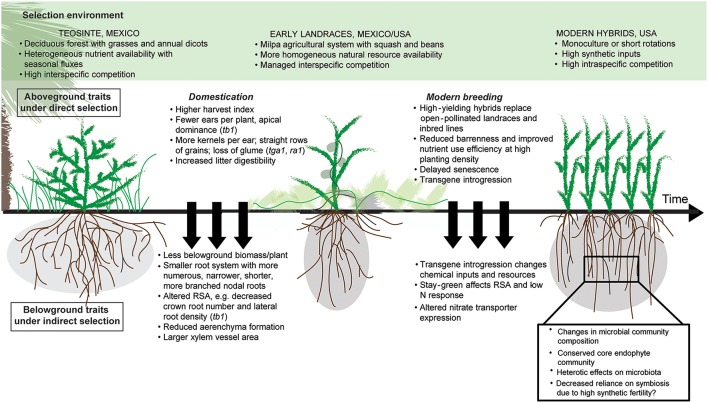
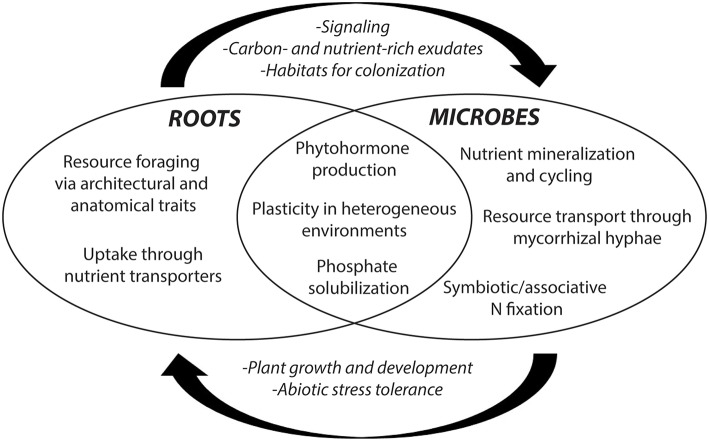
The effect of domestication and modern breeding on aboveground traits in maize (Zea mays) has been well-characterized, but the impact on root systems and the rhizosphere remain unclear. The transition from wild ecosystems to modern agriculture has focused on selecting traits that yielded the largest aboveground production with increasing levels of crop management and nutrient inputs. Root morphology, anatomy, and ecophysiological processes may have been affected by the substantial environmental and genetic shifts associated with this transition. As a result, root and rhizosphere traits that allow more efficient foraging and uptake in lower synthetic input environments might have been lost. The development of modern maize has led to a shift in microbiome community composition, but questions remain as to the dynamics and drivers of this change during maize evolution and its implications for resource acquisition and agroecosystem functioning under different management practices. Better understanding of how domestication and breeding affected root and rhizosphere microbial traits could inform breeding strategies, facilitate the sourcing of favorable alleles, and open new frontiers to improve resource use efficiency through greater integration of root development and ecophysiology with agroecosystem functioning.
驯化和现代育种对玉米地上部分性状的影响已得到充分研究,但对根系和根际的影响仍不清楚。从野生生态系统向现代农业的转变侧重于选择那些在作物管理水平和养分投入增加的情况下能实现最大地上产量的性状。根系形态、解剖结构和生态生理过程可能受到了与这种转变相关的重大环境和遗传变化的影响。因此,在较低合成投入环境中允许更高效觅食和吸收的根系和根际性状可能已经丧失。现代玉米的发展导致了微生物群落组成的变化,但关于这种变化在玉米进化过程中的动态和驱动因素及其对不同管理措施下资源获取和农业生态系统功能的影响仍存在疑问。更好地了解驯化和育种如何影响根系和根际微生物性状,可以为育种策略提供信息,促进有利等位基因的获取,并通过将根系发育和生态生理学与农业生态系统功能更紧密地结合,开辟提高资源利用效率的新领域。