Ortega Eduardo, Muñoz Rosa I, Luza Nelly, Guerra Francisco, Guerra Monserrat, Vio Karin, Henzi Roberto, Jaque Jaime, Rodriguez Sara, McAllister James P, Rodriguez Esteban
Unidad de Neurocirugía, Instituto de Neurociencias Clínicas, Facultad de Medicina, Universidad Austral de Chile, Valdivia, Chile.
Instituto de Anatomía, Histología y Patología, Facultad de Medicina, Universidad Austral de Chile, Valdivia, Chile.
BMC Neurol. 2016 Apr 11;16:45. doi: 10.1186/s12883-016-0566-7.
Mutant rodent models have highlighted the importance of the ventricular ependymal cells and the subcommissural organ (a brain gland secreting glycoproteins into the cerebrospinal fluid) in the development of fetal onset hydrocephalus. Evidence indicates that communicating and non-communicating hydrocephalus can be two sequential phases of a single pathological phenomenon triggered by ependymal disruption and/or abnormal function of the subcommissural organ. We have hypothesized that a similar phenomenon may occur in human cases with fetal onset hydrocephalus.
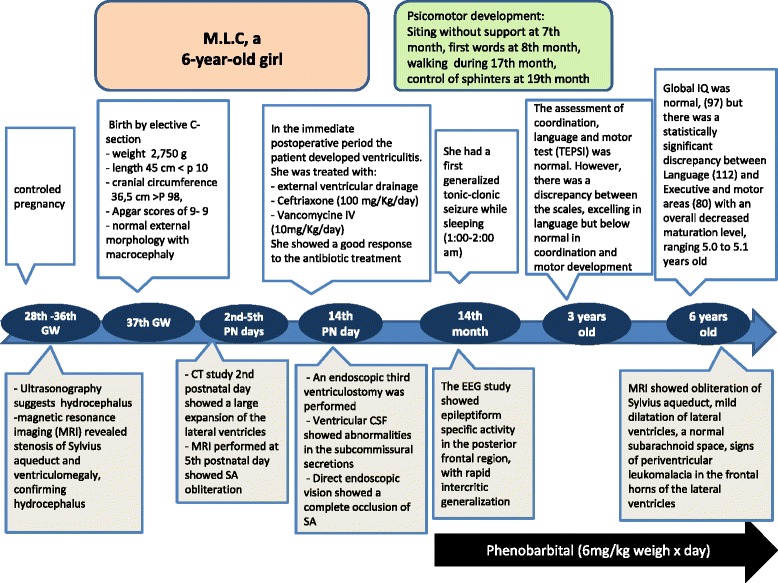
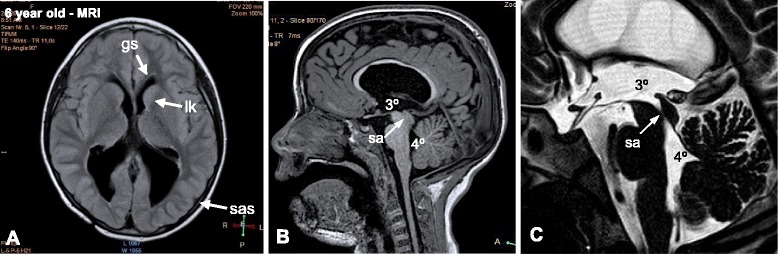
We report here on a case of human fetal communicating hydrocephalus with no central nervous system abnormalities other than stenosis of the aqueduct of Sylvius (SA) that became non-communicating hydrocephalus during the first postnatal week due to obliteration of the cerebral aqueduct. The case was followed closely by a team of basic and clinic investigators allowing an early diagnosis and prediction of the evolving pathophysiology. This information prompted neurosurgeons to perform a third ventriculostomy at postnatal day 14. The fetus was monitored by ultrasound, computerized axial tomography and magnetic resonance imaging (MRI). After birth, the follow up was by MRI, electroencephalography and neurological and neurocognitive assessments. Cerebrospinal fluid (CSF) collected at surgery showed abnormalities in the subcommissural organ proteins and the membrane proteins L1-neural cell adhesion molecule and aquaporin-4. The neurological and neurocognitive assessments at 3 and 6 years of age showed neurological impairments (epilepsy and cognitive deficits).
(1) In a hydrocephalic fetus, a stenosed SA can become obliterated at perinatal stages. (2) In the case reported, a close follow up of a communicating hydrocephalus detected in utero allowed a prompt postnatal surgery aiming to avoid as much brain damage as possible. (3) The clinical and pathological evolution of this patient supports the possibility that the progressive stenosis of the SA initiated during the embryonic period may have resulted from ependymal disruption of the cerebral aqueduct and dysfunction of the subcommissural organ. The analysis of subcommissural organ glycoproteins present in the CSF may be a valuable diagnostic tool for the pathogenesis of congenital hydrocephalus.
突变啮齿动物模型突出了脑室室管膜细胞和联合下器官(一种向脑脊液中分泌糖蛋白的脑腺)在胎儿期脑积水发展中的重要性。有证据表明,交通性脑积水和非交通性脑积水可能是由室管膜破坏和/或联合下器官功能异常引发的单一病理现象的两个连续阶段。我们推测,类似现象可能发生在胎儿期脑积水的人类病例中。
我们在此报告一例人类胎儿交通性脑积水病例,除中脑导水管(SA)狭窄外无其他中枢神经系统异常,该胎儿在出生后第一周因中脑导水管闭塞而变为非交通性脑积水。一个基础和临床研究团队对该病例进行了密切随访,从而实现了早期诊断并预测了不断演变的病理生理学过程。这些信息促使神经外科医生在出生后第14天进行了第三脑室造瘘术。通过超声、计算机断层扫描和磁共振成像(MRI)对胎儿进行监测。出生后,通过MRI、脑电图以及神经和神经认知评估进行随访。手术时收集的脑脊液显示联合下器官蛋白以及膜蛋白L1-神经细胞黏附分子和水通道蛋白-4存在异常。3岁和6岁时的神经和神经认知评估显示存在神经功能障碍(癫痫和认知缺陷)。
(1)在脑积水胎儿中,狭窄的SA在围产期可能会闭塞。(2)在本报告的病例中,对产前检测到的交通性脑积水进行密切随访,使得能够在出生后迅速进行手术,旨在尽可能避免脑损伤。(3)该患者的临床和病理演变支持这样一种可能性,即胚胎期开始的SA进行性狭窄可能是由于中脑导水管的室管膜破坏和联合下器官功能障碍所致。对脑脊液中联合下器官糖蛋白的分析可能是先天性脑积水发病机制的一种有价值的诊断工具。