Henriques Romina, von der Heyden Sophie, Matthee Conrad A
Evolutionary Genomics Group, Department of Botany and Zoology, Stellenbosch University , Stellenbosch , South Africa.
PeerJ. 2016 Mar 28;4:e1827. doi: 10.7717/peerj.1827. eCollection 2016.
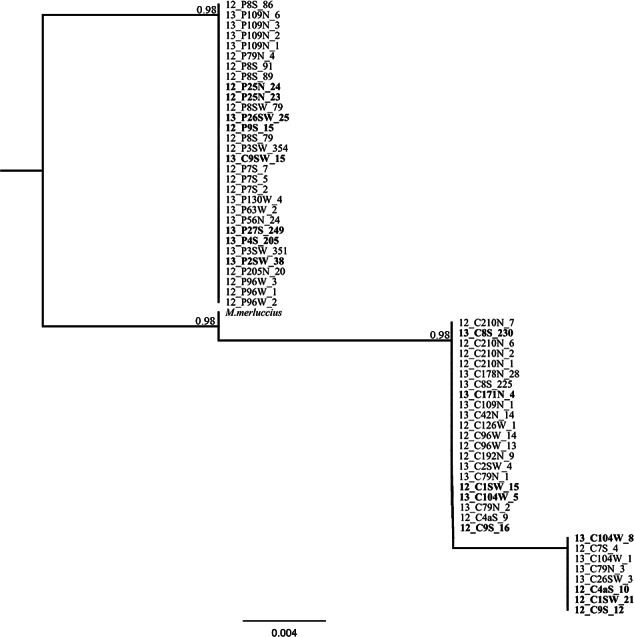
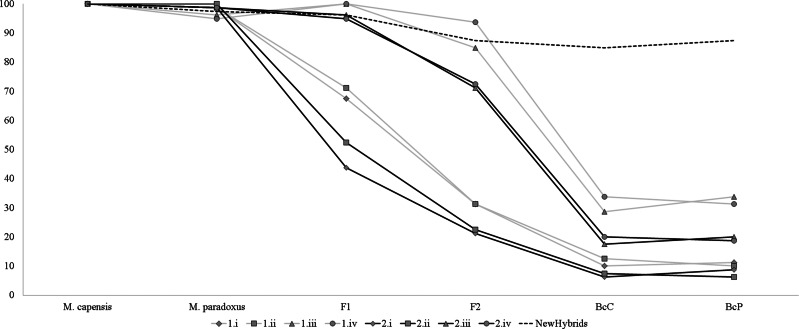
In the marine environment, an increasing number of studies have documented introgression and hybridization using genetic markers. Hybridization appears to occur preferentially between sister-species, with the probability of introgression decreasing with an increase in evolutionary divergence. Exceptions to this pattern were reported for the Cape hakes (Merluccius capensis and M. paradoxus), two distantly related Merluciidae species that diverged 3-4.2 million years ago. Yet, it is expected that contemporary hybridization between such divergent species would result in reduced hybrid fitness. We analysed 1,137 hake individuals using nine microsatellite markers and control region mtDNA data to assess the validity of the described hybridization event. To distinguish between interbreeding, ancestral polymorphism and homplasy we sequenced the flanking region of the most divergent microsatellite marker. Simulation and empirical analyses showed that hybrid identification significantly varied with the number of markers, model and approach used. Phylogenetic analyses based on the sequences of the flanking region of Mmerhk-3b, combined with the absence of mito-nuclear discordance, suggest that previously reported hybridization between M. paradoxus and M. capensis cannot be substantiated. Our findings highlight the need to conduct a priori simulation studies to establish the suitability of a particular set of microsatellite loci for detecting multiple hybridization events. In our example, the identification of hybrids was severely influenced by the number of loci and their variability, as well as the different models employed. More importantly, we provide quantifiable evidence showing that homoplasy mimics the effects of heterospecific crossings which can lead to the incorrect identification of hybridization.
在海洋环境中,越来越多的研究使用遗传标记记录了基因渗入和杂交现象。杂交似乎优先发生在姐妹物种之间,基因渗入的概率随着进化分歧的增加而降低。对于无须鳕(Merluccius capensis和M. paradoxus)这两个在300 - 420万年前分化的远缘无须鳕科物种,报道了这种模式的例外情况。然而,预计这种差异较大的物种之间的当代杂交会导致杂种适应性降低。我们使用9个微卫星标记和线粒体控制区数据对1137个无须鳕个体进行了分析,以评估所描述的杂交事件的有效性。为了区分杂交、祖先多态性和同塑现象,我们对最具差异的微卫星标记的侧翼区域进行了测序。模拟和实证分析表明,杂种鉴定结果会因所使用的标记数量、模型和方法而有显著差异。基于Mmerhk - 3b侧翼区域序列的系统发育分析,结合线粒体 - 核不一致性的缺失,表明先前报道的M. paradoxus和M. capensis之间的杂交无法得到证实。我们的研究结果强调了进行先验模拟研究以确定特定微卫星位点集用于检测多个杂交事件的适用性的必要性。在我们的例子中,杂种的鉴定受到位点数量及其变异性以及所采用的不同模型的严重影响。更重要的是,我们提供了可量化的证据表明同塑现象会模拟异源杂交的效应,从而可能导致杂交的错误鉴定。