Goswami Sudeshna, Sharma-Walia Neelam
H. M. Bligh Cancer Research Laboratories, Department of Microbiology and Immunology, Chicago Medical School, Rosalind Franklin University of Medicine and Science, North Chicago, Illinois, USA.
Oncotarget. 2016 Jul 5;7(27):42777-42791. doi: 10.18632/oncotarget.8658.
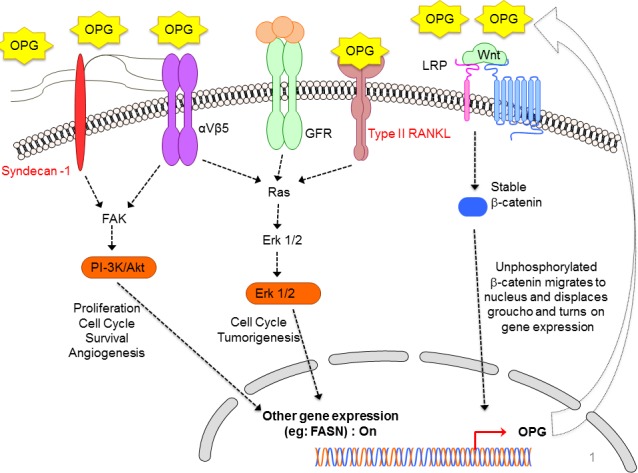
Osteoprotegerin (OPG) is a soluble decoy receptor for tumor necrosis factor (TNF)-related apoptosis inducing ligand (TRAIL). It belongs to the tumor necrosis factor receptor superfamily (TNFRSF). OPG was initially discovered to contribute to homeostasis of bone turnover due to its capability of binding to receptor activator of nuclear factor-kappaB (NF-kB). However, apart from bone turnover, OPG plays important and diverse role(s) in many biological functions. Besides having anti-osteoclastic activity, OPG is thought to exert a protective anti-apoptotic action in OPG-expressing tumors by overcoming the physiologic mechanism of tumor surveillance exerted by TRAIL. Along with inhibiting TRAIL induced apoptosis, it can induce proliferation by binding to various cell surface receptors and thus turning on the canonical cell survival and proliferative pathways. OPG also induces angiogenesis, one of the hallmarks of cancer, thus facilitating tumor growth. Recently, the understanding of OPG and its different roles has been augmented substantially. This review is aimed at providing a very informative overview as to how OPG affects cancer progression especially breast cancer.
骨保护素(OPG)是肿瘤坏死因子(TNF)相关凋亡诱导配体(TRAIL)的可溶性诱饵受体。它属于肿瘤坏死因子受体超家族(TNFRSF)。OPG最初因其能够结合核因子κB(NF-κB)受体激活剂而被发现有助于骨转换的稳态。然而,除了骨转换外,OPG在许多生物学功能中发挥着重要且多样的作用。除了具有抗破骨细胞活性外,OPG还被认为通过克服TRAIL施加的肿瘤监视生理机制,在表达OPG的肿瘤中发挥保护性抗凋亡作用。除了抑制TRAIL诱导的凋亡外,它还可以通过与各种细胞表面受体结合来诱导增殖,从而开启经典的细胞存活和增殖途径。OPG还诱导血管生成,这是癌症的标志之一,从而促进肿瘤生长。最近,对OPG及其不同作用的理解有了大幅增加。这篇综述旨在提供关于OPG如何影响癌症进展尤其是乳腺癌的非常丰富的概述。