Jiang Richeng, Wang Xinyue, Li Kai
Tianjin Medical University Cancer Institute and Hospital, National Clinical Research Center for Cancer, Tianjin 300060, PR China.
Key Laboratory of Cancer Prevention and Therapy, Tianjin 300060, PR China.
Oncotarget. 2016 May 3;7(18):26823-36. doi: 10.18632/oncotarget.8662.
The predictive and prognostic value of carcinoembryonic antigen (CEA), cytokeratin-19 fragments (Cyfra21-1), squamous cell carcinoma antigen (SCCA) and neuron-specific enolase (NSE) has been investigated in non-small-cell lung cancer (NSCLC) patients. However, few studies have directly focused on the association between these markers and epidermal growth factor receptor (EGFR) mutation status or mutation subtypes.
We retrospectively analyzed 1016 patients with stage I-IIIA NSCLC who underwent complete resection between 2008 and 2012. Correlations between serum tumor marker levels and EGFR mutations and survival parameters were analyzed and prognostic factors were identified.
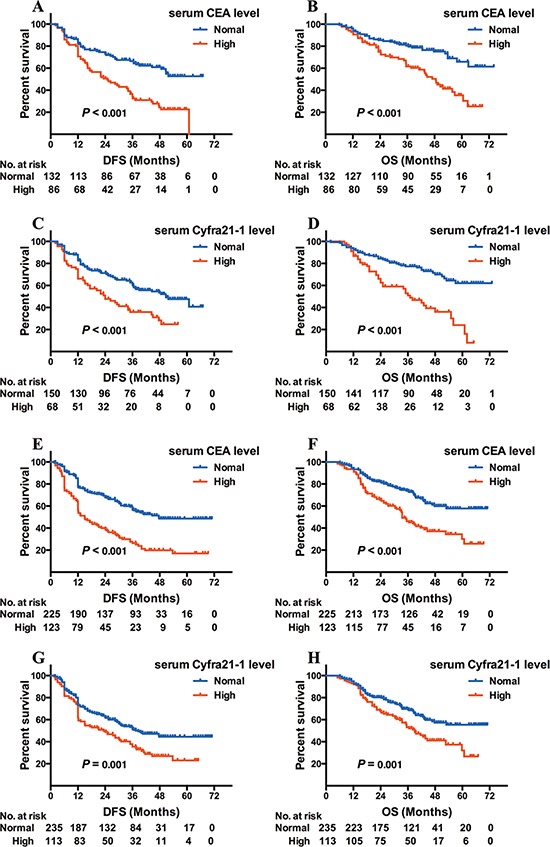
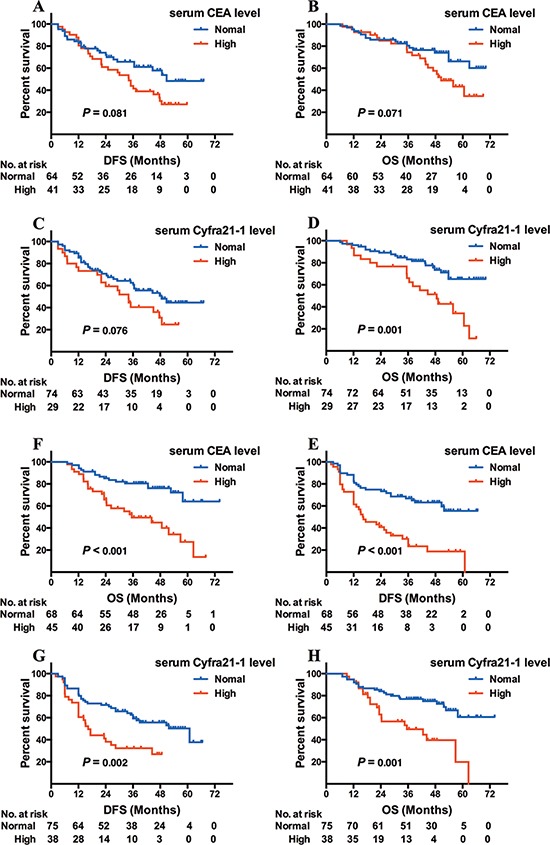
Cyfra21-1 levels (P = 0.032 for disease-free survival [DFS]; P < 0.001 for overall survival [OS]) and clinical stage were identified as independent predictive and prognostic factors in EGFR-mutated adenocarcinoma patients. CEA levels (P < 0.001 for DFS; P = 0.002 for OS) and clinical stage were independently predictive and prognostic in EGFR wild-type adenocarcinoma patients. Further stratification analysis revealed that in EGFR exon 19 deletion adenocarcinomas, elevated Cyfra21-1 was an independent prognostic factor (P = 0.002). Within the Leu858Arg substitution subgroup, increased CEA (P = 0.005) and clinical stage were predictive factors of DFS, while elevated CEA (P = 0.005) and Cyfra21-1 (P = 0.027) were independent prognostic factors.
Cyfra21-1 and CEA exhibit different predictive and prognostic values between EGFR-mutated and wild-type adenocarcinomas, as well as between EGFR mutation subtypes. The prognostic impact of preoperative serum tumor markers should be evaluated together with EGFR mutation status.
癌胚抗原(CEA)、细胞角蛋白19片段(Cyfra21-1)、鳞状细胞癌抗原(SCCA)和神经元特异性烯醇化酶(NSE)在非小细胞肺癌(NSCLC)患者中的预测和预后价值已得到研究。然而,很少有研究直接关注这些标志物与表皮生长因子受体(EGFR)突变状态或突变亚型之间的关联。
我们回顾性分析了2008年至2012年间接受根治性手术的1016例I-IIIA期NSCLC患者。分析血清肿瘤标志物水平与EGFR突变及生存参数之间的相关性,并确定预后因素。
Cyfra21-1水平(无病生存期[DFS],P = 0.032;总生存期[OS],P < 0.001)和临床分期被确定为EGFR突变腺癌患者的独立预测和预后因素。CEA水平(DFS,P < 0.001;OS,P = 0.002)和临床分期在EGFR野生型腺癌患者中具有独立的预测和预后价值。进一步的分层分析显示,在EGFR外显子19缺失腺癌中,Cyfra21-1升高是独立的预后因素(P = 0.002)。在Leu858Arg替代亚组中,CEA升高(P = 0.005)和临床分期是DFS的预测因素,而CEA升高(P = 0.005)和Cyfra21-1升高(P = 0.027)是独立的预后因素。
Cyfra21-1和CEA在EGFR突变型和野生型腺癌之间以及EGFR突变亚型之间表现出不同的预测和预后价值。术前血清肿瘤标志物的预后影响应与EGFR突变状态一起评估。