Phinyomark Angkoon, Osis Sean T, Hettinga Blayne A, Kobsar Dylan, Ferber Reed
Faculty of Kinesiology, University of Calgary, Calgary, AB, Canada.
Running Injury Clinic, University of Calgary, 2500 University Drive NW, Calgary, AB, T2N 1N4, Canada.
BMC Musculoskelet Disord. 2016 Apr 12;17:157. doi: 10.1186/s12891-016-1013-z.
Females have a two-fold risk of developing knee osteoarthritis (OA) as compared to their male counterparts and atypical walking gait biomechanics are also considered a factor in the aetiology of knee OA. However, few studies have investigated sex-related differences in walking mechanics for patients with knee OA and of those, conflicting results have been reported. Therefore, this study was designed to examine the differences in gait kinematics (1) between male and female subjects with and without knee OA and (2) between healthy gender-matched subjects as compared with their OA counterparts.
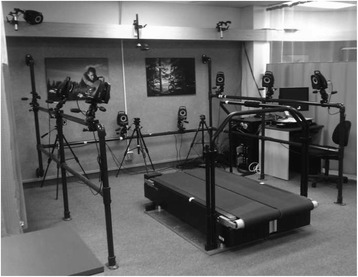
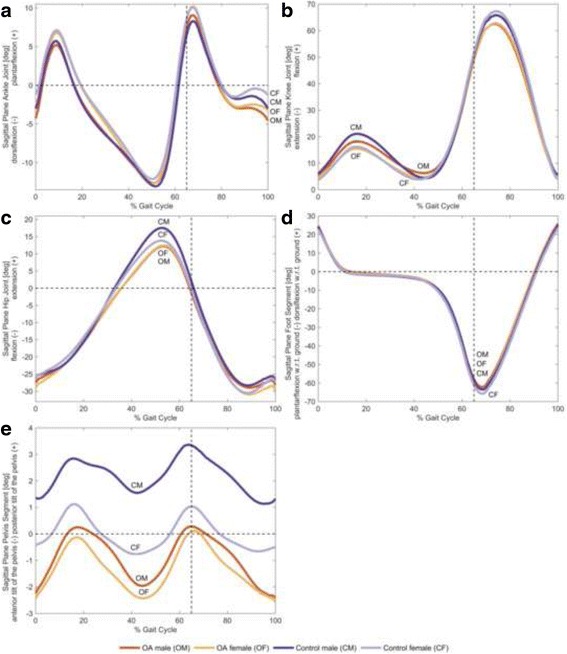
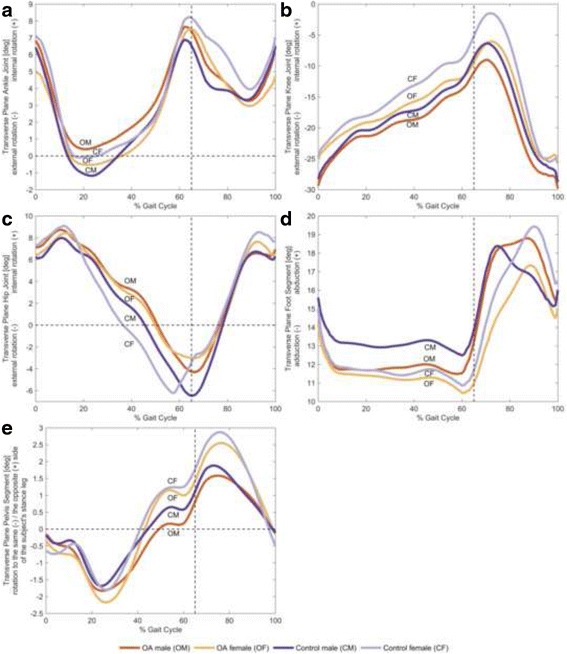
One hundred subjects with knee OA (45 males and 55 females) and 43 healthy subjects (18 males and 25 females) participated in this study. Three-dimensional kinematic data were collected during treadmill-walking and analysed using (1) a traditional approach based on discrete variables and (2) a machine learning approach based on principal component analysis (PCA) and support vector machine (SVM) using waveform data.
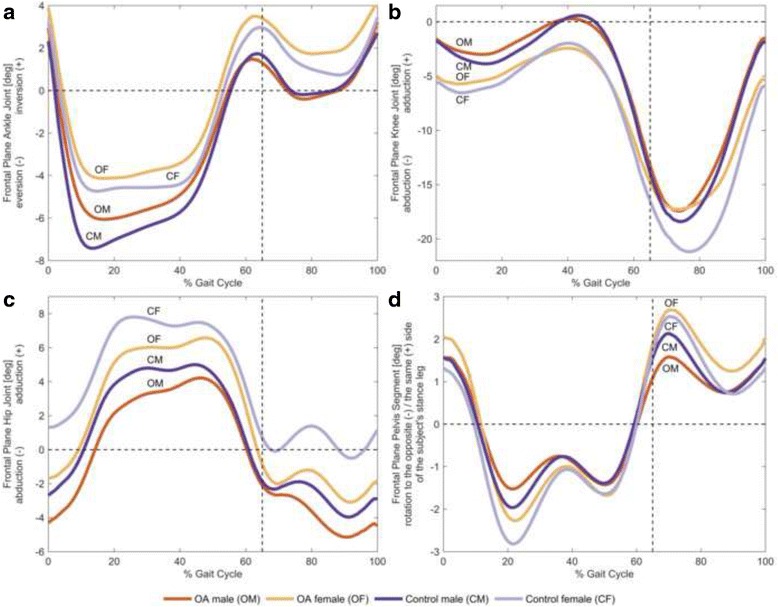
OA and healthy females exhibited significantly greater knee abduction and hip adduction angles compared to their male counterparts. No significant differences were found in any discrete gait kinematic variable between OA and healthy subjects in either the male or female group. Using PCA and SVM approaches, classification accuracies of 98-100% were found between gender groups as well as between OA groups.
These results suggest that care should be taken to account for gender when investigating the biomechanical aetiology of knee OA and that gender-specific analysis and rehabilitation protocols should be developed.
与男性相比,女性患膝关节骨关节炎(OA)的风险高出两倍,非典型步行步态生物力学也被认为是膝关节OA病因的一个因素。然而,很少有研究调查膝关节OA患者步行力学方面的性别差异,而且在这些研究中,报告的结果相互矛盾。因此,本研究旨在检查(1)患膝关节OA和未患膝关节OA的男性和女性受试者之间以及(2)健康的性别匹配受试者与其患OA的对应受试者之间的步态运动学差异。
100名膝关节OA患者(45名男性和55名女性)和43名健康受试者(18名男性和25名女性)参与了本研究。在跑步机行走过程中收集三维运动学数据,并使用(1)基于离散变量的传统方法和(2)基于主成分分析(PCA)和支持向量机(SVM)的机器学习方法,利用波形数据进行分析。
与男性对应受试者相比,OA患者和健康女性的膝关节外展和髋关节内收角度明显更大。在男性或女性组中,OA患者和健康受试者之间的任何离散步态运动学变量均未发现显著差异。使用PCA和SVM方法,在性别组之间以及OA组之间发现分类准确率为98 - 100%。
这些结果表明,在研究膝关节OA的生物力学病因时应考虑性别因素,并且应制定针对性别的分析和康复方案。